
Figuring out your SEO return on investment really just comes down to a simple formula: (Value of Conversions - Cost of SEO Investment) / Cost of SEO Investment.
This little calculation does a big job. It takes fuzzy metrics like rankings and traffic and turns them into a hard percentage, showing you exactly how much money your SEO work is making for every dollar you put in. It's the ultimate proof that what you're doing is working.
Why You Absolutely Have to Track SEO ROI

Let's be real for a second. Pouring money into any marketing channel without knowing the financial return is just a gamble. SEO is no exception.
Sure, it feels great watching your site climb the search rankings, but good feelings don't pay the bills. The actual goal is to turn those rankings into real business growth. That’s where calculating your return on investment becomes non-negotiable.
For a long time, SEO was treated like some kind of dark art, justified with vague wins like "brand awareness." But stakeholders and budget holders need something more concrete. They need to see a clear line connecting the investment in content, links, and tech fixes to the revenue hitting the bottom line. Learning how to measure SEO ROI is how you draw that line for them.
Justifying Budgets and Proving Your Worth
A solid ROI calculation is your single best weapon for defending—and growing—your SEO budget.
Imagine walking into a meeting and saying, "For every $1 we spent on SEO last quarter, we generated $22 in revenue." The entire conversation shifts. It’s no longer, "Is SEO worth it?" but, "How much more can we invest?"
And that's not some made-up number. SEO consistently delivers one of the highest returns of any digital marketing channel. Fresh 2025 data shows SEO's average return is about $22 for every $1 spent, making it a powerhouse of efficiency. In specific industries like B2B SaaS, the average SEO ROI can soar as high as 702%. You can dig into more of these powerful SEO statistics to see just how impactful it is.
The Bottom Line: Measuring SEO ROI isn't just about looking back. It's about building a rock-solid business case for future investment and proving that SEO is a primary revenue driver, not a line-item expense.
Making Smarter Strategic Moves
Beyond getting your budget approved, a clear view of your SEO ROI helps you make much better strategic decisions. When you know which activities are actually bringing in the cash, you can double down on what works and cut what doesn't. Simple as that.
Without this data, you're just guessing. You could be blowing thousands on a content campaign that gets tons of traffic but zero conversions, while a small technical fix you made last month is quietly bringing in high-value leads.
Tracking ROI helps you:
- Spot Your MVP Content: Pinpoint the exact blog posts or landing pages that are revenue magnets.
- Fix Your Leaky Funnel: See where people are dropping off between their Google search and a final purchase.
- Allocate Resources with Confidence: Decide if the next dollar is better spent on content, link building, or technical SEO based on real financial impact.
Ultimately, knowing your numbers turns your strategy from a shot in the dark into a data-driven roadmap for real, sustainable growth.
Gathering the Right Data for Your Calculation
Before you can even think about a formula, you need the right numbers. Honestly, a fuzzy calculation based on half-baked data is worse than no calculation at all—it can point you in completely the wrong direction. Think of it like cooking: if you start with the wrong ingredients, the final dish is doomed.
It all boils down to two things: what you're spending (your investment) and what you're getting back (your return). Let’s walk through how to find these numbers without getting lost in a sea of spreadsheets.
Pinpointing Your Total SEO Investment
First up, let's get real about your costs. This seems simple on the surface, but it’s amazing how many hidden expenses people miss, which completely skews their ROI. Your total investment is a lot more than just that monthly agency retainer.
You need to account for every single dollar that goes into your SEO program. That means including:
- Agency or Freelancer Fees: This is the obvious one—the monthly retainer or project fee you pay for SEO services.
- In-House Team Salaries: Got people on your team working on SEO? You need to calculate the portion of their salary dedicated to that work. Even 25% of a content writer's time is a significant cost.
- Content Creation Costs: Any invoices from freelance writers, designers, or videographers for SEO-focused content go right here.
- SEO Tool Subscriptions: Don't forget those monthly bills for tools like Ahrefs, Semrush, or Moz. They add up.
- Link Building or Digital PR: If you have a separate budget for outreach or campaigns to earn backlinks, that’s a direct SEO cost.
Add all that up, and you’ve got the "Cost of Investment" for your formula. Forgetting one of these will artificially inflate your ROI, so be meticulous.
Tracking Your SEO-Driven Revenue
Now for the fun part—tallying up the money SEO brings in. This is where your analytics platform, like Google Analytics 4 (GA4), becomes your best friend. The entire goal is to isolate the revenue that came directly from organic search traffic.
To do this right, you need solid digital marketing analytics tools that let you slice and dice your traffic and track what really matters. In GA4, for instance, you can create a filter to view reports for the "Organic Search" channel only. This is critical for making sure you aren't giving SEO credit for a sale that actually came from a paid ad or a social media campaign.
Key Takeaway: A trustworthy SEO ROI calculation is built on clean data. You have to isolate your organic search traffic and make sure every conversion—from a simple form fill to a checkout—is tracked perfectly. A small mistake here can throw your final numbers way off.
Once you've filtered for organic traffic, it's time to measure the conversions. How you tackle this really depends on your business model.
For E-commerce Businesses
If you run an online store, this is pretty straightforward. Your north star metric is revenue from organic traffic.
With e-commerce tracking set up correctly in GA4, you can see the exact dollar amount that customers who found you via organic search spent. It doesn't get much clearer than that for measuring the "Gain from Investment."
For Lead Generation Businesses
Things get a little more complex if your goal is generating leads for, say, a B2B service, a local business, or a SaaS company. You can't just count leads; you have to assign a real monetary value to them.
You do this by figuring out your Lead Value. The formula is pretty simple: (Total Sales Revenue / Total Leads) x Lead-to-Customer Rate.
Let’s say you close 10% of your leads and your average customer brings in $3,000. That means each lead is worth $300 to your business.
Once you have that number, you can multiply it by the number of leads that came from organic search to find your total conversion value. Setting up goals and events in GA4 to track every form submission or phone call is non-negotiable here. The quality of this data is what guides your strategy to increase organic traffic that actually turns into money.
The Core Formulas for Calculating SEO ROI
Alright, let’s get down to the numbers. Don't worry, you don't need a PhD in statistics to nail this. The logic for calculating SEO ROI is actually a classic business formula you've probably seen before.
The standard ROI formula looks like this:
(Gain from Investment - Cost of Investment) / Cost of Investment
To turn that into a percentage, just multiply the result by 100. This is the simplest way to see how much you're getting back for every dollar you put in. An ROI of 300% means you made $3 for every $1 you spent.
So, how do we apply this to SEO?
The "Cost of Investment" is the total SEO spend we talked about earlier—all your agency fees, tool subscriptions, salaries, and content costs rolled into one. The "Gain from Investment" is the monetary value of all the conversions that came from organic search.
This gives us our specific SEO ROI formula:
((Value of Organic Conversions - Total SEO Cost) / Total SEO Cost) x 100
This single percentage is your most powerful tool for proving the value of your work. It cuts right through the noise of rankings and traffic to show the real financial impact on the business.
From Traffic to Tangible Value
The trickiest part of that formula is pinning down the "Value of Organic Conversions." This isn't just about getting more visitors; it's about connecting those visitors to actual business outcomes. How you do this really depends on your business model.
You can also build a more predictive model using data like monthly search volume, click-through rate (CTR), conversion rate, and average order value (AOV). I've seen teams use a formula like: ((Total Monthly Searches x CTR x Conversion Rate x AOV) - SEO Costs) / SEO Costs. To make this work, you'd pull keyword volumes from a tool like Ahrefs and estimate your CTR based on your target ranking position. You can explore more about using ROI calculators at Omnius.so.
Let’s walk through how this works in two completely different, real-world scenarios.
E-commerce Scenario: An Online Shoe Retailer
Imagine you run an online store that sells custom sneakers. You want to figure out the ROI on a blog post you published six months ago called "How to Clean White Canvas Sneakers."
You dive into your Google Analytics 4 (GA4) and pull the following data:
- Total Organic Traffic to the Post: 15,000 visitors
- Conversion Rate (from post to purchase): 1.5%
- Average Order Value (AOV): $80
- Cost to Create and Promote the Post: $600
First, let's calculate the gain from that investment:
- Total Conversions: 15,000 visitors x 1.5% = 225 sales
- Total Revenue: 225 sales x $80 AOV = $18,000
You generated $18,000 in revenue from a $600 piece of content. Now we plug those numbers into our ROI formula:
( ($18,000 - $600) / $600 ) x 100 = 2,900% ROI
A 2,900% return is absolutely incredible. It shows how one well-optimized piece of content can become a long-term revenue-generating machine.
This infographic does a great job of showing how all the pieces fit together.
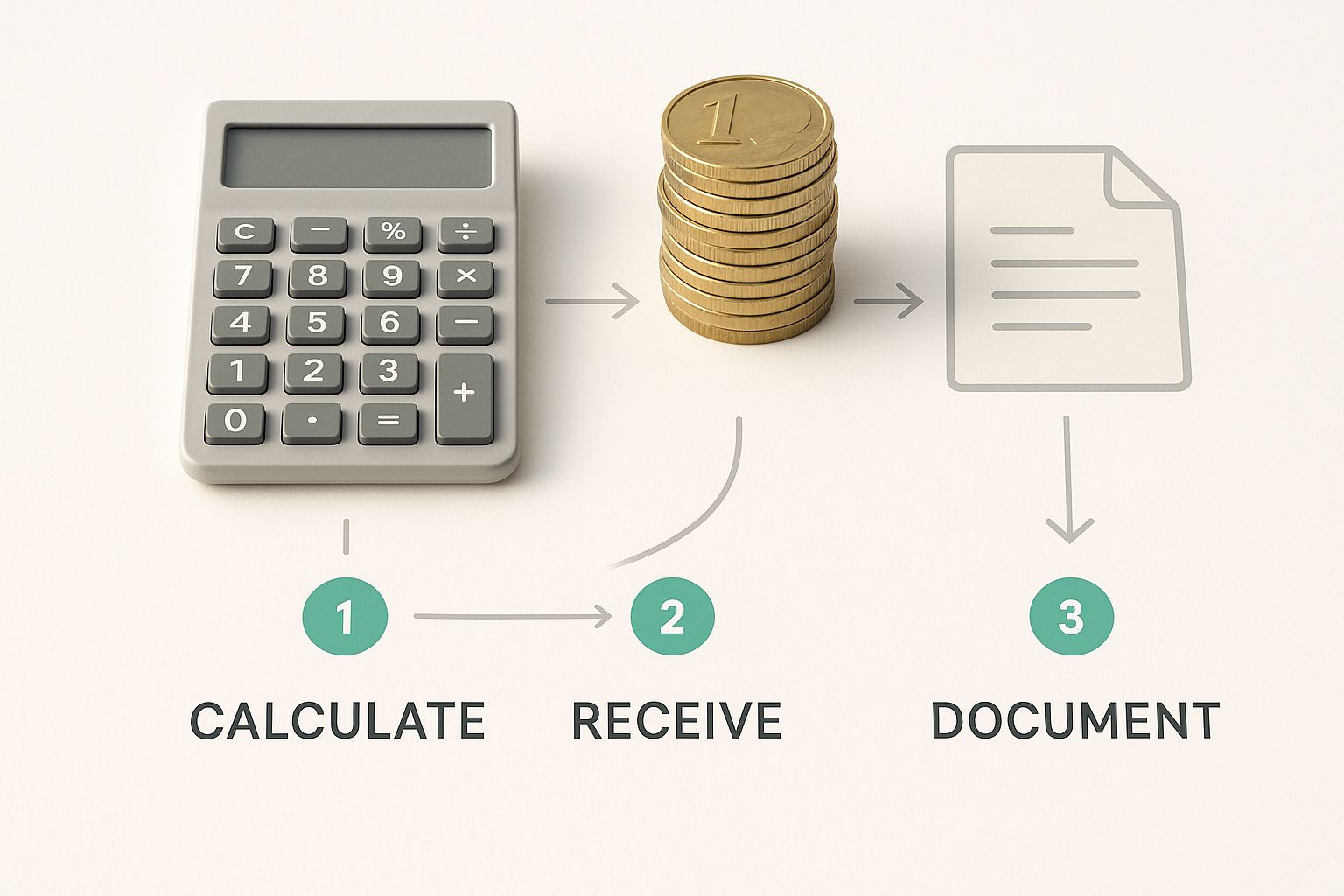
You can see the clear path from your initial investment all the way to the final profit, which really drives home how each step is crucial for an accurate calculation.
B2B Service Scenario: A Local Plumbing Business
Now, let's switch gears to a lead generation business. Imagine you're a local plumber, and your main SEO goal is to get more calls for emergency jobs.
Here’s your data from the last quarter:
- Total Organic Leads (phone calls tracked in GA4): 75
- Lead-to-Customer Rate: 20% (you book one job for every five calls)
- Average Customer Lifetime Value (CLV): $1,200
- Total SEO Investment for the Quarter: $4,500
First, you need to figure out what those leads were actually worth.
- Total Customers from SEO: 75 leads x 20% close rate = 15 new customers
- Total Revenue from SEO: 15 customers x $1,200 CLV = $18,000
Pro Tip: Never just look at the value of the first job. For a service business like plumbing, a new customer could be with you for years. Using Customer Lifetime Value (CLV) instead of a one-time transaction value gives you a much more honest picture of your true ROI.
With a total gain of $18,000, you can calculate your ROI:
( ($18,000 - $4,500) / $4,500 ) x 100 = 300% ROI
A 300% return is fantastic. It's hard evidence that your local SEO efforts are directly fueling high-value growth for the business. This is exactly the kind of data you need to justify your budget and make smarter decisions about where to invest next.
Analyzing and Interpreting Your SEO Results
Alright, you’ve done the math and have a nice, clean ROI percentage staring back at you. But what does that number really mean? Getting the result is one thing, but the real magic happens when you start to understand the story behind it.
A 300% ROI looks great on paper, and for most businesses, it’s a solid win. But if you’re a high-growth e-commerce brand, you might be aiming for 500% or more. What counts as "good" really depends on your industry, your business model, and how long you've been playing the SEO game.
This is where you shift from just plugging numbers into a formula to thinking like a true strategist. That one big ROI figure is a great headline, but the truly actionable insights are always buried a little deeper.
Digging Deeper Than the Headline Number
If you only look at your overall SEO ROI, you're getting a blended average that can easily hide what's working and what's failing miserably. To make smart moves, you have to slice and dice that data to see what’s actually driving performance. It’s time to stop looking at the forest and start examining the individual trees.
Try breaking down your ROI in a few different ways:
- By Content Type: Are your blog posts bringing in a better return than your product pages? You might discover your case studies, even with less traffic, are converting like crazy and bringing in high-value customers.
- By Keyword Clusters: Group your keywords based on user intent. For example, you could separate informational keywords (like "how to fix a leaky faucet") from transactional ones ("plumber near me"). The first group drives traffic, but the second one drives revenue.
- By Customer Segments: How do different user groups arriving from search behave? It's not uncommon to see mobile users converting on smaller, quicker purchases while desktop users are the ones making the big-ticket buys.
This kind of analysis transforms a simple metric into a strategic roadmap. It points a giant arrow at where you should double down and what parts of your strategy might need a complete overhaul.
Your goal isn't just to calculate a single number but to understand the "why" behind it. An ROI of 250% is a fact; discovering that 80% of that return comes from just three blog posts is an insight you can act on.
Connecting SEO to Broader Business Goals
Measuring SEO ROI isn’t just some marketing department exercise. It’s about proving how organic search directly fuels the company's bottom line. This is how you get buy-in from executives who might not know a meta tag from a price tag.
Always frame your results in the language of the business. For example, strong SEO performance has a massive impact on Customer Acquisition Cost (CAC). When you can show that SEO brings in new customers for $50 a pop while paid ads are costing $150, you’re speaking a language everyone understands: money.
And remember, getting more traffic is only half the battle. To really juice your ROI, you have to constantly work to improve website conversions once that organic traffic arrives. Traffic is vanity, conversions are sanity.
Of course, presenting this information clearly is just as important as gathering it. Our guide on creating a comprehensive SEO report can help you turn all these numbers into a story that gets people excited.
Benchmarking Your Performance
Without context, your ROI is just a number floating in space. To really grasp how you're doing, you need to compare it to something meaningful.
Here are a few ways to add that crucial context:
- Historical Performance: How does this quarter’s ROI look compared to last quarter? Or this time last year? A positive trend is often more telling than a single number because it proves the compounding power of good SEO.
- Other Marketing Channels: Put your SEO ROI side-by-side with your stats from PPC, social media, and email marketing. This is your most powerful tool for conversations about where to allocate the next marketing budget.
- Industry Averages: These can be a bit broad, but they're still useful for getting a general feel for where you stand in your niche.
Don't just take my word for it. Marketing surveys consistently show that SEO is viewed as the highest ROI channel by a wide margin. In fact, 50-60% of marketers name SEO as their top source of measurable return, frequently beating out paid channels. This isn't just a hunch; it's a proven fact that helps validate your investment and set clear expectations for what SEO can deliver.
Beyond the Formula: Common Challenges and Advanced Models
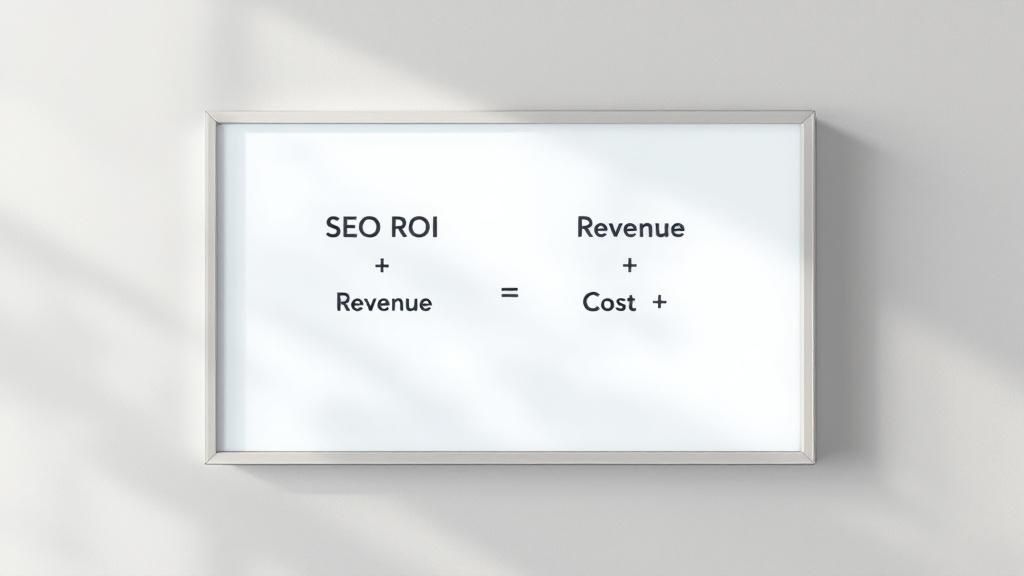
The basic ROI formula is a fantastic starting point, but let's be real—the world of marketing is messy. A customer's journey from a random Google search to a final purchase is rarely a straight line. They might read a blog post, see a social media ad a week later, and finally click on an email to buy.
This is where the simple ROI calculation starts to show its cracks. By default, it often operates on a last-click attribution model, giving 100% of the credit to the very last thing they did before converting. If SEO was the first or middle step, it gets completely ignored in the revenue tally, which can seriously undervalue its impact.
Navigating the Maze of Attribution Modeling
To get an honest picture of SEO's real value, you have to look beyond that final click. Attribution modeling is simply how you assign credit to the various marketing channels that nudged a customer toward a sale.
Sticking with last-click is like giving all the credit for a championship win to the person who scored the final point, ignoring the rest of the team's effort.
Here are a few other models that paint a more balanced picture:
- First-Touch Attribution: This model gives all the credit to the first channel a user interacted with. It’s perfect for understanding what’s bringing new people into your world. SEO often shines here, since organic search is a huge discovery channel.
- Linear Attribution: This one is the most democratic. It splits the credit equally among every single touchpoint. If a customer visited a blog post, saw a Facebook ad, and then clicked an email, each channel gets 33.3% of the credit. Simple and fair.
- Data-Driven Attribution: This is the smartest kid in the class, available in platforms like Google Analytics 4. It uses machine learning to analyze tons of conversion paths and assigns credit based on which touchpoints were actually the most influential.
Picking the right model is a game-changer for accurately showing SEO's contribution, especially since its main job is often to assist conversions early in the funnel.
Accounting for the Long-Term Value of SEO
Another huge challenge is that the simple ROI formula is just a snapshot in time. It measures immediate returns but completely misses the long-term, compounding value that makes SEO so incredibly powerful. Your work today doesn't just drive revenue this month; it builds an asset that pays you back for years.
Think about a single, high-quality blog post. It might cost $500 to create, but it can keep attracting organic traffic and generating leads for the next three, four, or even five years with minimal extra work. That’s the compounding effect in action.
Key Insight: True SEO ROI isn't just about the immediate sale. It’s about building brand authority, earning trust with great content, and capturing "assisted conversions" where organic search played a crucial but not final role. These long-term benefits are often the most valuable.
This is where exploring broader strategies to maximize ROI and move beyond traditional metrics can offer a fresh perspective. The core principle is the same: look beyond the immediate transaction to see the full picture of value.
Advanced ROI Models for a Deeper Look
If you have a more complex sales cycle or a subscription-based business, you need a more advanced approach. One of the best methods is to calculate ROI based on Customer Lifetime Value (CLV).
This is absolutely critical for SaaS or subscription businesses. A new customer might only pay $50 in their first month, but if your average customer sticks around for two years, their total value is actually $1,200. Using that $1,200 figure in your ROI calculation gives you a far more accurate measure of SEO's true business impact.
Another major hurdle is tracking what happens offline. Imagine a customer finds your local restaurant through Google, checks out the menu online, and then just walks in to eat. Without a tracking system—like asking customers how they found you or using call tracking—that conversion is totally invisible to your analytics. Connecting these online-to-offline journeys is essential for any business with a physical presence.
For those ready to build a powerful content engine that delivers this kind of long-term value, understanding content marketing best practices is non-negotiable. Great content is the fuel for sustainable SEO ROI, period.
Answering Your Biggest Questions About SEO ROI
Even after you've crunched the numbers and tracked your conversions, some questions always seem to linger. Let's be honest, figuring out the real return on your SEO efforts can be tricky, and it’s easy to get bogged down in the details.
I get these questions all the time from clients and fellow marketers. Nailing the answers is often the difference between a vague guess and a powerful calculation that truly proves the value of your work.
What’s Actually a “Good” SEO ROI?
This is the big one, isn't it? The most straightforward answer is, well, it depends. There’s no universal magic number that defines success for every business out there. A "good" ROI is entirely relative to your industry, your business model, and how long you've been at this.
That said, many people consider a 5:1 ratio—or a 500% ROI—a solid benchmark. It means for every $1 you put in, you’re getting $5 back. But don't get too hung up on that specific figure.
A better way to look at it is through the lens of your campaign's lifecycle:
- New Campaigns (less than a year): Honestly, seeing any positive ROI in the first 6-12 months is a huge win. You're building a foundation, and the real growth hasn't even started to compound yet.
- Established Campaigns (1 year+): Now you should be setting your sights higher. Returns in the 500% to 1,000% range are common because all that earlier work is finally paying off, month after month.
- High-Margin Niches (SaaS, legal, etc.): In fields where a single customer is worth a lot, a higher ROI is not just possible, it's expected.
- Low-Margin Niches (e-commerce, retail): A smaller percentage might still be fantastic, especially when you're dealing with high volume.
The most important benchmark is your own progress. If your ROI is consistently climbing, you're doing it right.
Seriously, How Long Until I See a Return?
If there's one virtue you need in SEO, it's patience. This isn't like running a paid ad and seeing clicks roll in within the hour. SEO is a long game, and you’re simply not going to see a meaningful, measurable ROI in the first couple of months.
As a rule of thumb, you should plan on waiting at least 6 to 12 months before you can start calculating your ROI with any real confidence.
Why the long wait? Because the first several months are packed with foundational work that doesn't directly spit out revenue. Think about everything that has to happen first:
- Running technical audits and patching up all the little issues on your site.
- Digging deep into keyword and competitor research to find your openings.
- Creating and publishing genuinely helpful, high-quality content.
- Building enough topical authority that Google starts to see you as a go-to source.
I always tell my clients to think of it like planting an orchard. You spend all that time and effort watering the saplings and tending to the soil long before you ever get to pick a single piece of fruit. The work you do in month one might be what finally lands you a lead in month eight. It's all part of the process.
Is It Even Possible to Forecast SEO ROI?
Forecasting SEO ROI is definitely more of an art than a science. There are just so many variables you can't control—sudden Google algorithm updates, a competitor launching a massive campaign, shifts in what your customers are searching for. It's more of an educated guess than a crystal ball prediction, but it's incredibly helpful for setting budgets and expectations.
Here’s a simplified way you can map out a projection:
- Estimate Your Traffic Potential: Grab a keyword research tool and look up the search volume for your main target keywords. From there, estimate your potential click-through rate (CTR) based on where you aim to rank. For example, the #1 spot often gets a 25-30% CTR.
- Project Your Conversions: Take that estimated traffic figure and multiply it by your website's historical conversion rate.
- Calculate Potential Revenue: Now, multiply your projected conversions by your average sale price or the lifetime value of a customer.
- Factor In Your Investment: Subtract what you plan to spend on SEO each month to get your potential profit. Then, just pop that into the ROI formula.
This approach gives you a data-driven estimate to work with. Just be sure to present it as just that—an estimate based on a clear set of assumptions.
Ready to stop guessing and start getting a clear picture of your SEO opportunities? RankHub uses AI to analyze your entire website and deliver a targeted keyword strategy in under a minute. No more manual research or confusing spreadsheets—just actionable insights to drive real ROI. Discover your hidden ranking opportunities today at RankHub.
More from Our Blog
7 Content Writing Tools That Boost Your SEO Rankings
Discover the top 9 SEO content writing tools to automate drafting, optimization, and publishing. Boost rankings with AI-assisted workflows.
Read more →
Zoho Marketing Automation Explained: Is It Right for You?
Compare Zoho Marketing Automation vs HubSpot on pricing, features, ease of use, and automation depth. See which wins for small teams and solo founders.
Read more →
Looking for an SEO Company? Here Are Your Best Options
Compare top SEO companies, AI platforms, and agencies. Find the best fit for your budget, from $49/month tools to full-service retainers.
Read more →