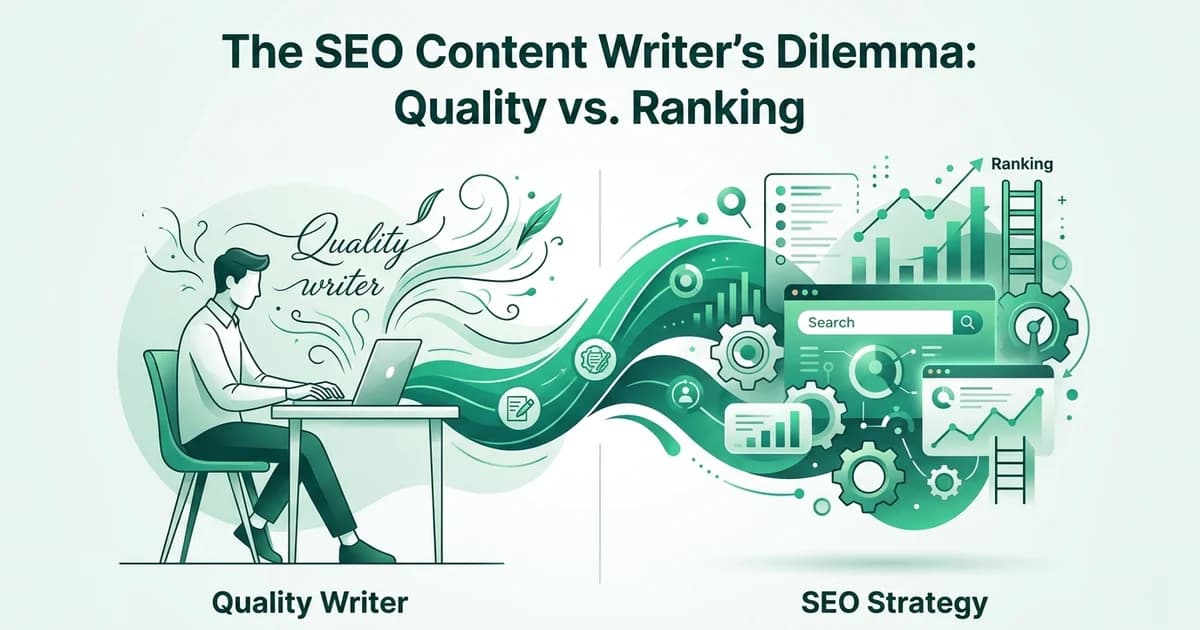
The SEO Content Writer's Dilemma: Quality vs. Ranking
Understanding the SEO content writer problem: why generic writers fail at search rankings
Most businesses investing in content marketing are quietly bleeding budget. They hire talented writers, publish consistently, and still watch their articles disappear on page four of Google. The problem is rarely the writing quality. It is almost always the strategy behind it.
When good writing is not enough
A skilled copywriter can craft compelling prose, but compelling prose does not automatically rank. Search engines reward content that satisfies a specific user intent, targets the right keyword clusters, and demonstrates topical authority. Traditional writers are trained to engage readers, not to reverse-engineer what those readers typed into a search bar three seconds ago. The result is polished content that earns zero organic traffic.
At RankHub, our analysis shows that the majority of small business blogs contain well-written articles that simply never addressed the search queries their target customers were actually using. That disconnect is invisible until you look at the traffic data.
The real cost of misaligned content
The financial damage compounds quickly. Every published article that fails to rank represents wasted writer fees, editing time, and publishing overhead. Low-traffic content also means fewer leads entering the funnel, which directly impacts revenue. According to the State of SEO Content (2024), optimizing existing articles delivers 60% more traffic than writing new pieces alone, which means most businesses are not just creating the wrong content, they are also ignoring the content they already have.
Why the SEO knowledge gap persists
Most generalist writers have never conducted keyword research, audited search intent, or structured a content brief around ranking signals. These are specialist skills that sit at the intersection of marketing strategy and technical SEO. Without them, even a 2,000-word article built around the wrong keyword phrase will consistently underperform shorter, better-targeted competitor content.
Quick fix: what an SEO content writer actually does (and what they don't)
An SEO content writer is not simply a blogger who sprinkles keywords into paragraphs. They combine keyword research, search intent analysis, and strategic writing to produce content that ranks and converts. The role sits firmly at the intersection of data and craft.
What the job actually involves
A skilled SEO content writer delivers more than finished articles. Their core outputs typically include:
- Keyword-optimized articles structured around primary and secondary search terms
- Topic clusters that build topical authority across a subject area
- Content briefs that guide writing with intent signals, competitor gaps, and target queries
- Optimized rewrites that improve existing pages rather than starting from scratch
They are not copywriters, journalists, or general bloggers. Each of those roles serves a different purpose.
How modern SEO writers actually work
The profession has shifted significantly. According to Search Engine Journal (2025), 86% of SEO professionals had integrated AI into their strategy by 2025. Today's SEO writer works alongside AI tools to research faster, identify gaps, and scale output without sacrificing quality.
Platforms like RankHub Autopilot take this further by automating the full pipeline, from keyword research through to scheduled publishing, making it a practical option for founders and small teams without a dedicated content function. For those exploring best seo automation tools, this kind of end-to-end approach is increasingly the benchmark.
Why this problem happens: the gap between writers and SEO strategists
The disconnect between writing quality and search performance usually comes down to a structural problem. Most content teams are built around one skill set or the other, rarely both. Understanding why this gap exists helps explain why so many businesses struggle to get traction from their content investment.
Writers aren't trained in SEO fundamentals
Most professional writers come from journalism, copywriting, or creative backgrounds. Keyword research, search intent analysis, and on-page optimization simply aren't part of that training. A skilled writer can produce genuinely compelling content that never ranks because it targets the wrong terms or misreads what a searcher actually wants to find.
Budget pressure pushes businesses toward the wrong hires
Smaller businesses often hire the most affordable writer available, then wonder why the content underperforms. Separating SEO strategy from content execution is expensive. Paying for both a dedicated strategist and a skilled writer is out of reach for most solo founders and small teams, so one function gets cut, and it is usually the strategy side.
AI has made the confusion worse
According to The Future of SEO Content in 2026 (2026), 68% of marketing teams now use AI-powered SEO optimization tools, up from 46% in 2025. That rapid adoption has created real uncertainty about what an SEO content writer should actually do versus what the tools handle. For online marketing platforms for small businesses, this confusion often leads to over-reliance on AI output without the strategic layer that makes content rank.
Solution 1: hire a specialized SEO content writer (best for mid-market teams)
Hiring a dedicated SEO content writer bridges the gap between raw writing talent and technical optimization. For mid-market teams with an established content budget, this is often the most direct path to consistent rankings. The right hire brings both strategic thinking and execution under one roof, reducing the coordination overhead that fragments most content programs.
What to look for in a qualified candidate
Not every writer who claims SEO expertise delivers results. When evaluating candidates, prioritize these signals:
- A portfolio with keyword ranking evidence. Ask for specific URLs and the positions they achieved, not just traffic screenshots.
- Demonstrated understanding of E-E-A-T. A strong candidate can explain how they build experience, expertise, authority, and trust into a piece, not just mention the acronym.
- AI tool proficiency. According to the Future of SEO Content in 2026 (2026), entity-rich, expert-led content consistently outperforms thin posts, and skilled writers know how to use AI tools to enhance depth rather than replace judgment.
What a specialized writer should actually deliver
A qualified SEO content writer does more than produce articles. Expect them to provide keyword research, competitive gap analysis, internal linking recommendations, and on-page optimization guidance. This full-service approach is what separates a genuine seo agency alternative from a freelance generalist.
Realistic costs and timelines
Budget $50 to $150 or more per article, depending on expertise, depth, and research intensity. For a full content strategy plus a first batch of articles, plan for a two to four week ramp-up period before you see consistent output.
This solution works well when you have the budget and bandwidth to manage a writer relationship. For teams that need volume without the overhead, the next solution offers a more automated path.
Solution 2: use AI-assisted SEO content platforms (best for solo founders and small teams)
AI-assisted SEO content platforms handle the full production pipeline automatically, from keyword research through to publishing. For solo founders and small teams without the budget or bandwidth to manage a writer relationship, this approach delivers consistent, optimized content at a fraction of the traditional cost.
How automation changes the economics
The numbers here are difficult to ignore. Research suggests average production time drops by roughly 52% when teams switch from manual writing to AI SEO tools, and cost per article falls from $100 or more with freelancers to as little as $5 to $20 with automation. According to The Future of SEO Content in 2026 (2026), 68% of marketing teams now use AI-powered SEO optimization tools, and the share of small businesses under 50 employees using AI SEO grew from 28% in 2025 to 42% in 2026.

What RankHub Autopilot does differently
Platforms like RankHub Autopilot go beyond basic AI writing by automating the entire content pipeline. The platform handles AI keyword research, writes SEO-optimized articles, includes featured images, and publishes content on a set schedule via webhook integration. Built-in anti-cannibalization checks prevent keyword overlap across your existing posts, which is a common and costly problem for growing sites.
For founders building content volume without a dedicated team, this kind of seo automation platform removes the operational overhead entirely. You define the strategy; the platform executes it consistently.
Who this solution suits best
This approach works best for:
- Solo founders with limited budgets who need regular, optimized output
- Small marketing teams managing multiple channels without a dedicated content resource
- SMBs entering new markets, particularly those who benefit from native multilingual support rather than translated content
Solution 3: build an in-house hybrid team (best for enterprises and agencies)
For larger organizations with existing headcount and budget, building a hybrid team combines human strategic oversight with AI efficiency. The model is straightforward: one experienced SEO strategist directs the entire operation, while junior writers and AI tools handle the volume work. Quality stays high because the strategist, not the tools, owns every final decision.
Explore what RankHub Autopilot offers for seo content writer RankHub Autopilot.
How to structure the hybrid team
The SEO strategist's role is non-negotiable at the center of this model. Their responsibilities include:
- Keyword strategy and competitive analysis: identifying gaps, prioritizing opportunities, and building a content roadmap
- Content brief creation: defining intent, structure, and target metrics before a single word is written
- Editing and optimization: reviewing AI-generated or junior-written drafts and elevating them to publishable quality
Junior writers and AI tools then handle drafting at scale, dramatically reducing the strategist's time per piece without compromising the strategic layer.
Why this model delivers measurable ROI
According to The Future of SEO Content in 2026 (2026), 78% of enterprise SEO teams already use AI for keyword research and 71% for content brief generation. The efficiency gains are real. In our experience at RankHub, optimizing existing articles under expert editorial oversight can drive up to 60% more organic traffic, a result that compounds over time as the content roadmap matures.
For teams managing this at scale, pairing a hybrid structure with a platform like RankHub Autopilot handles the publishing pipeline automatically, freeing your strategist to focus entirely on quality and direction rather than operational logistics. You can explore the data behind SEO automation ROI in 2026 to benchmark what this model could realistically deliver for your organization.
Prevention: how to avoid hiring the wrong SEO content writer or tool
Avoiding a bad hire or a poor tool choice saves you months of wasted budget and thin content that never ranks. The right screening process filters out low-quality options before they cost you. Here is what to watch for at every stage.
Define your content output requirements upfront
Before screening candidates or tools, clarify how many articles per month you need, what word count targets matter, and which topics align with your business goals. This prevents hiring someone overqualified for simple tasks or underqualified for complex strategy work.
Test keyword research and search intent analysis
Ask candidates or trial tools with a real keyword from your industry. Evaluate whether they identify search intent correctly, find related keywords, and understand competitor positioning. Poor keyword research is the #1 reason content fails to rank.
Review on-page optimization practices
Check how they structure headers, optimize meta descriptions, place keywords naturally, and handle internal linking. Generic writers often skip these steps or apply them inconsistently, leaving ranking potential on the table.
Assess brand voice alignment and editing capability
Request a sample article or trial piece in your brand voice. Determine whether they can adapt tone, terminology, and perspective to match your audience. Verify they're open to feedback and revision cycles.
Verify track record with measurable results
Ask for case studies, portfolio links, or references showing articles that actually ranked and drove traffic. Avoid anyone who can only show writing samples without ranking data or traffic metrics.
Red flags in writer discovery calls
A skilled SEO content writer will ask about your target keywords, search intent, and audience before writing a single word. If a candidate jumps straight to word count or turnaround time, that is a warning sign. Writers who ignore intent produce content that reads well but ranks nowhere.
Why cheap bulk services underdeliver
Bulk writing services optimise for volume, not depth. The result is thin, generic content that search engines increasingly penalise. According to Search Engine Journal (2025), showing real people behind the site through author pages, case studies, and expert quotes is now essential for SEO content. Bulk services rarely accommodate this.
How to test before committing
Always request a sample article that includes keyword research notes and on-page optimisation decisions. This reveals whether the writer understands entity coverage and E-E-A-T alignment, not just sentence structure.
Evaluating AI tools beyond word count
When assessing a content marketing automation platform, prioritise tools that produce entity-rich, E-E-A-T-aligned output. RankHub Autopilot, for instance, combines AI keyword research with anti-cannibalization checks, ensuring every article targets a distinct search opportunity rather than simply adding volume.
When to seek help: deciding between hiring, outsourcing, and automation
Knowing which path to take depends on your budget, output requirements, and strategic goals. There is no single right answer, but there are clear signals that point toward hiring, outsourcing, or automating. Matching your situation to the right model prevents wasted spend and missed ranking opportunities.

Hire a dedicated SEO content writer if...
You publish five or more articles per month and have a monthly content budget of at least $5,000. At that scale, a dedicated writer builds brand voice consistency, develops topical authority over time, and can collaborate directly with your marketing team. The investment justifies itself through compounding organic growth.
Use an AI platform if...
You are a solo founder or part of a small team with limited resources but a genuine need for consistent output. SEO content automation software like RankHub Autopilot handles keyword research, article writing, featured images, and scheduled publishing in one pipeline, saving 40+ hours per month without requiring a full hire.
Outsource to an agency if...
You need a complete content strategy, competitive analysis, and multi-channel execution beyond publishing cadence alone. Agencies absorb complexity that neither a single writer nor an AI tool can fully manage.
The hybrid approach
According to The Future of SEO Content in 2026 (2025), by 2026 AI will not replace content marketers. It will replace content marketers who refuse to adapt. The smartest teams use AI for drafting, optimization, and scheduling, then layer in human expertise for strategy and quality control. RankHub Autopilot fits naturally into that model as the production engine, freeing your strategist to focus on what automation cannot replicate.
Measuring success: metrics that prove your SEO content writer is working
Knowing whether your SEO content strategy is working requires tracking the right numbers at the right intervals. Without clear benchmarks, you risk investing months of effort into content that looks productive but delivers no measurable business impact.
Organic traffic growth
Set a realistic baseline in your analytics tool on day one, then review month-over-month. A well-executed strategy typically delivers 10 to 30% organic traffic growth within three to six months. Content length plays a significant role here: research suggests that 2,000-word-plus articles average around 168 clicks compared to just 16 clicks for content under 500 words, a tenfold difference worth building your editorial calendar around.
Keyword rankings
Target top-10 positions for your primary keywords within six months. Track a focused set of 10 to 20 keywords rather than hundreds, and watch for movement in positions 11 to 20 first, as those gains often precede page-one breakthroughs.
Engagement signals
Monitor time on page, scroll depth, and click-through rate from search results. These tell you whether visitors find your content genuinely useful once they arrive.
ROI calculation
Divide revenue attributed to organic traffic by your total content investment. Teams using platforms like RankHub Autopilot that automate the full pipeline, from keyword research through publishing, reduce that investment significantly, improving ROI even before organic revenue climbs. For a deeper look at how automation changes these numbers, see seo automation for content teams.
Frequently asked questions
What does an SEO content writer do?
An SEO content writer creates articles, landing pages, and blog posts designed to rank in search engines while genuinely engaging readers. Their work spans keyword research, content structuring, on-page optimization, and ensuring every piece serves both search algorithms and human intent.
How is an SEO content writer different from a regular content writer?
A regular content writer focuses primarily on storytelling and brand voice. An SEO content writer layers technical knowledge on top of that, including keyword targeting, search intent matching, internal linking, and metadata optimization, to ensure content actually drives organic traffic.
Do I still need an SEO content writer if I use AI tools like ChatGPT?
AI tools accelerate production but cannot replace strategic judgment. According to First Page Sage, winning teams design systems where AI drafts and humans edit, optimize, and own strategy. Tools like RankHub Autopilot combine both, automating the pipeline while maintaining SEO quality.
How much does it cost to hire an SEO content writer?
Freelance SEO content writers typically charge anywhere from $50 to $500 per article depending on experience, niche complexity, and length. Managed platforms and automated solutions like RankHub Autopilot can significantly reduce per-article costs while maintaining consistent output.
Can an AI SEO content writer replace a human writer?
Not entirely. AI handles research, drafting, and optimization efficiently, but human oversight remains essential for brand voice, nuanced expertise, and strategic decisions. The most effective approach combines automation with human editorial judgment.
How do I become an SEO content writer with no experience?
Start by learning SEO fundamentals through free resources like Google Search Central, then practice writing optimized articles on a personal blog. Build a portfolio of published pieces, study keyword research tools, and gradually pitch clients or apply for junior content roles.
What skills should a good SEO content writer have in 2025?
Core skills include keyword research, search intent analysis, on-page SEO, persuasive writing, and basic analytics interpretation. According to [Search Engine Journal](https://www.searchenginejour
More from Our Blog
SEO Writing Essentials: A Practical Guide to Ranking Content
Learn how to write SEO-optimized content that ranks. Follow our step-by-step guide covering keyword research, intent, drafting, and optimization.
Read more →
8 SEO Best Practices That Actually Improve Your Rankings
Master SEO best practices with 13 expert tips covering on-page optimization, technical SEO, and AI-era strategies. Boost rankings and qualified traffic today.
Read more →
The Top Influencer Marketing Platforms That Drive Real Results
Compare the best influencer marketing platforms for 2025. Find tools for creator discovery, campaign management, and ROI tracking tailored to your business.
Read more →