
Picking the right SEO software can feel like a huge task, but it doesn't have to be. Honestly, it all comes down to one thing: matching a tool's strengths to what you actually need to accomplish. A good seo software comparison isn't just a list of features; it's about seeing how heavy-hitters like Semrush, Ahrefs, Moz, and our own RankHub stack up in the real world.
Think of this as your personal guide to cutting through the noise and making a choice you feel good about.
How to Choose the Right SEO Software
Let's be real—the SEO platform market is crowded. Every tool promises the world, making it tough to figure out what's what. The secret is to ignore the flashy marketing and focus on what really matters for you. Whether you're running a small business that needs a do-it-all platform or you're an agency pro who needs the deepest data possible, knowing how to properly vet these tools is key.
This guide will give you a straightforward framework for making that call. We're going to focus on:
- The core strengths and, just as importantly, the weaknesses of each platform.
- Who each tool is really for.
- The pricing models and what you get for your money.
- How accurate and reliable their data actually is.
The explosive growth of these platforms tells you everything you need to know about their importance. The global SEO software market is already valued at around USD 74.6 billion and is expected to more than double by 2030. This isn't surprising when you consider how fierce the competition is for a spot on the first page of Google. If you're a data nerd, you can dig into the full SEO software market report from Grand View Research for more on that trend.
Before we dive deep, let's start with a quick overview. This table gives you a snapshot of the major players and where they shine.
At a Glance Comparing Top SEO Platforms
| Platform | Best For | Core Strength | Starting Price |
|---|---|---|---|
| Semrush | All-in-One PPC/SEO Data | Comprehensive Market & Competitor Research | ~$139/mo |
| Ahrefs | Deep Backlink Analysis | Best-in-Class Backlink Index & Competitor Gaps | ~$129/mo |
| Moz | Beginners & Local SEO | User-Friendly Interface & Educational Resources | ~$99/mo |
| RankHub | AI-Driven Keyword Strategy | Automated, Context-Aware Keyword Discovery | Pay-As-You-Go |
This table should help you quickly see which platforms might be a good fit, but the devil is always in the details, which we'll get into next.

The image above lays out the fundamental building blocks these tools are designed to help you with. It breaks down the difference between on-page and off-page SEO, a concept you’ll find at the heart of every platform we're about to compare.
Comparing Core Features of Leading SEO Platforms
Look, anyone can slap together a feature list. A true seo software comparison is about digging into how these tools actually work in the real world. What’s a game-changer for a small business might be total overkill for a large agency, and vice versa. Let's get practical and break down the real differences between RankHub, Semrush, Ahrefs, and Moz on the stuff that actually moves the needle.
Comparing platforms is an art in itself. To see what a good, honest breakdown looks like, it's worth checking out how WP Foundry compares to other leading solutions like ManageWP and MainWP. We're taking a similar approach here—focusing on the "why" behind the features, not just the "what."
This graphic gives you a quick snapshot of the annual cost, features, and user ratings for the big three.
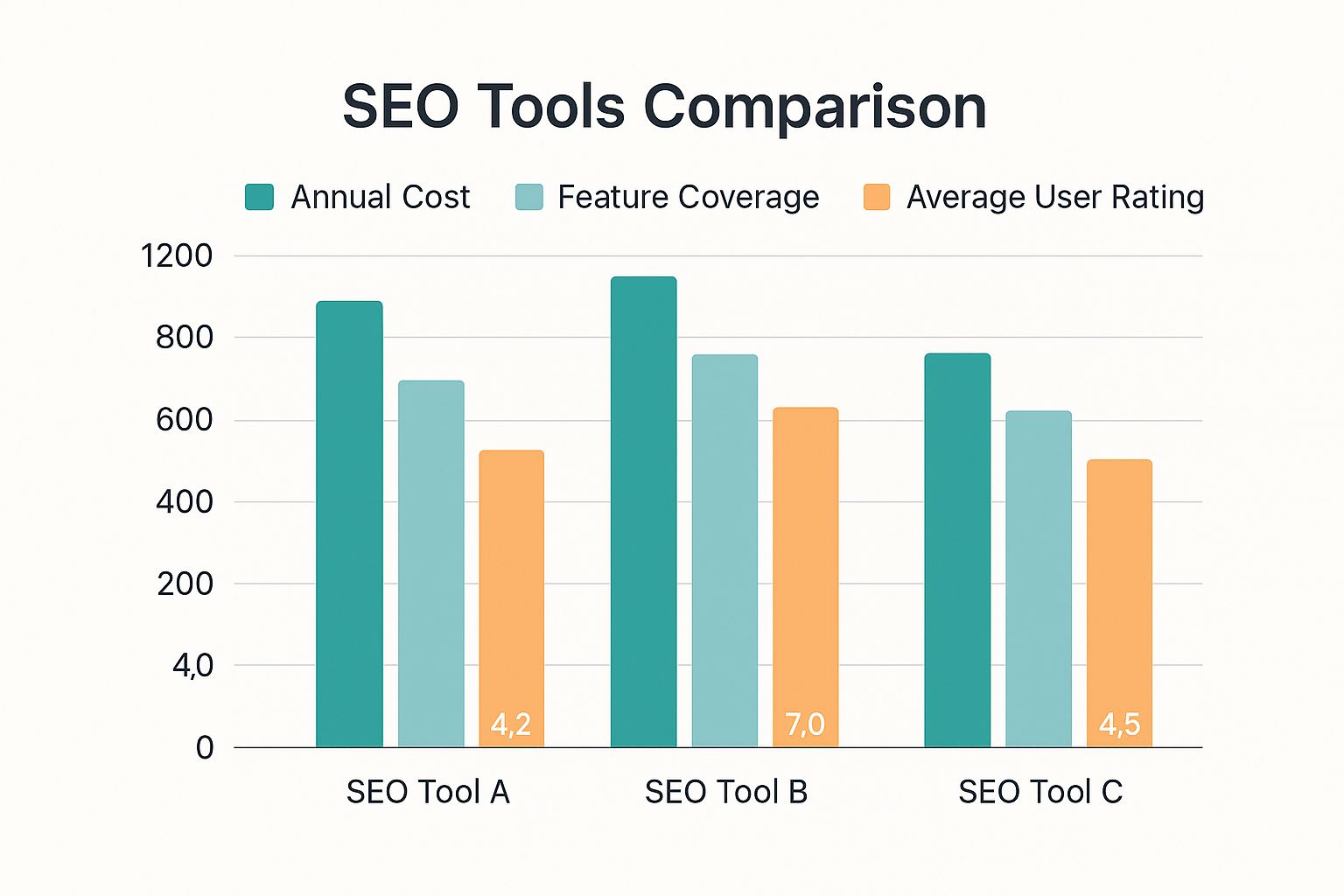
You can immediately see the trade-offs. Each tool is trying to strike a different balance between price and power, and this helps visualize where they all land.
Keyword Research and Discovery
Keyword research is the bedrock of SEO, but every platform has its own philosophy on how to do it. Take Semrush, for instance. Its Keyword Magic Tool is a beast. It just unloads massive lists of related terms, questions, and commercial queries. It’s a pure powerhouse for brainstorming and making sure you’ve explored every possible angle of a topic.
Ahrefs is also a keyword data juggernaut, but its superpower is showing you exactly what keywords your competitors rank for that you don't. This makes it my go-to for a killer competitive gap analysis. If you want to go deeper on that specific tactic, our guide is a must-read: https://rankhub.ai/blog/ultimate-guide-to-competitor-analysis-in-seo-for-better-rankings.
Then you have RankHub, which flips the whole script. Instead of you feeding it seed keywords, its AI scans your entire website to figure out what your business is all about. From there, it automatically spits out a curated list of high-value keyword opportunities. We’re talking hours of manual sifting and second-guessing just… gone. Meanwhile, Moz offers solid, reliable keyword data, but its real charm is its simplicity. It’s a fantastic starting point if you're still getting your sea legs with SEO.
Key Differentiator: Think of it this way: Semrush and Ahrefs hand you an industrial-strength fishing net to trawl a massive ocean of data. RankHub is more like an AI fishing guide who’s already studied the waters and just points you to the hot spots.
Backlink Analysis and Link Building
For years, Ahrefs has been the king of backlink analysis, and for good reason. Its web crawler is one of the most active out there, meaning its backlink index is enormous and constantly refreshed. If you need to dissect a competitor’s link profile with surgical precision or find new link-building targets, this is where you go.
Semrush has a seriously strong backlink analytics suite, too. I especially like its tools for sniffing out toxic links and managing outreach campaigns. While its database is huge, some old-school SEOs will argue that Ahrefs’ index still feels a bit larger and more up-to-the-minute.
Moz’s approach is built around its famous Domain Authority (DA) metric. DA has become an industry-standard shorthand for gauging a site’s link strength, and the Link Explorer tool is fantastic for teaching you why links matter. RankHub, on the other hand, uses backlink data more behind the scenes. It analyzes competitor link profiles to help shape its automated strategy, saving you from having to do that deep-dive analysis yourself.
Technical SEO and Site Audits
A site audit isn’t just about finding errors—it's about getting fixes you can actually implement. This is where you really see the different personalities of these platforms shine through.
- Semrush: Delivers a super comprehensive site audit, giving your site a health score and neatly sorting issues into Errors, Warnings, and Notices. The reports are granular and make it easy to create actionable tasks.
- Ahrefs: Also has a powerful site audit that’s particularly great at visualizing your site structure. It helps you see how one technical problem can cause a ripple effect across your site.
- Moz: Its On-Page Grader and Site Crawl tools are incredibly user-friendly. They don’t just flag an issue; they explain why it's a problem in plain English, which is perfect for anyone still learning technical SEO.
- RankHub: It isn't a dedicated technical audit tool in the same vein as the others. Instead, its initial site scan identifies the foundational SEO elements it needs to build its AI-driven content strategy. The focus is less on server logs and more on the on-page factors that directly influence content and keyword success.
Matching SEO Software to Real-World Scenarios
A long list of features looks great on a sales page, but what really matters is how a tool actually performs when you’re in the trenches. The best SEO platform isn't the one with the most bells and whistles; it’s the one that fits right into your daily work without causing a headache.
So, let's step away from the abstract and put these tools into three common, everyday situations. We'll look at how each platform would work for a specific type of user, giving you a much clearer picture of how it would feel to use it day-to-day.
This is all about finding the right fit. The goal is to see which tool will genuinely help you get results, not just become another line item on your credit card bill.
The Small Business Owner
If you're a small business owner, you're the definition of a multitasker. You’re juggling marketing, sales, and probably a dozen other things at once. You need an SEO tool that’s easy to pick up, gets straight to the point, and delivers clear results without a crazy learning curve or a scary price tag.
Simplicity is everything here. You don’t have time to get bogged down in complicated dashboards or spend weeks just figuring out how to use the software. You need to find opportunities, make a change, and see an impact on your business—and you need to do it fast.
Best Fit Platform Analysis:
- Top Recommendation: For most small business owners, Mangools is a fantastic starting point. It's built for beginners, with a super clean interface and metrics that just make sense, like its famous keyword difficulty score. Tools like KWFinder and SERPChecker give you the essential data you need without the noise of enterprise-level platforms.
- Alternative Option: RankHub is a really strong contender, especially if you feel totally lost when it comes to keyword research. It takes the guesswork out of the equation by analyzing your whole site and handing you a focused strategy. Plus, its pay-as-you-go pricing is a huge plus for businesses that aren't quite ready for a monthly subscription.
A small business owner's most valuable asset is time. The right software gives them a direct path to SEO wins without requiring them to become a full-time search analyst.
The SEO Agency
An SEO agency’s reputation is built on one thing: getting results for clients and proving it. For this kind of user, you need a seriously robust platform that can juggle multiple projects, create slick white-label reports, and dive deep into competitive analysis. Scalability isn't just nice to have; it's essential.
Your daily grind could involve anything from technical site audits and building backlinks to tracking keyword rankings across dozens of different client campaigns. The tool has to be a data-crunching, client-managing powerhouse.
Best Fit Platform Analysis:
- Top Recommendation: Semrush and Ahrefs are the undisputed champions for agencies. Semrush shines as a complete marketing toolkit, packing in powerful features for PPC, content marketing, and social media right alongside its world-class SEO capabilities. Its client management and reporting tools are practically built for the agency workflow.
- How They Compare: Ahrefs often gets the nod for its incredible backlink data and killer competitor analysis tools, like its "Content Gap" feature. Agencies that are laser-focused on link building and competitive intelligence might prefer its depth. On the other hand, agencies offering a wider range of digital marketing services will probably find Semrush to be a better all-in-one fit.
The In-House Marketing Team
An in-house team is in a unique spot, somewhere between a small business owner and a full-blown agency. You usually have more resources and SEO know-how than a solo entrepreneur, but you constantly need to justify your budget and show leadership a clear return on investment. The main goal is driving deep, sustainable growth for one single brand.
Your team needs a tool that makes collaboration easy, provides rich data for long-term strategic planning, and plays nice with the other marketing software you’re already using. You’re not just buying a tool; you’re looking for a long-term growth partner.
Best Fit Platform Analysis:
- Top Recommendation: Semrush is often the go-to for in-house teams because it’s just so versatile. It can be the home base for your SEO specialist, your content marketer, and your PPC manager, all under one subscription. That makes working together a whole lot smoother.
- A Strategic Choice: RankHub also makes a pretty compelling argument, especially for teams that live and breathe content. By automating the foundational strategy and keyword discovery, it frees up your team to spend their brainpower on high-level content creation and promotion. It can be an incredibly powerful supplement to a bigger, more comprehensive suite.
2. A Deep Dive into Data Accuracy and Performance
Let's be honest: in any serious SEO tool showdown, data accuracy is everything. Your entire strategy is built on the numbers you see, so you have to trust them. Bad data can send you on a wild goose chase for impossible keywords or, even worse, cause you to miss out on golden opportunities right under your nose.
You've probably noticed that metrics from different tools can vary—a lot. It's not usually because one is flat-out "wrong" and another is "right." It's that they all have their own secret sauce: different crawlers, data sources, and ways of calculating things. So, let’s unpack how the big players really compare when it comes to reliable data.
H3: Backlink Data Freshness and Index Size
When you're talking about backlinks, two platforms always lead the pack: Ahrefs and Semrush. For years, Ahrefs has been the gold standard for many, and for good reason. They run an absolutely massive and hyperactive web crawler. The result? A backlink index that’s not only huge but also updated constantly, making it the go-to for deep-diving into a competitor's link profile or spotting new links the moment they appear.
Just take a peek at the Ahrefs dashboard—it gives you a real sense of the sheer scale we're talking about.
The number of referring domains and individual backlinks it tracks is a clear sign of just how powerful their crawling operation is. This is what lets SEO pros get almost surgical with their analysis.
Of course, Semrush is no slouch. It has a massive backlink database of its own and offers fantastic tools for auditing your links and managing outreach campaigns. That said, many seasoned pros will tell you that Ahrefs still has a slight edge in discovering brand-new links just a little bit faster.
The Bottom Line: Ahrefs is king for spotting new backlinks almost in real-time thanks to its incredible crawler. Semrush, on the other hand, gives you a powerful, all-in-one system for managing the entire link-building process, from finding opportunities to sending outreach emails. Your choice really boils down to whether you need the absolute freshest data or a more integrated workflow.
H3: Keyword Volume and Difficulty Scores
Keyword data is another battlefield where you'll see some major discrepancies. Search volume and keyword difficulty (KD) scores are ultimately just educated guesses, and every platform has its own algorithm for making them. This can definitely lead to some head-scratching moments.
Semrush is often praised for its keyword data, largely because it pulls from a huge pool of clickstream data. This gives them a wider perspective on actual user behavior, making their volume estimates particularly solid for figuring out commercial intent and digging up valuable long-tail keywords. Ahrefs' keyword data is also top-notch, and many users swear by its Keyword Difficulty score for its reliability.
This is also where a platform like RankHub comes at the problem from a totally different angle. Instead of just throwing raw numbers at you, RankHub uses AI to understand your website's specific context and then serves up curated keyword opportunities. It essentially does the initial filtering for you, pointing you toward predictive insights instead of just historical data. This approach can be a lifesaver, helping you avoid the analysis paralysis that comes from staring at conflicting metrics all day. For a closer look at how to turn this data into something useful, check out our guide on creating an effective SEO report.
The demand for these tools is massive, especially in digitally mature markets. North America currently dominates the SEO software space, making up about 35% of global revenue. The U.S. market alone was recently valued at roughly USD 23.7 billion and is projected to explode to USD 75 billion by 2034. This growth is fueled by the intense pressure on businesses to find a competitive edge with accurate data. You can explore the full analysis of the SEO software market growth for a deeper dive.
Data Accuracy and Feature Strength Ratings
To cut through the noise, here’s a quick-glance rating of where each platform’s data and features truly excel. Think of this as a cheat sheet for matching the right tool to your specific needs.
| Platform | Keyword Data Accuracy | Backlink Index Freshness | Technical Audit Depth | Reporting Customization |
|---|---|---|---|---|
| Ahrefs | ★★★★☆ | ★★★★★ | ★★★☆☆ | ★★★★☆ |
| Semrush | ★★★★★ | ★★★★☆ | ★★★★★ | ★★★★★ |
| RankHub | ★★★☆☆ | ★★☆☆☆ | ★★★☆☆ | ★★★★★ |
As you can see, there's no single "best" tool—it's all about trade-offs. If your world revolves around link building, Ahrefs is hard to beat. If you need a powerful, do-it-all suite with top-tier keyword data and technical SEO features, Semrush is a beast. RankHub shines in a different way, focusing on AI-driven opportunity-finding and highly customizable reporting, making it a strong choice for those who value strategic guidance over raw data dumps.
A Clear Analysis of Pricing and Value
Let's talk money. Every SEO software comparison needs a real-world look at the price tag versus what you actually get. It's easy to see a high monthly fee and run, but the real cost is often hiding in the fine print—things like project limits, user seats, and data quotas that can sneak up and blow your budget.
You have to look past the monthly subscription cost. Sometimes, a more expensive platform can deliver an incredible return by saving your team dozens of hours a month. On the flip side, a budget-friendly tool is the smarter play if you just need a few core features to get the job done and don't want to pay for a bunch of extras you'll never touch.
Deconstructing Subscription Models
Each of the big players has a different pricing philosophy, built for different types of users and budgets. Semrush and Ahrefs both start their entry-level plans around $129-$139 per month. These are powerful, no doubt, but they come with caps on things like the number of projects you can run, keywords you can track, and reports you can pull. They're built for serious users, but the cost can jump up fast when you add team members or scale up your work.
Moz comes in with a slightly more accessible entry point, usually starting around $99 per month. Their pricing is pretty straightforward and offers great value, especially if you appreciate their top-notch educational resources and a cleaner, less intimidating interface.
This screenshot from Moz's website really drives home its focus on an approachable dashboard, which is a big part of its appeal for anyone feeling overwhelmed by more data-heavy tools.

The simplicity you see here is intentional. Moz is all about making SEO data easy to understand and act on, and that's a huge part of its overall value.
The Rise of Flexible and Global Pricing
Then you have a completely different approach like RankHub's pay-as-you-go system. This model flips the whole cost-benefit equation on its head. Instead of locking into a recurring monthly fee, you just buy credits when you need to do research. It’s a perfect fit for agencies with fluctuating client work, consultants on project-based contracts, or small businesses trying to keep fixed costs down.
The real value isn't just the feature list; it's how the pricing model fits your workflow. A pay-as-you-go system gives you flexibility that a subscription can't, making sure you're never paying for software that's just sitting there.
This flexible model also taps into a much bigger trend. The global SEO market is massive—projected to be worth around USD 100.1 billion. The Asia Pacific region alone makes up 27.05% of that. In fact, that region's SEO industry has nearly doubled in recent years, a fascinating trend you can read more about in this in-depth SEO market report.
Aligning Cost with Your Strategic Needs
Ultimately, the "best value" is the tool that lines up with your specific goals. An agency juggling ten WordPress clients has completely different needs than a solo founder. If you're managing multiple sites, our guide on the 12 best SEO tools for WordPress is a great place to find specialized options.
When you're weighing price against value, ask yourself these three simple questions:
- Time Savings: Will this tool automate tasks that are eating up my team's time?
- Data Quality: Are the insights good enough to help me make smarter decisions?
- Scalability: Can this tool grow with me, or am I going to hit a pricing wall in six months?
Answering these will point you toward a platform that’s not just an expense, but a genuine investment in your growth.
Alright, let's wrap this up. It's time to make your final call.
Choosing the right SEO platform isn't about finding the one "best" tool on the market. Honestly, that doesn't exist. The real goal is to find the one that fits your world—your budget, your team, and your specific goals. This decision will be the engine behind your organic growth, so it’s worth a little extra thought.
To cut through the noise, I've put together a simple gut-check list. Forget the complicated feature-by-feature breakdowns for a moment. Answering these four questions honestly will make the right choice pretty obvious.
Your Final Decision Checklist
- What’s your real monthly budget? If money is tight, you shouldn’t be looking at pricey annual contracts. A pay-as-you-go model like RankHub's or a more budget-friendly suite like Mangools is a much smarter starting point.
- How big is your team? If you’re a one-person show, you need something straightforward and effective. But if you’re running an agency or a larger in-house team, you have to think about user seats, collaboration features, and white-label reports. Those things suddenly become non-negotiable.
- What’s your main SEO objective right now? If your entire world revolves around link building, a beast like Ahrefs is probably your best bet. If you need a single platform to handle SEO, PPC, and content marketing, then Semrush is the undisputed king of the all-in-one marketing suite.
- What’s your current skill level? And be honest with yourself here. If you're just starting out, a tool with a massive learning curve will just sit there collecting digital dust. Pick something that feels approachable, not like you need a PhD to operate it.
Here's a good way to think about it: treat your SEO software like a new team member. You wouldn’t hire a senior strategist for an intern’s job, and you wouldn't ask a junior analyst to run the whole department. Match the tool’s power and price tag to the actual job you need it to do.
Thinking this way gets you past the shiny feature lists and forces you to consider what you'll actually use day-to-day. When you focus on your budget, team, goals, and skills, you’ll pick a platform that becomes a genuine partner in your growth, not just another line item on your credit card statement.
Got Questions? We've Got Answers
Diving into the world of SEO platforms can feel like a lot. Let's wrap things up by answering some of the questions we hear all the time. My goal is to help you feel confident you're picking the right tool for the job.
I'm a Beginner. What's the Most Important Feature for Me?
If you're just getting your feet wet with SEO, forget about the million-and-one features for a second. The two things that will make or break your experience are a super intuitive user interface and a top-notch site audit tool.
A clean, simple dashboard is everything. When you're not overwhelmed just by logging in, you'll actually want to use the software. You need a tool that guides you, not one that presents a wall of data and leaves you guessing.
Think of a good site audit tool as your personal SEO coach. It shouldn't just flag problems like broken links or missing title tags; it should tell you why these things matter and how to fix them, in plain English. This is how a tool transforms from a simple piece of software into an educational resource that helps you grow.
For anyone starting out, the best tool isn't the one with the most bells and whistles. It's the one that gives you the clearest, most direct path to making meaningful improvements. Actionable advice beats a mountain of confusing data every single time.
How Can I Justify the Price Tag on Premium SEO Software?
Getting approval for a monthly subscription is all about framing it as an investment, not just another cost. The easiest way to do this is by focusing on the potential return on investment (ROI). Show your boss or client how the insights from the tool will directly lead to better rankings, more organic traffic, and—most importantly—more leads and revenue.
If ROI isn't enough, here are a few other angles:
- Time Savings: Seriously, do the math. Figure out how many hours you or your team spend manually tracking keywords, pulling reports, and spying on competitors. A good platform automates all of that, freeing you up to focus on big-picture strategy.
- Competitive Edge: These tools are your secret weapon. They let you peek behind the curtain to see exactly what your competitors are ranking for and where their traffic comes from. This is how you find the gaps in their strategy and swoop in on missed opportunities.
- Smarter Decisions: SEO without solid data is just a shot in the dark. Premium software gives you the accurate, reliable metrics you need to stop guessing and start making strategic decisions that actually move the needle.
Can I Use More Than One SEO Tool?
Absolutely! In fact, most pros don't rely on a single platform. Building a "tool stack" is common practice because, let's be honest, no one tool does everything perfectly. Combining the strengths of different platforms gives you a much richer, more complete picture.
For instance, you might swear by Ahrefs for its incredible backlink data but prefer Semrush for its deep keyword and PPC insights. Then, you could bring in a specialized tool like RankHub to handle the initial content brainstorming and keyword discovery, using its AI to unearth opportunities the others might not catch.
The trick is to make sure each tool serves a unique purpose. You want them to complement each other, not just create redundant work.
Ready to stop guessing and start strategizing? Let RankHub do the heavy lifting. Our AI-powered platform analyzes your entire site to deliver a focused, actionable keyword strategy in under 60 seconds. See how it works at RankHub.
More from Our Blog
7 Content Writing Tools That Boost Your SEO Rankings
Discover the top 9 SEO content writing tools to automate drafting, optimization, and publishing. Boost rankings with AI-assisted workflows.
Read more →
Zoho Marketing Automation Explained: Is It Right for You?
Compare Zoho Marketing Automation vs HubSpot on pricing, features, ease of use, and automation depth. See which wins for small teams and solo founders.
Read more →
Looking for an SEO Company? Here Are Your Best Options
Compare top SEO companies, AI platforms, and agencies. Find the best fit for your budget, from $49/month tools to full-service retainers.
Read more →