
Let's talk about competitor website analysis. It's not about spying or stealing ideas. Think of it more like strategic reconnaissance—you're looking at what your rivals are doing online to figure out their game plan, see what’s working for them, and spot their weaknesses. This isn't about blindly copying them; it's about collecting smart intel to sharpen your own strategy and get ahead.
Why Competitor Analysis Is Your Secret Weapon

In any market that’s even a little bit crowded, knowing what your competition is up to isn't just a nice-to-have. It’s a must for survival. A solid competitor analysis gives you a backstage pass to their operational playbook, showing you exactly how they’re winning (and losing).
When you dig into a competitor's website and overall online presence, you start to understand the "how" and "why" behind their results. You can see their wins, learn from their face-plants, and find holes in their strategy that you can exploit. This goes way beyond just SEO; it's about figuring out their entire process for attracting, engaging, and converting an audience.
Gaining Actionable Intelligence
Think of this as business intelligence for the digital world. A proper analysis gives you a direct look at what’s resonating in your niche right now, which can save you a ton of time and money on trial-and-error. The insights you pull out should directly fuel your marketing, content, and even product development decisions.
You also get a much clearer picture of your own performance by benchmarking against the top players. This whole process shines a light on gaps in your strategy and uncovers opportunities you might have missed. To really get a handle on this, you can explore a complete competitor analysis framework that helps turn these findings into real strategic moves.
The goal of competitor analysis isn't to imitate. It's to innovate. Use what you learn to make your brand different, fine-tune your value proposition, and find unique ways to serve your shared audience better than anyone else.
The Strategic Advantages
A well-done analysis doesn't just hand you a pile of data; it gives you a roadmap. Our own guide on https://rankhub.ai/blog/competitor-analysis-in-seo shows how these insights directly translate into better search rankings and more visibility. The strategic perks are undeniable:
- Spotting Market Opportunities: You can find topics or customer pain points that your competitors are completely ignoring.
- Dodging Bullets: Learn from the mistakes others have already made, whether it's a failed ad campaign or a content format that flopped.
- Benchmarking Your Performance: Objectively measure your website's performance—from traffic to user experience—against your rivals.
- Making Smarter Decisions: Stop guessing. Start using data to decide where to put your time and budget for the biggest impact.
Finding Your True Digital Competitors

Before you can even think about outranking anyone, you have to figure out who you’re actually up against online. It’s easy to get this wrong. You probably have a list of local businesses you consider rivals, but in the SEO game, your most significant competitors are often invisible in your day-to-day world.
These are your digital competitors—the websites that consistently steal the spotlight in search results for the exact keywords your customers are using.
A smart competitor analysis starts here, by identifying these digital players. The shop down the street might sell the same widget, but if their website is collecting dust, they aren't your search competitor. Your real fight might be with a national blog, a super-niche forum, or even an e-commerce giant that somehow ranks for your terms.
Direct vs. Content Competitors
To make your analysis count, you need to know who you're looking at. I've found it's incredibly helpful to split them into two camps.
Direct Competitors: This is the obvious one. They sell a similar product or service to the same people you do. If you run a local coffee shop, it’s the other café across town. Simple.
Content Competitors: This is where it gets interesting. These sites might not sell a single thing you offer, but they're creating content that pulls in your target audience. For that same coffee shop, a content competitor could be a food blogger reviewing local spots or a city magazine writing about the "best espresso in town." They're competing for the same eyeballs.
Your goal isn't to boil the ocean. A focused analysis of 3-5 key players who are genuinely siphoning your traffic will give you way more actionable intel than a shallow look at 20 different sites.
And the online space is crowded. The global web hosting market is expected to hit $157.9 billion in 2024, with platforms like Wix.com hosting something like 110 million customers. That’s a staggering number of websites all vying for attention. You can find more data about the scale of the web that really puts this competitive space into perspective.
So, how do you find your real competitors? Just ask Google.
Pop open an Incognito window (so your search history doesn't skew the results) and search for your top 5-10 most valuable keywords. See who consistently shows up on page one. Those are the sites you need to be dissecting.
Peeking Under the Hood: Decoding Their SEO and Content Strategy

Alright, you’ve got your list of competitors. Now for the fun part: putting on your detective hat and figuring out what makes them tick online. We're going to dive deep into their website to see how they’re pulling in traffic and winning over customers.
This isn't just about surface-level stuff. We're going beyond the basics to really understand their entire digital playbook, from their on-page SEO tactics to the core of their content strategy.
Your first port of call should be the fundamental on-page SEO elements. These are the direct signals they're sending to Google. Pull up some of their top-ranking pages and start asking questions. What’s the deal with their title tags and meta descriptions? Are they just stuffing in keywords, or are they writing compelling, benefit-driven copy?
Pay close attention to their header tags (H1s, H2s, H3s) as well. This is a dead giveaway for how they structure their thoughts for both readers and search engine bots. A clean, logical header structure usually means they’ve put real thought into the user experience.
Uncovering Their Content Game Plan
Technical SEO is important, but the real gold is in understanding what they're writing about and why. A proper competitor website analysis needs to look past the keywords and dig into the story they're telling. Are they the cheap and cheerful option? The go-to expert? The cool, innovative brand? Their content will tell you everything.
To make sense of it all, I like to categorize the different types of content they’re creating. It’s a simple way to see where they’re spending their time and money, which tells you what they believe works for your shared audience.
- Blog Posts & Articles: Look for their main content pillars. Are they publishing massive, in-depth guides or short, punchy listicles?
- Video Content: Are they using video for how-to tutorials, product showcases, or sharing customer success stories?
- Case Studies & Whitepapers: This is a huge signal. It means they're serious about creating content for people who are ready to buy.
- Lead Magnets: Spot any ebooks, checklists, or webinars? This uncovers exactly how they’re building their email list.
Once you’ve done this, you’ll start seeing the holes. Maybe all your competitors are blogging their hearts out, but nobody is making video tutorials. That’s not a gap; that’s a massive opportunity waiting for you. If you want to dive deeper into these kinds of strategies, resources like rebelgrowth's blog are fantastic for more advanced tips.
Performing a Content Gap Analysis
Now it’s time to get a bit more technical with a content gap analysis. In plain English, this just means finding the valuable topics your competitors are ranking for that you aren’t. Most SEO tools make this super easy—you can plug in your domain and a competitor's, and it will spit out a list of all the keywords they rank for that you've missed.
A content gap isn't just about a missed keyword; it's a missed chance to solve a customer's problem. Filling these gaps is one of the fastest ways I know to start siphoning relevant, high-intent traffic away from your rivals.
Imagine finding out your top competitor is on page one for "how to choose [your product type] for a small business," and you've never even written about it. That’s a five-alarm fire. It’s a clear signal of what customers are searching for, and it should shoot straight to the top of your content to-do list.
When I'm analyzing a competitor's content, I try to organize my findings into a few key areas. It helps me see the bigger picture of their strategy, from the topics they cover to how they try to engage their readers.
Core Areas of Competitor Content Analysis
| Analysis Area | What to Look For | Potential Insight |
|---|---|---|
| Topic Coverage | The main themes and categories they focus on. Are there recurring topic clusters? | Reveals their areas of perceived expertise and what audience segments they are targeting. |
| Content Formats | The mix of content types: blog posts, videos, case studies, podcasts, infographics, etc. | Shows where they invest their resources and which formats they believe are most effective for their audience. |
| Content Quality | Depth of information, accuracy, writing style, and use of visuals (images, videos). | Helps you understand the quality standard in your niche and identify opportunities to create superior content. |
| On-Page SEO | Use of keywords in titles, headers, and body text. Internal linking structure and image optimization. | Uncovers their approach to search engine optimization and how they structure content for discoverability. |
| Call-to-Action | What they ask the reader to do next. Are they pushing for a sale, an email signup, or just more reading? | Highlights their primary conversion goals for different types of content (e.g., lead generation vs. brand awareness). |
| Publishing Cadence | How frequently they publish new content. Is it daily, weekly, or sporadically? | Indicates their level of investment in content marketing and helps you set a competitive baseline for your own efforts. |
By breaking down their content this way, you move from simply looking at what they’ve published to truly understanding the "why" behind it. Your end goal here is to build a hit list of these content opportunities to fuel your own strategy and start closing the gap.
Getting a Read on Their Backlinks and Authority
If content is the king, then backlinks are the powerful allies that keep him on the throne. Think of backlinks as votes of confidence from other websites. They're a massive factor in how search engines see your site's authority, and a strong backlink profile is often the invisible engine behind a competitor's top rankings.
This is exactly why a competitor analysis isn't finished until you’ve dug deep into who's linking to them. It's like finding their secret network of supporters. You can see who vouches for them, which reveals everything from their PR wins and guest posting networks to their key industry partnerships. This isn't just a list of links; it’s a roadmap for building your own credibility.
Spotting the High-Value Links
Let's be real: not all links are created equal. A single link from a major industry publication can be worth more than a hundred from obscure blogs. Your first task is to sift through their backlink profile and find the absolute gems.
Hop into a tool like Ahrefs or Semrush and sort your competitor's backlinks by metrics like Domain Rating (DR) or Authority Score (AS). This will immediately push the most powerful and influential links to the top of the list. Keep an eye out for links coming from:
- Top-tier industry blogs that everyone in your space reads and respects.
- Well-known news publications or major media outlets.
- Reputable educational institutions or government websites (those coveted .edu or .gov domains).
- Key business partners or other respected organizations in your field.
This process peels back the curtain on their digital PR and outreach strategy. You can see exactly which sites they've managed to get featured on, which hands you a ready-made list of high-value targets for your own campaigns.
Finding Your "Link Gap" Opportunities
Okay, this is where backlink analysis gets really actionable. It’s all about the "link gap" or "link intersect" analysis. This is where you directly compare your backlink profile against your competitors' to find all the websites that link to them, but not to you.
Think about it this way: if a high-authority website has already linked to two of your main competitors, they’ve basically raised their hand and said, "I'm interested in this topic!" This makes them a warm lead for your own outreach. They're already familiar with your niche and are far more likely to listen to a pitch from you—especially if you can offer a fresh angle or a piece of content that blows your competitors' out of the water.
A link gap analysis doesn't just show you a list of websites. It hands you a prioritized outreach list of targets that are already proven to be interested in your industry.
Let's say you run a B2B software company. You run a link gap analysis and find that a major tech review site has linked to three of your competitors' "getting started" guides. This is a huge signal. You now know:
- This site is a major influencer for your ideal customer.
- They clearly like linking to beginner-friendly, educational content.
- You have a golden opportunity to create an even better, more comprehensive guide and pitch it directly to them.
By methodically finding these high-potential links, you can stop guessing who to contact. You're now building a targeted, effective link-building strategy based on what's already working for the top players in your space. This is how you turn a simple audit into a powerful growth machine.
Choosing the Right Tools for the Job
Trying to do a real competitor analysis without the right software is like trying to build a house with only a hammer. Sure, you might get a wall up, but the whole thing is going to be slow, frustrating, and probably fall down. The right tools are what turn a mountain of raw data into actual insights you can use, saving you from endless hours of manual guesswork.
There’s a whole universe of platforms out there, but a few have become the go-to choices for a reason. These aren't just fancy spreadsheets; they're strategic weapons that help you see exactly what your competition is doing online. The trick is knowing which tool to pull out of the toolbox for which task.
The All-in-One Powerhouses vs. Specialists
For most of us, the choice comes down to a handful of major players. A solid competitor analysis needs to cover a lot of ground, from digging into backlinks to finding keyword gaps. It's no surprise that by 2025, tools like Ahrefs, Semrush, and SpyFu have become non-negotiable for tracking everything from a rival's SEO performance to their ad campaigns. This is how smart marketers spot openings and fine-tune their own strategies.
I find myself bouncing between different tools depending on what I’m trying to figure out.
- Ahrefs: This is the undisputed king of backlink analysis. If you need to dissect a competitor's link profile with surgical precision, this is where you go. Hands down.
- Semrush: This is my favorite all-in-one suite. It’s fantastic for managing entire projects, comparing several competitors at once, and sniffing out those crucial keyword gaps.
- SpyFu: A master of the PPC world. It gives you an incredible window into a competitor's advertising history, right down to their ad copy and estimated budgets.
Turning User Experience into a Weapon
Beyond the SEO and ad data, you have to look at how a competitor's website actually feels to use. This is where you can find huge competitive advantages that you’ll never see in a data table.
This simple flowchart lays out how you can audit a competitor's user experience.
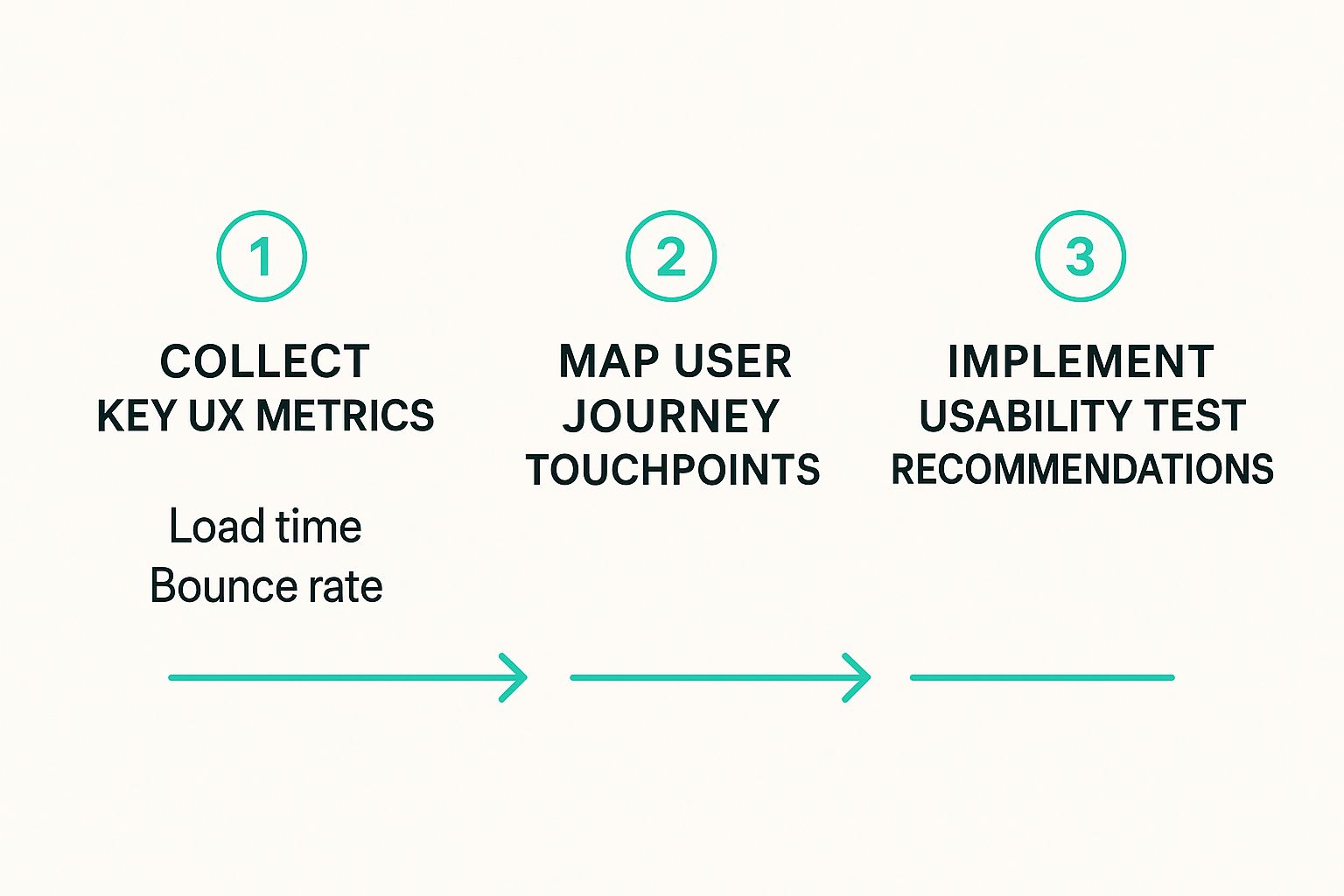
As you can see, a good UX review starts with concrete metrics, then moves to mapping out the user journey, and finishes with real testing—a cycle that works just as well for your own site.
Don’t just look at what your competitors rank for; look at how their site feels to a potential customer. A clunky, slow website is a weakness you can exploit, even if their SEO looks strong on paper.
Ultimately, picking the right tool boils down to your main goal. If you're all-in on organic growth, finding keyword opportunities is everything. For a deeper dive into that, our guide on keyword research best practices is a great place to start. If paid advertising is your battleground, then a tool with serious PPC intelligence will be your best friend.
Honestly, the smartest move is usually a combination, cherry-picking the best features from each platform to build a complete, 360-degree view of the competition.
Alright, let's turn all that data into a real game plan.
Building Your Competitive Action Plan
All the research and data you've gathered is fascinating, but let's be honest—insight without action is just trivia. The final, and frankly most important, part of any competitor analysis is turning those findings into a concrete plan that actually grows your business.
This is where you pull everything together: the keyword gaps, the content they're crushing you on, and all those juicy backlink opportunities. The goal is to stop playing defense and start making proactive, data-backed moves.
Your competitor report shouldn’t just be a list of what your rivals are doing. It should be a prioritized list of what you are going to do next to win.
From Data to Decisions
The first thing I always do is create a simple report that lays out what I've found. The key here is prioritization. It's so easy to get buried under a mountain of "should-dos." You need a clear way to decide what to tackle first.
For example, do you jump on creating content for those untapped keywords, or is it more urgent to kick off a link-building campaign? The answer really depends on where you're weakest. If your site has decent authority but your content is thin, filling those gaps is priority one. On the flip side, if you have amazing content that no one is linking to, you know your immediate focus has to be outreach.
This whole process is becoming a non-negotiable for businesses. The market for competitor analysis tools is expected to hit around $6.6 billion by 2025—that's a leap of over 53% in just four years. That massive investment tells you everything you need to know about how critical this is. You can read more about this growing market and its impact on business strategy if you're curious.
Setting Goals and Measuring Success
Once you know your priorities, you can start setting realistic goals and KPIs using your competitors as a benchmark. Your action plan might look something like this:
- Content Creation: Target 3-5 high-opportunity keywords where your competitors are ranking. Your mission is to publish something way better within the next quarter.
- On-Page SEO: Overhaul the on-page elements of your top 10 service pages. Look at what's clearly working for your competitors and adapt those strategies for your own site.
- Technical SEO: Fix any critical site structure problems that are making your user experience worse than your rivals'. A solid site architecture is a great place to start, and our guide on designing your website structure for SEO can walk you through it.
What you're left with is a clear, actionable roadmap. It’s a plan that gives your team the confidence to make the right moves and start closing the gap.
Got Questions? Let's Get Them Answered
It's totally normal to have a few questions swirling around after digging into competitor analysis for the first time. Let's tackle some of the most common ones I hear.
How Often Should I Be Doing This?
For the full-blown, deep-dive analysis we've talked about, I'd suggest doing it once a quarter. That timing is frequent enough to spot significant changes in your competitors' strategies but not so often that you get lost in the weeds.
That said, I’m a big fan of a quicker, more informal check-in every month. Just a quick peek at their new ranking keywords, any big backlinks they’ve landed, or major new blog posts can prevent you from being blindsided. Think of it as keeping a casual eye on the neighborhood.
What's the Single Biggest Mistake People Make?
Hands down, the biggest trap is becoming a copycat. The goal isn't to create a carbon copy of your competitor’s website or content strategy. That's a race to the bottom.
Your real mission is to understand their game plan so you can find gaps and create your own. See their weaknesses as your openings. Learn from their successes to inspire your own unique approach, not just to imitate it. A competitor website analysis is all about carving out your own space to be different—and better.
Can I Really Do This Without Paying for Fancy Tools?
Honestly, yes, you can get a basic feel for things without dropping cash on subscriptions. You can absolutely start by manually poking around their websites and using Google in Incognito mode to check rankings. It gives you a decent lay of the land.
But, if you're serious about this, those premium tools are where the magic happens. The data, scale, and efficiency you get from something like Ahrefs or Semrush are what turn a good analysis into a game-changing one.
Ready to stop guessing and start winning? RankHub analyzes your entire site in under a minute to uncover your best keyword opportunities and competitor gaps, so you can build a data-driven content strategy that gets results. Check out what's possible at https://www.rankhub.ai.
More from Our Blog
Zoho Marketing Automation Explained: Is It Right for You?
Compare Zoho Marketing Automation vs HubSpot on pricing, features, ease of use, and automation depth. See which wins for small teams and solo founders.
Read more →
Looking for an SEO Company? Here Are Your Best Options
Compare top SEO companies, AI platforms, and agencies. Find the best fit for your budget, from $49/month tools to full-service retainers.
Read more →
Marketing AI Tools Compared: Which Delivers Real Results?
Compare top marketing AI tools for SEO content creation. See pricing, features, and which tool fits solo founders, SMBs, and marketing teams.
Read more →