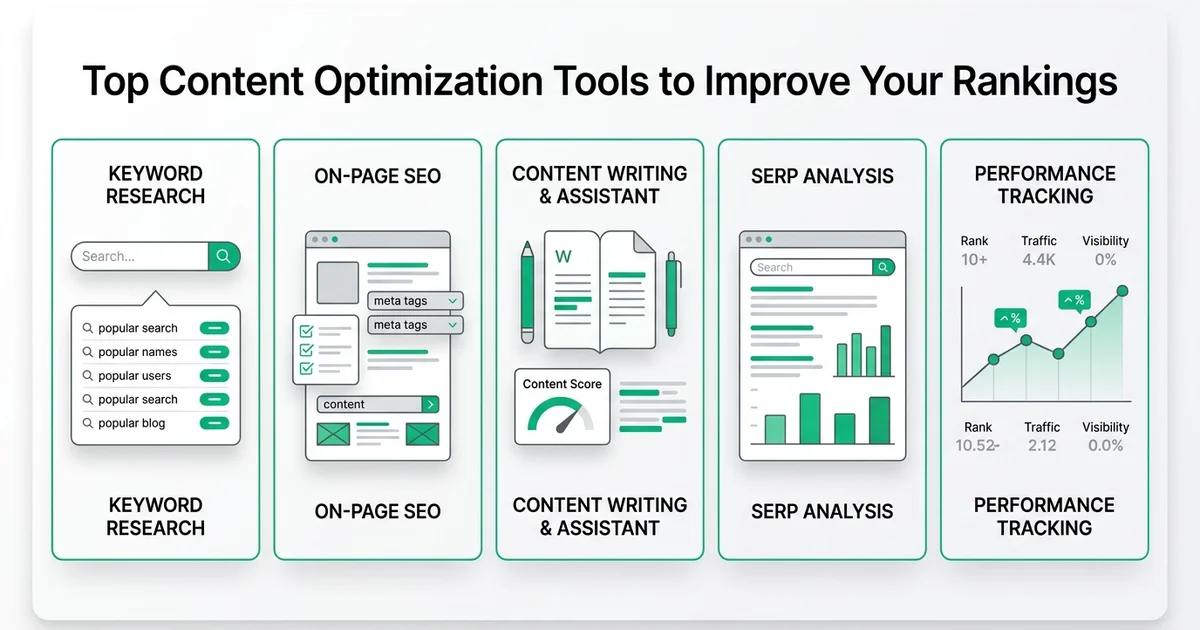
Top Content Optimization Tools to Improve Your Rankings
Introduction: why content optimization tools matter for your SEO strategy
Content optimization tools have become essential for anyone serious about organic search performance. At RankHub, our analysis shows that teams using dedicated optimization platforms consistently produce content that ranks faster, targets the right keywords, and avoids the costly mistakes that come with manual workflows.
What these tools actually do
Modern content optimization tools combine keyword research, competitive analysis, and AI-assisted writing into a single workflow. Rather than toggling between a dozen tabs, you get a structured process that guides every article from topic selection to publish-ready draft. According to Rankability (2026), the best platforms go beyond basic suggestions and actively shape content structure to match search intent.
How the market is shifting
The category is evolving quickly. AI SEO tools are moving away from passive suggestion editors toward fully automated, publish-and-optimize pipelines that handle research, writing, and distribution with minimal human input. This shift matters for solo founders and small teams who lack dedicated content resources.
How we evaluated each tool
Every tool in this list was assessed on four criteria: ease of use, feature depth, pricing transparency, and real-world ranking impact. Pricing clarity deserves special attention because cost-per-article math varies significantly across tiers and is rarely straightforward to compare.
Our top picks: quick summary of the best content optimization tools
The five tools below represent the strongest options across different budgets and use cases. Each earns its place based on a distinct strength, whether that is full publishing automation, deep content analysis, or cost-effective optimization for lean teams.
| Tool | Best for | Starting price |
|---|---|---|
| RankHub | Autopilot SEO content automation | See plans |
| Clearscope | Content relevance analysis | $129/month |
| Outrank | AI writing with publishing automation | $99/month |
| SE Ranking | Affordable all-in-one SEO | $75.20/month |
| PageOptimizer Pro | Budget-friendly solo optimization | $37/month |
RankHub earns the top spot for teams and solo founders who want a genuine content marketing automation platform rather than another writing assistant. It handles keyword research, article creation, featured images, and webhook publishing in a single automated pipeline.
Clearscope suits established marketing teams prioritizing content relevance scoring. Outrank appeals to those wanting AI writing paired with direct publishing. SE Ranking and PageOptimizer Pro serve budget-conscious users who need solid fundamentals without enterprise pricing.
1. RankHub: best autopilot SEO content automation
RankHub earns the top spot because it is the only tool on this list that handles the entire SEO content workflow without requiring you to lift a finger. From keyword research and article writing to featured images and CMS publishing, every step runs automatically on a fixed schedule.
RankHub
Autopilot SEO content automation handling the entire workflow from keyword research to publishing. One new post every week with the Starter Plan.
What RankHub does
RankHub is a fully automated seo content automation software platform built for founders and small teams who want consistent organic growth without hiring a content department. Once configured, it runs 15 automated steps each month, covering keyword discovery, anti-cannibalization checks, article creation, image generation, and webhook publishing to your platform of choice.
Publishing tiers and pricing
RankHub offers three plans scaled to your publishing cadence:
- Starter: One new post per week, AI keyword research, SEO-optimized articles, featured images, and webhook publishing included
- Growth: One post every two days, plus dedicated support and backlink credits to accelerate domain authority
- Scale: One post per day, the highest output tier for teams treating content volume as a core growth lever
Who it suits best
RankHub is purpose-built for solo founders, lean marketing teams, and SMBs that cannot justify a full content operation. It saves users an estimated 40-plus hours per month and supports native language publishing, which eliminates the awkward translation artifacts common in localized SEO campaigns.
Compared to tools like Outrank or SEObot, which still require meaningful editorial input, RankHub is the closer match for anyone who wants a genuinely hands-off pipeline from keyword to published post.
Best for: Solo founders and small teams wanting consistent, automated SEO output with zero manual intervention. Start here: rankhub.ai
2. Clearscope: best for content relevance and depth analysis
Clearscope takes a different approach to content optimization. Rather than automating production, it gives writers and content teams the analytical depth to make every piece as relevant and competitive as possible before it goes live. It is a strong choice for teams that prioritize quality over volume.
Clearscope
$129/monthDeep content relevance and depth analysis tool that helps writers and content teams optimize every piece for search competitiveness. Starting at $129/month.
How Clearscope analyzes your content
Clearscope compares your draft directly against the top-ranking pages for your target keyword, surfacing content gaps, missing terms, and structural weaknesses in real time. The result is a clear, graded report that tells you exactly where your content falls short and what to add to close the gap.
Workflow integrations
The platform integrates natively with Google Docs and WordPress, so writers can optimize without switching between tools. This keeps the editorial process clean and reduces friction for teams already working inside those environments.
Pricing and who it suits
According to Zapier (2026), Clearscope pricing starts at $129 per month for individual users and $189 per month for teams. That positions it firmly in the professional tier, making it most practical for established content teams rather than solo founders watching their budgets closely.
Best for: Content teams and marketing managers who want rigorous, data-driven optimization before publishing. Limitation: The price point and manual workflow mean it is less suited to high-volume, automated publishing pipelines.
3. Outrank: best for AI-powered content creation and publishing
Outrank takes a different approach from tools like Clearscope by combining keyword research, AI writing, and auto-publishing into a single workflow. Rather than optimizing content you have already written, it generates and publishes SEO-optimized articles for you, making it a strong fit for teams managing high-volume seo content calendar automation.
Outrank
$99/monthAI-powered content creation and publishing platform combining keyword research, AI writing, and auto-publishing. All-in-One plan includes 30 SEO-optimized articles per month.
Pricing and article volume
Outrank's All-in-One plan is priced at $99 per month (or $999 per year) and includes 30 SEO-optimized articles per month. For publishers who need more output, an add-on option delivers 60 additional articles per month for $85 per month. According to RankPine (2026), this usage-based, article-volume pricing model reflects a broader industry shift toward measurable content output rather than flat feature access.
What you get on the platform
Every plan includes AI-generated images, unlimited user seats, and integrations for direct publishing, which removes the bottleneck of manual uploads. That combination makes it particularly practical for agencies and marketing teams coordinating multiple content calendars simultaneously.
Limitations to consider
Outrank is built for volume and speed. Teams that prioritize deep editorial control or granular on-page scoring, as Clearscope offers, may find the automated approach less flexible for highly nuanced content briefs.
Best for: Agencies, SMBs, and marketing teams that need consistent, automated content output at scale. Limitation: Less suited to workflows that require detailed manual optimization before publishing.
4. SE Ranking: best budget-friendly all-in-one SEO platform
SE Ranking is a strong choice for small businesses and solo founders who need a full suite of SEO capabilities without paying enterprise-level prices. According to Zapier (2026), content marketing features start at $75.20/month, making it one of the more accessible all-in-one platforms on the market.

What you get at this price point
SE Ranking bundles keyword research, content optimization, rank tracking, and backlink analysis into a single dashboard. Rather than juggling four separate tools, users can monitor all core SEO metrics from one view. This consolidation is particularly valuable for teams without a dedicated SEO specialist.
Who it suits best
SE Ranking works well as an entry point for founders and small marketing teams exploring online marketing platforms for small businesses for the first time. It provides enough depth to produce meaningful results, while remaining approachable for beginners. As your needs grow, you can layer in more specialized tools on top of the foundation SE Ranking builds.
Best for: Beginners, small businesses, and budget-conscious teams needing broad SEO coverage in one place. Limitation: Teams requiring advanced content automation or AI-driven publishing workflows may outgrow it quickly.
5. PageOptimizer Pro: best for solo founders on a tight budget
PageOptimizer Pro is a lean, focused content optimization tool built specifically for on-page SEO. At just $37/month, it is one of the most affordable entry points in this category, making it a practical choice for solo founders and freelancers who need reliable optimization guidance without paying for features they will never use.
What it does well
The tool zeroes in on on-page SEO factors and competitor content analysis, surfacing actionable recommendations that tell you exactly what to adjust on a given page. According to Zapier (2026), PageOptimizer Pro is highlighted for both its affordability and accuracy, two qualities that matter most when you are working alone and every decision counts.
Who it suits best
The interface is deliberately lightweight, which reduces the learning curve for freelancers and solo entrepreneurs. It does not include AI writing capabilities, so it works best alongside a separate writing workflow rather than replacing one.
Best for: Solo founders and freelancers who want precise on-page optimization guidance on a tight budget. Limitation: Not suited for teams needing content automation, AI-generated drafts, or a broader SEO content strategy.
Content optimization tools comparison table: features and pricing at a glance
With so many tools reviewed, a side-by-side view makes it easier to spot which platform fits your workflow. The table below covers the features that matter most to founders and marketing teams: pricing, AI writing, publishing automation, CMS integrations, and advanced capabilities like fact-checking and internal linking.
Check out Starter Plan's approach to content optimization tools Starter Plan.
| Tool | Starting price | AI writing | Auto-publishing | Internal linking | Fact-checking | Multi-site support |
|---|---|---|---|---|---|---|
| RankHub | Starter Plan | Yes | Yes (webhook) | Yes | Yes | Yes |
| Outrank | Paid plans | Yes | Yes | Yes | Yes | Limited |
| SEObot | Paid plans | Yes | Yes | Limited | No | Limited |
| PageOptimizer Pro | Low-cost tier | No | No | No | No | No |
In our experience at RankHub, the features most teams overlook when comparing tools are anti-cannibalization checks and native language support. These gaps become costly at scale.
For a deeper look at matching tools to your growth stage, see our guide on choosing the right digital marketing platform.
How we chose these content optimization tools: our selection methodology
Selecting the right content optimization tools requires more than reading feature lists. We applied a consistent evaluation framework across every tool in this guide, focusing on the criteria that actually move rankings and save time for real teams.
Ease of use and feature completeness
We assessed how quickly a new user could go from signup to published content, and whether core features like keyword research, on-page optimization, and content scoring were genuinely integrated or bolted together. Tools that required multiple separate platforms to complete a single workflow scored lower.
Pricing transparency and cost-per-article value
We calculated the real cost per published article at each pricing tier, not just the headline monthly fee. Opaque pricing structures and hidden usage caps were flagged as friction points for SMBs and solo founders managing tight budgets.
Trust, quality controls, and anti-hallucination
This is one of the most under-covered evaluation areas across competitor reviews. We specifically tested whether tools offered fact-checking, source citations, and anti-hallucination safeguards. For teams publishing at volume, these features directly affect brand credibility. You can explore how these quality signals connect to broader content writing tools that boost your SEO rankings.
Workflow automation depth and multi-site capability
We evaluated auto-publishing support, internal linking automation, CMS integrations, and webhook compatibility. Tools were also tested for multi-site management, a critical requirement for agencies and growing teams handling several domains simultaneously.
What to look for in a content optimization tool: buyer's guide
Choosing the right content optimization tool comes down to matching its capabilities to your actual workflow. The market is crowded, and every platform claims to do everything. These are the criteria that genuinely separate useful tools from expensive distractions.

Keyword research depth
Look for tools that surface long-tail keyword variations and map search intent, not just search volume. The best platforms flag keyword conflicts before you publish, preventing content cannibalization across your existing pages. This is especially valuable for growing sites with dozens of posts competing for similar terms.
Content analysis and gap identification
A strong tool compares your draft against top-ranking competitors and highlights what you are missing. Structural gaps, missing subtopics, and thin coverage are all signals that affect rankings. According to Rankability (2026), content gap analysis is one of the highest-impact features agencies prioritize when evaluating platforms.
AI writing quality and trust signals
If a tool includes AI writing, the output should be original, factually grounded, and properly attributed. Source citations and fact-checking features are becoming genuine differentiators, particularly for B2B audiences where credibility matters. Generic, unverified AI content creates reputational risk.
Publishing automation and CMS integration
Check whether the tool connects directly to your CMS or supports webhook publishing for custom setups. Multi-CMS and multi-site support is increasingly central for agencies managing several client domains. RankHub's Starter Plan covers this with webhook integration that pushes finished, image-ready articles to virtually any platform automatically.
Pricing model clarity
Fixed monthly pricing, usage-based billing, and article-volume tiers each suit different team sizes. Understand exactly what triggers additional charges before committing.
Team collaboration and reporting
Multi-user access, editorial workflow support, and performance tracking round out a complete toolset. If you cannot measure ranking movement and traffic growth over time, you cannot prove the tool is working. This connects naturally to broader marketing automation considerations when building a scalable content operation.
Honorable mentions: other solid content optimization tools worth considering
Beyond the top-ranked picks, several tools deserve a place on your shortlist depending on your workflow and budget. Each serves a distinct use case, so the right choice depends on what gap you most need to fill.
Surfer SEO
Surfer SEO focuses tightly on on-page optimization and competitor analysis, scoring your content against top-ranking pages in real time. It is a frequent comparison point against Clearscope: Surfer leans toward structural guidance and SERP data, while Clearscope prioritizes topic depth and term grading.
Semrush
Semrush is a comprehensive SEO suite where content optimization sits alongside keyword tracking, backlink auditing, and site health tools. It suits teams that want everything under one roof.
Ahrefs
Ahrefs excels at keyword research and content gap analysis, helping you identify topics competitors rank for that your site currently misses. If you are also looking for an SEO company to supplement your efforts, Ahrefs data is a common foundation they use.
Jasper
Jasper is an AI writing platform with built-in SEO optimization capabilities, suited to teams that prioritize content volume alongside search visibility.
Budget options: best content optimization tools under $100/month
Strong SEO results do not require an enterprise budget. Several capable content optimization tools sit comfortably under the $100/month mark, making them realistic choices for solo founders, lean marketing teams, and growing SMBs. Cost-per-article is increasingly the metric that matters at this tier.
RankHub Starter: editor's pick
Price: Entry-level (Starter Plan)
RankHub earns the top spot here because it removes the most painful part of budget SEO: finding the time to actually do it. The Starter Plan delivers one fully SEO-optimized article every week, complete with AI keyword research, featured images, and webhook publishing to your platform of choice. Anti-cannibalization checks prevent keyword conflicts across your growing content library, and native language support means no clunky translation artifacts. For founders without a dedicated content team, that adds up to 40+ hours saved monthly on autopilot.
Visit RankHub to explore the Starter Plan.
PageOptimizer Pro
Price: $37/month
PageOptimizer Pro focuses tightly on on-page optimization, making it a lean, affordable pick for solo founders who already produce content and need sharper ranking signals without paying for features they will never use.
SE Ranking
Price: $75.20/month
SE Ranking bundles keyword tracking, site auditing, and content optimization into a single dashboard. According to Rankability (2026), it is one of the more complete all-in-one platforms available at this price point.
Outrank
Price: $99/month
Outrank delivers 30 AI-generated articles per month, which makes its per-article cost competitive for teams prioritizing volume. According to RankPine (2026), it suits businesses focused on consistent publishing cadence rather than deep technical SEO features.
Enterprise solutions: content optimization tools for large teams and agencies
Large teams and agencies need content optimization tools that scale beyond individual use. Multi-site management, white-label reporting, and high-volume publishing pipelines are now central requirements. The platforms below are built for organizations publishing at scale across multiple clients or domains.
RankHub Scale plan (Editor's Pick)
RankHub's Scale plan is designed for agencies and high-volume publishers that need daily content output without building an internal writing team. The platform runs 15 automated steps monthly, handles AI keyword research, anti-cannibalization checks, and delivers SEO-optimized articles with featured images included. Webhook integration means content pushes directly to any CMS without manual intervention, which removes a significant operational bottleneck for multi-site agencies.
Key enterprise advantages include:
- Anti-cannibalization checks that prevent keyword conflicts across large content libraries
- Native language support for agencies managing multilingual clients
- Backlink credits built into the workflow to support domain authority growth
- Webhook publishing compatible with virtually any platform
For agencies managing multiple client accounts, RankHub consolidates what would otherwise require separate tools for research, writing, and publishing.
Outrank for high-volume publishing
Outrank offers custom article volume add-ons suited to teams that need to exceed standard monthly limits. According to best-ai-seo-software.com (2026), Outrank includes unlimited users and publishing integrations, making it a practical option for larger editorial teams coordinating across departments.
Clearscope team plans
Clearscope's team plans support unlimited users with advanced permissions, which suits agencies that need structured access controls. Its content grading and optimization workflow integrates cleanly into existing editorial processes, though it focuses on optimization rather than automated content creation.
Conclusion: choosing the right content optimization tool for your needs
The right content optimization tool depends on your publishing frequency, team size, and how much of the process you want to automate. With pricing increasingly shifting toward usage-based and article-volume models, it pays to match a tool's structure to your actual output before committing.
RankHub: best for hands-off SEO automation
RankHub is the strongest overall pick for founders and small teams who want consistent SEO output without managing the process manually. Its Starter Plan delivers one new post every week, complete with AI keyword research, featured images, and webhook publishing. Anti-cannibalization checks prevent keyword conflicts, and native language support removes the need for separate translation workflows. For teams ready to scale, the Growth and Scale plans increase article volume while keeping the same automated pipeline.
Matching other tools to your situation
- Clearscope: best if you want deep content grading and optimization before publishing, with strong team permissions for structured editorial workflows.
- Outrank: a solid choice when you need AI writing combined with full publishing automation at scale.
- SE Ranking: suits budget-conscious teams wanting broad all-in-one SEO features.
- PageOptimizer Pro: a practical starting point for solo founders testing content optimization for the first time.
Most tools offer free trials or money-back guarantees, so testing before committing is straightforward regardless of where you start.
Frequently asked questions
What is a content optimization tool?
A content optimization tool helps you improve existing or new content so it ranks higher in search results. It typically analyzes top-ranking pages, identifies relevant keywords, and scores your content against competitors to highlight gaps.
Which content optimization tool is best for SEO?
The best choice depends on your workflow. RankHub suits solo founders and small teams wanting full autopilot automation, while tools like Clearscope and Surfer SEO serve teams that prefer hands-on editing with detailed scoring.
How much do content optimization tools cost?
Pricing varies widely. According to Zapier (2026), PageOptimizer Pro starts at $37/month, Dashword at $99/month, and Clearscope at $189/month, so there are options across most budgets.
Are AI content optimization tools worth the investment?
For most businesses, yes. AI tools reduce the time spent on keyword research, drafting, and publishing, making consistent content output realistic even without a dedicated team.
What features should I prioritize in a content optimization tool?
Look for keyword research automation, content scoring, anti-cannibalization checks, and publishing integrations. Featured image generation and native language support are valuable bonuses for teams publishing at scale.
Can content optimization tools improve your search rankings?
Yes, when used consistently. These tools align your content with what search engines reward, including topical relevance, keyword coverage, and structural clarity.
Which tool is best for solo founders versus marketing teams?
Solo founders benefit most from fully automated tools like RankHub's Starter Plan, which runs 15 automated steps monthly with minimal input. Marketing teams typically prefer platforms with user permissions and collaborative editorial workflows.
Based on our work at RankHub, the founders and small teams that see the fastest ranking gains are those who commit to a consistent publishing cadence rather than chasing the most feature-rich tool available.
More from Our Blog
How to Build an SEO Content Strategy That Ranks
Learn how to build an effective SEO content strategy from scratch. Follow our 7-step process to plan, create, and optimize content for organic search success.
Read more →
How to Choose the Right Digital Marketing Platform for Your Small Business
Step-by-step guide to selecting and setting up a digital marketing platform that automates content, social, and SEO for small businesses.
Read more →
7 Content Writing Tools That Boost Your SEO Rankings
Discover the top 9 SEO content writing tools to automate drafting, optimization, and publishing. Boost rankings with AI-assisted workflows.
Read more →