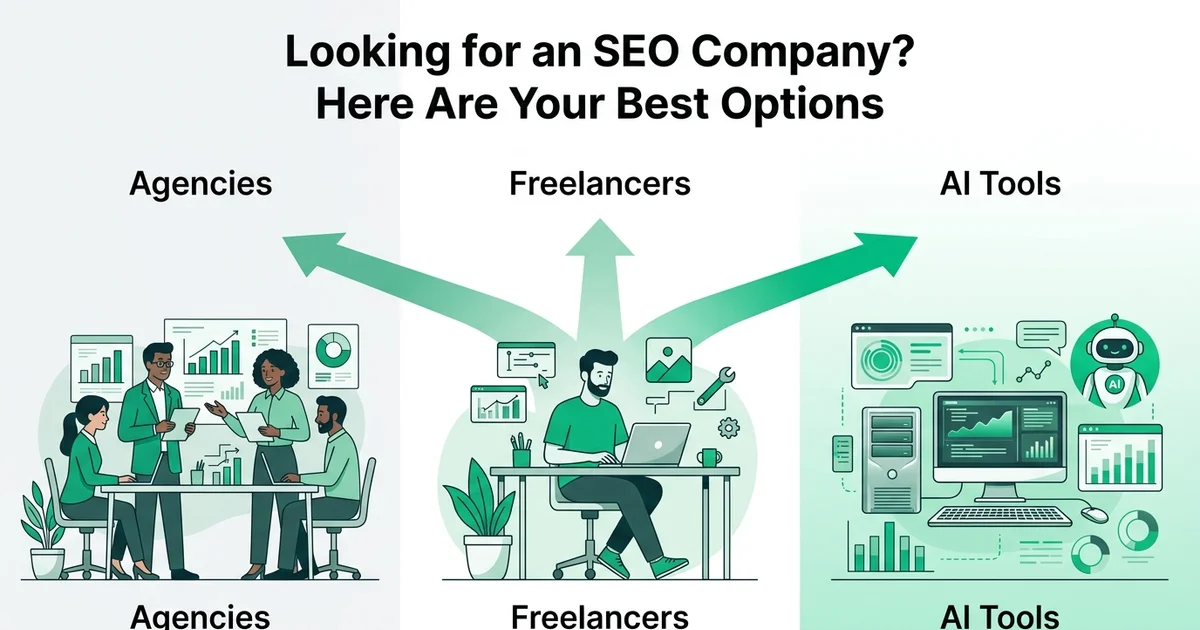
Looking for an SEO Company? Here Are Your Best Options
Introduction: why businesses seek SEO company alternatives
The SEO landscape has changed dramatically. Businesses that once had only one real option, hiring a traditional agency, now face a much richer set of choices: boutique freelancers, AI-powered platforms, and hybrid tools that automate what agencies used to charge a premium for.
The cost reality of traditional SEO agencies
Budget is often the first friction point. According to Searchbloom (2026), the average monthly SEO agency retainer sits at $3,209, and The Stacc (2026) reports that 63% of agencies charge between $500 and $5,000 per month. For solo founders and small teams, that range can feel wide and unpredictable.
Why AI-first tools are gaining ground
At RankHub, our analysis shows that businesses are increasingly turning to AI-powered platforms because they offer faster, more measurable ROI without the overhead of a full agency relationship. Tools that automate keyword research, content creation, and publishing compress timelines that once stretched across months.
Different businesses need different solutions
A bootstrapped founder has different needs than a marketing team managing multiple product lines. This guide compares agencies, freelancers, and software tools side by side so you can match the right solution to your actual situation, budget, and growth stage.
Quick comparison table: SEO solutions at a glance
Choosing the right SEO solution comes down to three factors: what you can spend, how fast you need results, and how much you want to manage. This table gives you a direct side-by-side view so you can filter options quickly.
| Solution Type | Monthly Cost Range | Time to Results | Management Effort |
|---|---|---|---|
| RankHub | $99–$299/month | 4–6 weeks | Low (autopilot) |
| Traditional SEO Agency | $2,000–$20,000 | 3–6 months | Low (hands-off) |
| Freelance SEO Specialist | $500–$3,000 | 2–4 months | Medium (ongoing direction) |
| AI-Powered Platforms | $49–$1,050 | 4–8 weeks | Low to Medium |
| Solution | Typical cost | Setup time | Best for |
|---|---|---|---|
| Traditional SEO agency | $1,500–$5,000+/month retainer | 2–4 weeks | Established businesses needing full-service strategy |
| Freelance SEO consultant | $75–$150/hour | 1–2 weeks | Project-based work, audits, one-off campaigns |
| RankHub (Starter Plan) | Entry-level flat rate | Same day | Founders and SMBs wanting automated weekly content |
| Outrank | Subscription-based | Fast | Content-focused teams scaling article output |
| SEObot | Subscription-based | Fast | Developers and technical users automating SEO |
According to Searchbloom (2026), most businesses pay between $1,500 and $5,000 monthly for agency retainers, making software alternatives significantly more accessible for lean teams.
Key differentiators to weigh:
- Publishing speed: RankHub delivers one new post every week on autopilot, with webhook integration removing manual steps entirely
- Human review options: Agencies offer editorial oversight; AI platforms like those covered in our best seo automation tools guide trade that for speed and cost savings
- Output metric: Flat-rate tools make cost-per-article predictable; hourly freelancers and retainer agencies do not
Why look for SEO company alternatives?
Traditional SEO companies deliver real results, but their cost structures, timelines, and opacity create genuine friction for founders and growing businesses. Understanding where the pain points cluster helps you choose a model that actually fits your situation.
High costs that strain SMB budgets
Retainer fees are the dominant pricing model in the industry. According to The Stacc (2026), 78.2% of agencies charge monthly retainers, with typical ranges running from $2,000 to $20,000 per month. For solo founders and small teams, that commitment is difficult to justify before results materialise.
Slow timelines and limited transparency
Agencies often take weeks to onboard, months to publish meaningful content, and longer still to report measurable ROI. Many clients receive summary reports rather than real-time visibility into what is being done and why.
The case for scalable, faster alternatives
Businesses increasingly want faster iteration, predictable output, and control without hiring full content teams. SEO autopilot tools that actually deliver results address exactly this gap, automating keyword research, content creation, and publishing so teams can scale without proportional headcount increases.
RankHub: AI-powered autopilot SEO content at scale
For SMBs and solo founders who want a genuine hands-off content engine, automated platforms streamline the entire SEO content workflow, from keyword research through to published articles, without requiring a dedicated team or agency retainer. This approach is a strong SEO agency alternative for businesses that need consistent output at a predictable cost.
Autopilot publishing that runs in the background
The core promise of such solutions is consistent, scheduled content without manual intervention. Depending on the plan, publishing frequency ranges from one post per week at entry level up to daily posts on higher tiers. Each cycle runs through 15 automated steps, covering keyword selection, content generation, image creation, and CMS delivery via webhook. For founders managing multiple priorities, that kind of structured cadence removes one of the biggest growth bottlenecks: the blank-page problem.
Integrated keyword research and conflict prevention
Unlike tools that handle only writing or only distribution, these platforms bundle AI keyword research directly into the workflow. Crucially, they include anti-cannibalization checks that prevent new articles from competing with existing content, a problem that quietly undermines many content programs. Native language support also means localized content reads naturally rather than like a translated draft.
Pricing and plan structure
Output-based pricing aligns well with the broader industry shift toward transparency. According to SEO Agency Pricing Models 2026 (2026), clients increasingly prefer knowing exactly what they receive for each dollar spent. Entry-level plans deliver this clarity at accessible price points, while premium tiers add backlink credits for authority building and dedicated support for teams that need a closer partnership.
Best for: SMBs and solo founders who want consistent, automated SEO content without managing writers or agencies. Consider alternatives if: You need technical SEO audits, link-building campaigns, or bespoke strategy work beyond content production.
Traditional full-service SEO agencies: when to hire them
Full-service SEO agencies are best suited to businesses with complex, multi-channel needs that require dedicated human expertise, strategic consultation, and ongoing account management. If your situation demands custom technical implementations, international SEO, or coordinated campaigns across content, links, and PR, an agency relationship makes sense.
- Pros
- Dedicated account manager and strategic consultation
- Multi-channel expertise (technical SEO, link building, content, PPC integration)
- Hands-off execution with regular reporting
- Proven track record and case studies available
- Can handle complex, enterprise-level requirements
- Cons
- High monthly cost ($2,000–$20,000 average)
- Slower time to first results (3–6 months typical)
- Less transparency into day-to-day work
- Minimum contract terms often required
- Overkill for simple content-focused SEO needs
What agencies actually cost
Budget expectations matter here. According to Searchbloom (2026), the average monthly agency retainer sits around $3,209, with hourly rates averaging $111. Critically, Webtonic (2026) notes that 63% of agencies price their retainers between $2,000 and $20,000 per month, meaning costs scale quickly with scope and seniority.
For most SMBs and solo founders, that pricing band is difficult to justify without a clear revenue case behind it.
When the investment is warranted
Agencies earn their fees in specific scenarios:
- Enterprise-scale strategies involving multiple stakeholders, markets, or product lines
- Custom technical implementations such as site migrations, JavaScript SEO, or structured data at scale
- Relationship-driven account management where a dedicated team learns your business over time
- Annual SEO budgets of $50,000 or more, where strategic guidance compounds meaningfully
Best for: Established businesses with complex SEO needs and the budget to match. Consider alternatives if: You primarily need consistent content output. An seo automation platform like RankHub will deliver better value at a fraction of the cost.
Freelance SEO specialists: flexibility and lower costs
Freelance SEO specialists sit between DIY and full-service agencies, offering targeted expertise without the overhead. They work well for audits, one-off projects, or part-time support, but they require more hands-on management than a retained agency relationship.
- Pros
- Lower cost than agencies ($500–$3,000/month typical)
- Direct communication with the expert doing the work
- Flexible engagement (hourly, project-based, or retainer)
- Good for audits, one-off projects, or part-time support
- Can scale up or down quickly
- Cons
- Availability and reliability can be inconsistent
- Limited to single-specialist expertise
- No backup if freelancer becomes unavailable
- Requires more hands-on management from your team
- Harder to scale beyond freelancer's capacity
Pricing and what to expect
According to SEO Pricing Guide: A 2026 Walk-Through (2026), roughly 34.8% of SEO providers bill hourly, while 48.9% use project-based fees. Hourly rates typically range from $50 to $150, making freelancers noticeably cheaper than agency retainers for short-term work.

Trade-offs worth considering
The cost savings come with real limitations:
- Variable quality and availability across the freelancer market
- No built-in team, so complex projects may require coordinating multiple specialists
- Limited scalability if your SEO needs grow quickly
- Consistent content output, in particular, is difficult to sustain through freelance arrangements alone. Platforms built for SEO automation ROI often deliver more reliable volume.
Best for: Businesses with specific, time-bound needs like a technical audit or a one-time content strategy sprint.
AI-powered SEO platforms: Outrank, SEObot, and competitors
For founders and marketing teams who need consistent content volume without the overhead of an agency or freelancer, AI-powered SEO platforms offer a compelling middle ground. These tools combine automated keyword research, AI writing, and direct CMS integrations into a single subscription, making them a natural fit for businesses scaling content on a tight budget.
See how Starter Plan compares when it comes to seo company Starter Plan.
- Pros
- Very low cost ($49–$1,050/month depending on volume)
- Fully automated keyword research and content creation
- Fast setup (1–3 days) and quick content publishing
- Consistent output without human bottlenecks
- Transparent, predictable pricing with no surprises
- Cons
- No strategic consultation or account management
- Content quality varies; requires editorial oversight
- Limited to content SEO; no link building or technical work
- Less customization for niche or highly competitive markets
- Requires internal team to monitor and optimize
Outrank and SEObot: what the pricing looks like
According to Outrank vs SEObot: A Detailed Comparison (2026), Outrank starts at $99/month for 30 articles, while SEObot ranges from $49/month for 9 articles up to $1,050/month for 300 articles. Both platforms normalize pricing per article, which makes budgeting more predictable than traditional agency retainers.
Key features shared across leading AI SEO platforms include:
- Automated keyword research built into the publishing workflow
- AI-generated, SEO-optimized articles published on a set cadence
- CMS and webhook integrations for hands-off delivery
- Emerging human review add-ons to reduce quality-control risk
Where RankHub fits in
In our experience at RankHub, the biggest friction point for SMBs is not finding keywords but sustaining output without burning internal resources. The RankHub Starter Plan addresses this directly with 15 automated monthly steps, anti-cannibalization keyword checks, and included featured images. For teams exploring what a dedicated ai seo agency alternative looks like in practice, this kind of full-stack automation is worth evaluating alongside Outrank and SEObot.
Best for: Businesses prioritizing content volume, faster time-to-publish, and predictable per-article costs over bespoke strategy.
Feature comparison matrix: agencies vs. AI tools vs. RankHub
Choosing between an SEO agency, an AI platform, and automated content tools comes down to what your business actually needs right now. This matrix maps the most decision-relevant criteria across all three categories so you can compare them on equal footing.
| Feature | Traditional Agency | Freelancer | AI Platforms (Outrank/SEObot) | Automated Content Tools |
|---|---|---|---|---|
| Keyword Research | Yes | Yes | Yes | Yes |
| Content Creation | Yes | Yes | Yes | Yes |
| Publishing Integration | Limited | Limited | Yes | Yes |
| Monthly Cost | $2,000–$20,000 | $500–$3,000 | $49–$1,050 | $99–$299 |
| Hands-Off Automation | No | No | Partial | Yes |
| Strategic Consultation | Yes | Limited | No | No |
| Account Management | Yes | Limited | No | No |
| Scalability | Limited | Very Limited | High | High |
| Setup Time | 2–4 weeks | 1–2 weeks | 1–3 days | 1–2 days |
Side-by-side comparison
| Criteria | SEO agency | AI platforms (Outrank, SEObot) | Automated Content Tools |
|---|---|---|---|
| Pricing model | Monthly retainer ($1,500–$10,000+) | Subscription, varies by volume | Flat subscription by tier |
| Cost per article | High (often $300–$800+) | Moderate, scales with usage | Low, predictable per-plan rate |
| Setup time | Weeks (onboarding, audits, contracts) | Days to a week | Near-immediate |
| Keyword research depth | Manual, expert-led | AI-assisted | AI-driven with anti-cannibalization checks |
| Publishing speed | Slow (review cycles, approvals) | Faster than agencies | Automated via webhook, minimal delay |
| CMS integrations | Manual or custom | Platform-dependent | Webhook publishing to any platform |
| Human review options | Full editorial oversight | Limited | Automated by design |
| Support level | Dedicated account manager | Ticket or chat support | Plan-based support |
| Scalability | Expensive to scale | Good volume capacity | Built for consistent, scalable output |
| Content localization | Requires specialist hire | Varies | Native language support included |
Where each option leads
According to Searchbloom (2026), most SEO agencies charge between $1,500 and $10,000 per month on retainer. That investment buys genuine strategic depth, custom deliverables, and a human account manager. For businesses with complex competitive landscapes, that trade-off makes sense. You can explore what that looks like in practice through our guide to SEO agencies that deliver measurable organic growth.
AI platforms like Outrank and SEObot close the gap on speed and volume, but pricing structures vary and human oversight remains limited.
Automated content tools sit in a distinct position: fully automated, low cost-per-article, and built around consistent monthly output. These solutions run 15 automated steps each month, including keyword research, article creation, featured images, and webhook publishing. According to The Stacc (2026), agencies rarely match this cost efficiency at scale, making such platforms a strong fit for founders and small teams who need predictable content output without the overhead.
Bottom line: Agencies win on strategy and custom work. AI platforms offer volume with moderate flexibility. Automated tools lead on automation, cost-per-article, and ease of deployment.
How to choose the right SEO solution for your business
Choosing the right SEO solution comes down to four variables: budget, timeline, internal expertise, and how much control you want over execution. Getting this decision wrong is costly, so a structured framework helps you match the right tool or service to your actual situation.
Solo founders and early-stage startups
If you are running a one-person operation, your biggest constraint is time, not money. AI-powered platforms offer the strongest ROI here because they remove the need for a dedicated content team entirely. Automating keyword research, article creation, and publishing through a tool like RankHub means you recover 40+ hours monthly that would otherwise go to manual SEO tasks.
SMBs with a defined marketing budget
For businesses spending between $5,000 and $15,000 per month on marketing, a hybrid approach often works best. According to Webtonic (2026), retainer-based pricing dominates agency contracts, which suits businesses with consistent, ongoing needs. Pairing a lightweight seo agency for technical audits and link building with an automation platform for content volume gives you strategic depth without overpaying for full-service management.
Enterprise teams
Larger organizations with complex site architectures and competitive markets typically need full-service agencies offering custom strategy, dedicated account management, and cross-channel integration.
Key questions to ask before deciding
- Do you have SEO expertise in-house? If not, automation or a managed service reduces your dependency on specialist knowledge.
- What is your content volume requirement? Volume-based pricing suits high-output needs, while retainers work better for steady, lower-volume strategies.
- How quickly do you need results? AI platforms deploy faster than agency onboarding, which typically takes four to six weeks.
Switching guide: how to migrate from your current SEO provider
Once you have chosen a new SEO solution, a structured migration prevents ranking losses and wasted effort. Moving carelessly between providers is one of the most common reasons businesses see traffic drops during transitions. Follow these steps to protect what you have already built.
Step 1: Audit your current position
Before cancelling anything, document your baseline. Export your current keyword rankings, organic traffic data, and backlink profile using tools like Google Search Console or Ahrefs. This snapshot becomes your benchmark for measuring whether the new provider is delivering progress.

Step 2: Export keyword targets and content calendar
Request a full data export from your existing provider. This should include target keywords, content briefs, and any scheduled publishing plans. Gaps in this handover are where content cannibalization risks emerge, particularly if your new platform lacks built-in conflict checks. RankHub's anti-cannibalization keyword checks are worth noting here, as they automatically flag overlapping targets before new content is commissioned.
Step 3: Set up integrations before going live
Configure your new tool or seo marketing agency with your CMS before the transition date. Webhook publishing, native CMS connectors, and user permissions should all be tested in a staging environment. Rushing this step is a leading cause of duplicate content and broken internal linking.
Step 4: Plan a content transition schedule
Map existing content to new keyword targets and decide what to keep, update, or retire. Avoid publishing large volumes of new content simultaneously, as search engines need time to process changes. A phased rollout over four to six weeks reduces volatility.
Step 5: Redirect and repurpose strategically
For any URLs being retired or restructured, implement 301 redirects to preserve link equity. Repurpose high-performing older content by updating it under your new provider rather than replacing it entirely. According to Searchbloom (2026), pricing transparency across providers has improved significantly, making it easier to compare cost-per-deliverable and ensure you are not paying twice for overlapping work during a transition period.
Step 6: Monitor closely during switchover
What we don't recommend: red flags in SEO services
Knowing what to avoid is just as important as knowing what to look for. Certain warning signs consistently predict poor results, wasted budget, and in the worst cases, Google penalties that can take months to recover from.
Guaranteed rankings or first-page promises
No legitimate SEO provider can guarantee specific rankings. Search algorithms change constantly, and any agency making ironclad promises is either misleading you or planning to use tactics that will eventually backfire.
Black-hat tactics
Private blog networks, link schemes, and keyword stuffing may produce short-term gains but carry serious long-term risk. Always ask providers to explain their link-building methodology before signing anything.
Suspiciously low pricing
According to Searchbloom (2026), credible SEO services rarely cost less than a few hundred dollars monthly. Offers around $50 per month typically signal templated, low-effort work with little strategic value.
No transparency, reviews, or case studies
Avoid agencies that cannot show reporting samples, client references, or documented results. Lack of evidence is itself evidence.
RankHub vs. traditional agencies: the deep dive
Choosing between an AI-powered tool and a traditional SEO agency is less about quality and more about what your business actually needs right now. Cost, speed, and control all look very different depending on which path you take.
AI automation wins on cost and speed; agencies win on complexity
If your primary need is consistent, hands-off SEO content at scale without breaking the budget, such solutions deliver. At $99–$299/month with full autopilot automation, this approach costs 90% less than traditional agencies while producing results in 4–6 weeks instead of 3–6 months. However, if your business requires multi-channel SEO strategy, link building, technical audits, or dedicated account management, a traditional agency remains the better choice despite the higher cost. The decision hinges on whether you need breadth (agencies) or depth in content automation (automated platforms).
Cost comparison
According to Searchbloom (2026), traditional agency retainers typically run between $2,000 and $20,000 per month. Automated content platforms start at the opposite end of that spectrum, beginning at $99 per month for weekly automated, SEO-optimized content with AI keyword research, featured images, and webhook publishing included. For founders and small teams watching every dollar, that gap is significant.
Speed and publishing cadence
Agencies often require weeks of onboarding, strategy alignment, and approval cycles before a single piece of content goes live. Automated platforms run 15 steps monthly and publish on a weekly to daily cadence depending on your plan, which means content is indexing while agencies are still drafting proposals.
Control and scalability
These tools are built for hands-off automation. You set parameters, the platform executes. Agencies, by contrast, require ongoing collaboration, briefings, and periodic renegotiation as your needs grow. Scaling with automation means upgrading to higher tiers. Scaling with an agency often means a new contract.
The hybrid approach worth considering
For most growing businesses, the smartest move is combining both. Use automated content tools to maintain consistent volume and fill keyword gaps without cannibalizing existing posts. Bring in an agency for periodic strategy audits, technical SEO, and link-building campaigns that require human judgment. You get speed and coverage from automation, and depth from expertise.
Frequently asked questions
How much does an SEO company cost per month?
According to SEO Pricing Guide: A 2026 Walk-Through (2026), most businesses pay between $2,000 and $20,000 per month, with an average closer to $2,917. Smaller retainers exist for local or niche work.
What does an SEO company do?
An SEO company handles keyword research, on-page optimization, technical audits, content creation, and link building. Some also manage reporting and competitor analysis.
Is it worth hiring an SEO company?
For most SMBs, yes, provided you track ROI through organic traffic growth and lead quality, not just rankings.
How long does SEO take to work?
Most businesses see meaningful results within three to six months, with compounding gains over twelve-plus months.
What is the difference between an SEO company and an SEO agency?
The terms are interchangeable in practice. Both offer professional SEO services, though "agency" sometimes implies a broader marketing scope.
How do I choose the best SEO company?
Prioritize transparency in reporting, clear pricing models, and proven experience in your industry.
Based on our work at RankHub, businesses that combine automated content tools with targeted agency support consistently outperform those relying on either approach alone.
More from Our Blog
Top Marketing Automation Platforms That Save Time & Money
Compare the best marketing automation software for SMBs and enterprises. See pricing, features, and expert recommendations to find your ideal platform.
Read more →
Why Your Content Isn't Ranking: The Content Optimization Fix
Master content optimization to boost SEO rankings and engagement. Learn root causes, 5 proven solutions, and prevention tactics for 2024-2025.
Read more →
Digital Marketing Online: Your Complete Roadmap to Success
Master digital marketing online with our comprehensive guide. Learn strategies, tools, and best practices to grow your business in 2025.
Read more →