
Let's get one thing straight: there's no magic number for how many keywords you should cram onto a page. It's a question I hear all the time, but it’s the wrong one to ask.
Instead, a solid rule of thumb is to build each page around one primary keyword. For shorter content, you can support it with 3-5 secondary keywords. For those big, in-depth articles, that number can easily climb to 15-30+ without breaking a sweat.
It’s a Strategy, Not a Headcount
Back in the day, SEO was a numbers game. We'd chase a specific keyword count, which usually led to clunky, overstuffed content that Google now actively punishes. Today, it’s all about creating a great user experience and being genuinely relevant. The real question isn't "how many keywords?" but "which keywords and where do they fit naturally?"
The right number really comes down to the page's job and its length. Your homepage, for example, is all about your brand. It should probably only target 3 to 5 of your most important core keywords. On the other hand, a massive 2,500-word blog post can easily and naturally include 15 to 30 different keywords because you’re diving deep into subtopics and answering a ton of related questions.
This image gives you a great visual of how recommended keyword usage stacks up against what we actually see in top-ranking content.
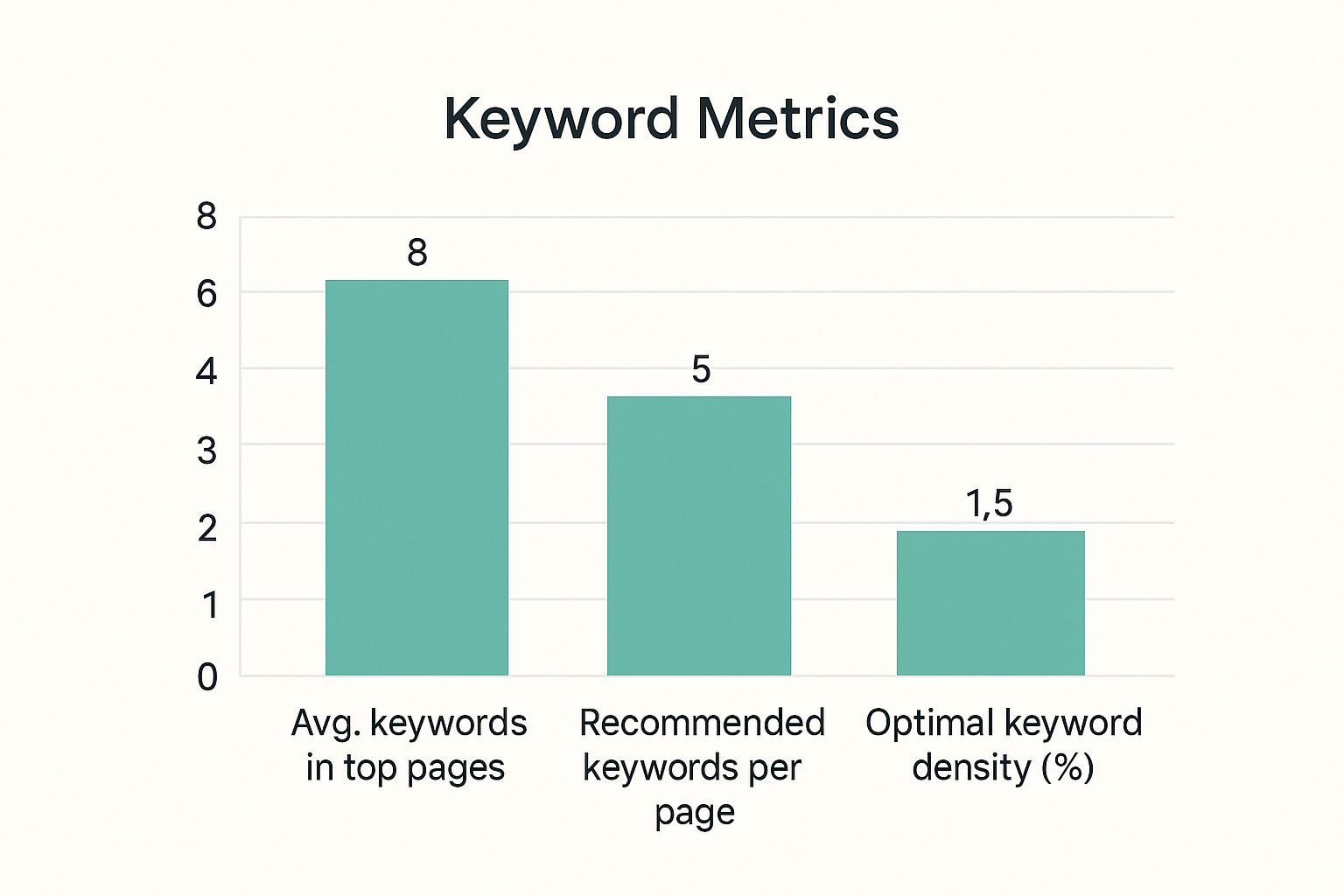
As you can see, the trend is crystal clear—quality and relevance have completely replaced quantity. The ideal keyword density is way lower than the stuffed-crust SEO tactics of the past.
Building a Simple Keyword Framework
Rather than obsessing over a final tally, think about your keywords in layers. Every single page needs a clear hierarchy. This structure tells both your readers and the search engines exactly what the page is about.
Here's how I break it down:
- One Primary Keyword: This is your North Star. It's the absolute core topic of the page and a non-negotiable. It has to be in your title tag, your main H1 heading, and right at the beginning of your content.
- A Handful of Secondary Keywords: Think of these as close cousins and synonyms of your primary keyword. They add much-needed context and help you show up for a wider range of related searches.
- A Bunch of Long-Tail Keywords: These are the longer, super-specific phrases, and they often look like questions people type into Google. They are gold for capturing traffic from people who are ready to act, and they fit perfectly into subheadings or an FAQ section.
My Two Cents: A good keyword strategy is like putting together an all-star team. Your primary keyword is the MVP. The secondary keywords are the solid, reliable supporting players. And the long-tail keywords? They're the specialists you bring in to win those very specific, high-stakes moments.
Keyword Count Quick Guide by Content Type
To make this even more practical, here’s a quick-glance table to help you match your keyword goals to your content type.
| Content Type | Typical Word Count | Recommended Keyword Count |
|---|---|---|
| Homepage | 500-1,000 words | 3-5 |
| Service Page | 800-1,500 words | 5-10 |
| Short Blog Post | 1,000-1,500 words | 8-15 |
| Long-Form Guide | 2,000-3,500+ words | 15-30+ |
This isn't a set of hard-and-fast rules, but it's a solid starting point based on what works. Let the topic and the user's intent guide you, and you'll find the right balance naturally.
As you start putting this into practice, you might wonder how things are changing with all the new AI tools out there. It’s a huge topic, and it’s worth exploring the potential impact of generative AI on search engines and SEO to stay ahead of the curve.
For an even deeper dive into this, don't forget to check out our full guide on https://rankhub.ai/blog/how-many-keywords-for-seo.
Finding Your Single Most Important Keyword

Before we even get into the weeds of how many keywords to sprinkle into a post, we need to nail down the one that really matters. I’m talking about your primary keyword. Every great piece of content I've ever seen or worked on has one. It's the North Star for your entire article.
This single phrase is the heart of your topic and perfectly matches what a user is actually looking for. Getting this part right is, without a doubt, the most important thing you'll do. It's not about chasing the highest search volume. It's about finding the right term for the person you're trying to reach. This one keyword shapes everything from your headline all the way down to your conclusion.
Let's Use a Real-World Bakery Example
Imagine you own a small, local bakery that’s famous for its custom cakes. A rookie mistake would be to go all-in on a massive term like "bakery." Sure, it gets a ton of searches, but you'll be competing with every grocery store and national chain imaginable. Plus, it doesn’t speak to your specialty.
A much smarter play is to get more specific. Your brainstorming process might look something like this:
- Broad (and bad): "custom cakes" – High volume, but the competition is brutal.
- Getting warmer: "custom cakes in [Your City]" – Better! Now you’re attracting local customers.
- The sweet spot: "custom birthday cakes for kids" – Perfect. This is someone with a clear need and their credit card probably in hand.
By targeting "custom birthday cakes for kids," you’re talking directly to a person who knows exactly what they want. You're no longer just a bakery; you're the solution to their very specific problem.
Key Takeaway: Your primary keyword needs to be a direct answer to a user's problem. The more specific it is, the better the traffic you'll get.
How to Know if You've Picked a Winner
Once you think you have the perfect primary keyword, don't just start writing. You need to check your work. It's simple, really. Just Google it.
Take a look at the first page of results. Who's ranking? Are you seeing huge national brands, or is it mostly other local shops like yours? If the search results are full of businesses on your level, that's a fantastic sign that you have a real shot at ranking. This quick reality check is often more valuable than staring at complicated keyword tools for hours.
The goal is to land on a term that is relevant, has crystal-clear user intent, and gives you a fighting chance to get on page one. If you want to dive deeper into this process, we have a complete guide on how to choose SEO keywords that walks you through every step.
Ultimately, picking that one perfect primary keyword is the foundation of your entire on-page SEO strategy. It keeps your content focused and purposeful. Everything else—all your secondary and long-tail keywords—will branch off from this solid base, helping you build an article that both users and search engines will love.
Building Authority with Secondary Keywords

Alright, you’ve picked your primary keyword. Now the real work begins.
Think of that primary keyword as the foundation of a house. It’s absolutely critical, but you can't live in a foundation. You need the walls, the roof, the different rooms—that's what makes it a home. In the world of content, those are your secondary keywords. They’re the supporting framework that gives your article real substance and context.
These related terms show search engines you’re not just superficially covering a topic; you’re exploring it from every angle. When Google’s crawlers see you talking about “how many keywords should I use for seo” and related ideas like “keyword density best practices” or “finding LSI keywords,” they get a clear signal. This content is a deep, valuable resource. That’s a massive part of what it takes to rank.
Uncovering the Best Supporting Keywords
You don't need to spend hours drowning in keyword tool data. While those tools are useful, some of the best secondary keywords are staring you right in the face on the search results page. Why? Because they show you exactly what real people are searching for around your topic.
Here are a few dead-simple ways I find these gems:
- Google's "People Also Ask" Box: This is pure gold. These are the exact questions your audience is typing into Google. If your main keyword is "cold brew coffee maker," you'll probably see questions like "is cold brew stronger than espresso?" or "how long does cold brew last?" Each one of those is a perfect H3 subheading for your article.
- Competitor Subheadings: Open the top three articles ranking for your primary keyword. Just scan their H2 and H3 subheadings. You’ll notice patterns and common subtopics right away—these are the things Google clearly expects to see in a top-ranking piece. Don't plagiarize, but let their structure inspire your own outline.
- Related Searches: Scroll to the very bottom of the Google results. That list of eight related searches is fantastic for understanding how people think about your topic and for finding different ways they phrase their searches.
My Pro Tip: I keep a simple doc open while I do this. After about 15 minutes of this kind of manual digging, I usually have a solid outline packed with secondary keywords that actually add value, instead of just being SEO filler.
How Many Secondary Keywords Is Enough?
There's no magic number, but I have a solid rule of thumb. For a standard blog post around 1,500 words, I shoot for 8-15 secondary keywords. If I'm writing a much longer, in-depth guide, that number can easily climb to 20 or more.
The point isn't to hit a quota. The real goal is to use these keywords to build out the logical sections and subtopics of your article.
Each secondary keyword should introduce a new idea, guiding the reader through the piece. This approach does more than just boost your SEO; it makes your content way more organized and readable for your audience. That's how you turn a simple blog post into a pillar page that ends up ranking for dozens of related terms.
Why Long-Tail Keywords Are Your Secret Weapon
Okay, let's get real. If your primary and secondary keywords are the foundation of your house, long-tail keywords are the front door, the welcome mat, and the comfy couch. It's where the real action happens.
While everyone else is duking it out over those big, flashy, high-volume terms, you can be smarter. You can sidestep that brawl entirely and connect with people who are actively looking for what you offer.
Think about it. Someone searching for "headphones" is just window shopping. But a person typing in "best noise-cancelling headphones for open offices"? They have a specific problem and are ready to pull out their wallet to solve it. They’re deep into the buying journey.
That’s the magic right there. Short-tail keywords attract browsers. Long-tail keywords attract buyers.
Tapping into High-Intent Searchers
Long-tail keywords are just more… human. They’re conversational. People often type full questions or super-detailed descriptions into Google, just like they’d ask a friend. When you focus on these, you stop guessing and start meeting people at their exact point of need.
Here’s a simple way to look at it:
- Broad Keyword: "SEO tools" (Tons of competition, vague intent)
- Long-Tail Keyword: "what is the best SEO tool for a small business" (Way less competition, sky-high intent)
When you target that second phrase, you can build a piece of content that speaks directly to that small business owner. The chances of them converting go through the roof. This is really the heart and soul of effective long-tail keyword research.
And the numbers don't lie. A staggering 91.8% of all search queries are actually long-tail keywords. Better yet, these super-specific searches tend to have conversion rates about 2.5 times higher than their shorter counterparts because you're automatically filtering out the casual looky-loos. You can dig into more eye-opening stats like this over at keyword.com.
Letting Questions Guide Your Content
One of my favorite tricks is to use question-based long-tails to build the entire outline of an article. When you find what people are asking, you can structure your content to give them the answers, plain and simple. This works so well for a couple of reasons.
First, it forces you to create a logical flow that's genuinely helpful for the reader. Each subheading can tackle a different question, making your post a super scannable, easy-to-digest resource.
My Takeaway: Building your content around long-tail questions is the closest you can get to having a direct conversation with your audience. You're anticipating their needs and delivering answers before they even have to dig for them.
Second, this strategy plays perfectly into how Google works now with semantic search and featured snippets. By answering common questions clearly and directly, you put yourself in a great position to show up in those "People Also Ask" boxes or even snag that coveted "Position Zero" spot.
So, stop worrying about "how many keywords should I use for SEO?" and start asking, "Which long-tail questions can I answer better than anyone else?" That little shift in mindset is what separates content that just exists from content that truly owns the search results.
Getting Keyword Placement and Density Just Right

Alright, you've done the hard work and have your list of primary, secondary, and long-tail keywords. Now comes the part where the rubber meets the road: execution. It’s one thing to know which keywords to use, but knowing where and how often to place them is what really separates content that ranks from content that just... exists.
Let's get one thing straight right away. SEO isn't about cramming your keyword into every sentence anymore. That old-school tactic, keyword stuffing, is the fastest way to get on Google's bad side. Today, it's all about weaving your keywords into the text so seamlessly that a human reader wouldn't even notice.
The name of the game is creating a valuable, natural reading experience. Search engines are smarter than ever; they understand context and intent, so a helpful, conversational tone will always win.
Where to Put Your Primary Keyword for the Biggest Bang
Think of your webpage as having prime real estate. There are certain spots where search engines expect to find the most important clues about your content. Dropping your primary keyword in these key locations sends a crystal-clear signal to Google about what your page is all about.
Here are the absolute must-haves for your main keyword:
- The Page Title (Title Tag): This is the big one. Get your primary keyword in here, and try to place it as close to the beginning as you can without it sounding weird.
- The Main Heading (H1 Tag): Your H1 tag should almost always include your primary keyword. It’s the first thing people see on the page and it confirms they’ve landed in the right place.
- The First 100 Words: Mention your keyword somewhere in the opening paragraph. It reinforces the topic for both your readers and the search crawlers right from the get-go.
- The URL Slug: A clean, simple URL that includes the keyword is a small but powerful signal (e.g.,
yourwebsite.com/keyword-placement-tips).
My Takeaway: Honestly, don't overcomplicate it. If you nail these four spots, you’ve done 80% of the heavy lifting for on-page keyword placement. The rest is just about letting it flow naturally.
Finding the Sweet Spot for Keyword Density
Once you have your strategic placements sorted, you might wonder about frequency. This is where keyword density comes in—it’s just the percentage of times a keyword shows up in your text compared to the total word count. While it's not the ultimate ranking factor it once was, it's still a useful guardrail to keep you on track.
More often than not, keyword density is a better signal of relevance than just counting how many times you used a term. For example, if you have a 1,000-word article and mention your keyword 20 times, that’s a 2% density. These days, a good rule of thumb is to aim for a density of around 1-2%. This range is generally seen as safe and effective. If you want to dive deeper, you can find more recommended keyword counts for SEO articles in this helpful guide.
You don’t need a fancy tool to check this. Just hit "Ctrl+F" (or "Cmd+F") in your document to see how many times you’ve used your keyword. Divide that number by your total word count, multiply by 100, and you’ve got your percentage. If you're in that 1-2% zone, you're golden. The goal is to be intentional, not obsessive. Natural writing always beats forcing numbers.
Your Questions on SEO Keywords Answered
https://www.youtube.com/embed/2wpwcB0yLeE
When you start digging into SEO keywords, a ton of "what if" questions inevitably pop up. It's easy to get stuck on the little details, but getting them right is what separates a strategy that works from one that falls flat.
Let's run through some of the most common questions I hear all the time. Think of this as your quick-reference guide to avoid those classic SEO mistakes.
Can I Use Too Many Keywords in an Article?
You absolutely can. This is what we call keyword stuffing, and it’s one of the oldest black-hat SEO tricks in the book—and trust me, it doesn't work anymore. Forcing keywords into your content makes it sound unnatural and, frankly, painful to read.
Google’s algorithms are smarter than ever. They’re designed to understand context and reward content that actually helps people, not content that’s just trying to manipulate rankings.
So, forget about hitting a specific number. Instead, write for your reader first. Let your keywords flow naturally within the sentences. As a general rule of thumb, keeping your keyword density around 1-2% for any single term is a safe bet. It’s enough to signal relevance to search engines without sounding like a robot.
Should Every Page on My Website Target a Different Keyword?
Yes, one hundred percent. This isn't just a good idea; it's a fundamental part of a solid SEO strategy. Every single page or post should have its own unique primary keyword.
Why? To avoid a nasty problem called keyword cannibalization. This happens when you have multiple pages on your site all trying to rank for the same exact search term. It's like making your own pages compete against each other. It confuses Google and splits your authority, which usually means none of the pages rank well.
Imagine you wrote two different articles both targeting "best running shoes." Search engines won't know which one is your main authority on the topic, so they might rank both of them lower.
A much better way to handle this is to get more specific. Create one page for "best trail running shoes" and another for "best marathon running shoes." Each page now has a clear, distinct purpose, which makes your site structure stronger and gives each piece a better shot at ranking.
This approach lets every piece of content own its niche and contribute to your site's overall authority without stepping on any toes.
How Often Should I Update My Keyword Strategy?
SEO is never a "set it and forget it" game. The online world changes constantly, so your keyword strategy needs to evolve with it. What brought you traffic six months ago might not be as effective today.
I always tell people to review their keyword performance at least once a quarter. This doesn't have to be a massive project, but you should be looking at a few key things:
- What's working? See which keywords are bringing in traffic and conversions. You might want to create more content around those topics.
- What isn't working? Identify the keywords that are stuck on page three or four. Maybe the content needs a refresh, or perhaps it's time to target a different term.
- What's new? Are there emerging trends or new customer questions popping up in your industry? These are your future opportunities.
Search behavior shifts, new competitors arrive on the scene, and your own business goals can change. A regular check-in ensures your strategy stays sharp and relevant. For your most important, money-making pages, I'd even suggest a quick monthly review. It's not overkill; it's just smart business.
Ready to stop guessing and start ranking? RankHub takes the manual labor out of keyword research. Our AI-powered platform analyzes your entire website in under 60 seconds to uncover high-value keyword opportunities you're missing. Get started today at RankHub.ai.
More from Our Blog
How to Choose the Right Digital Marketing Platform for Your Small Business
Step-by-step guide to selecting and setting up a digital marketing platform that automates content, social, and SEO for small businesses.
Read more →
7 Content Writing Tools That Boost Your SEO Rankings
Discover the top 9 SEO content writing tools to automate drafting, optimization, and publishing. Boost rankings with AI-assisted workflows.
Read more →
Zoho Marketing Automation Explained: Is It Right for You?
Compare Zoho Marketing Automation vs HubSpot on pricing, features, ease of use, and automation depth. See which wins for small teams and solo founders.
Read more →