
Building a killer keyword list isn't just about finding words; it’s about pinpointing the exact phrases your ideal customers are typing into Google. It's a mix of brainstorming, digging into data with research tools, spying on your competitors (ethically, of course), and then arranging everything into a clear roadmap for your content.
Your Keyword List Is Your SEO Blueprint
Before we get into the nuts and bolts, let's nail down why this matters so much. A solid keyword list is far more than just a jumble of terms in a spreadsheet. It’s the architectural plan for your entire SEO strategy.
Think of it this way: your keyword list is a direct line into your audience's brain. It shows you precisely what they're looking for, which lets you shape your content and website structure to give them exactly what they need. You stop guessing and start creating content that actually connects. It's how you attract the right kind of traffic—people who are already searching for the very solutions you offer.
The Real Impact of a Strategic Keyword List
When you have a well-researched list, you're building a bridge between your business and your customers' problems. Your content goes from being a shot in the dark to a calculated move designed to rank, attract, and convert.
The data doesn't lie. Organic search drives about 53% of all website traffic, and a smart SEO approach can pull in returns as high as 748%. To make your keyword list truly work as an SEO blueprint, you have to understand the bigger picture, which is covered in a comprehensive guide to blog search engine optimization. Building this foundation is what makes digital marketing a high-value investment. You can also read more about keyword tool market trends on cognitivemarketresearch.com.
Simply put, if you skip this step, you risk creating content that no one ever finds. With 62% of searchers admitting they will ignore businesses they can't find online, invisibility is a steep price to pay.
Ultimately, this blueprint is your guide to:
- Smarter Content Creation: It tells you exactly which blog posts, landing pages, and guides to create next. No more guesswork.
- A Serious Competitive Edge: You can uncover the high-value search terms your competitors are ranking for that you’ve completely missed.
- Better Conversion Rates: By attracting visitors with clear intent, you bring in more qualified leads and drive more sales.
Finding Your First Batch of Seed Keywords

Every great keyword strategy starts with a handful of core ideas. We call these seed keywords. Don't think of these as long, complicated search queries. They’re the big-picture topics that sit at the very heart of what you do. Think of them as the roots from which your entire keyword tree will grow.
The best way to find them isn't by guessing what people might be searching for. It's about putting yourself squarely in your customer's shoes and thinking like they do. The real goal here is to capture the actual words and phrases your audience uses when they're looking for a solution like yours. This first step is way more about human empathy than it is about fancy SEO software.
Ditch Your Assumptions and Start Listening
I can't stress this enough: the most powerful seed keywords come from real-life customer conversations, not from a brainstorm in a conference room. Your customers are literally telling you what they want, day in and day out. You just have to tune in. For example, what are the top three questions your sales team gets on every single demo call? That's a goldmine right there.
Here are a few places I always look for authentic seed keywords:
- Customer Support Tickets: Crack open your help desk software. What are the common threads? Look for recurring problems or questions. Pay close attention to the exact phrasing people use, because it's almost always different from your internal company jargon.
- Sales Team Chats: Your sales reps are on the front lines every day. Sit down with them and ask about the biggest pain points prospects bring up. What problems are they trying to solve? What features get them the most excited?
- Online Communities: Go hang out where your audience hangs out. Scour Reddit, Quora, and niche forums related to your industry. Search for your product category and just read. You’ll find raw, unfiltered questions and frustrations straight from the source.
My Two Cents: The quality of your entire keyword list hinges on how good your seed keywords are. When you start with real customer language, you build your whole SEO strategy on a foundation of actual user needs, not just what a tool tells you has high search volume.
How to Turn Problems into Keywords
Let's walk through a quick example. Imagine you sell project management software specifically for small creative agencies. A generic seed keyword like "project management tool" is a weak starting point. It’s just too broad.
But if you did your homework, your research might uncover more specific, problem-based ideas.
For instance, your support tickets might be full of questions about "how to track billable hours." A Reddit thread in r/advertising might have agency owners complaining about the nightmare of "managing client feedback."
Suddenly, you’ve got a much stronger set of seed keywords:
- billable hours tracking
- client feedback tool
- creative agency workflow
- project profitability for agencies
See the difference? This method ensures your keyword list is directly tied to solving real-world headaches right from the get-go. This is a core idea in any decent guide on how to do keyword research, and it's what separates a list that just looks good from one that actually brings in the right kind of traffic. These are the gems you’ll plug into your research tools to expand your list later.
Time to Power Up Your List With Research Tools

Alright, you’ve got your seed keywords—the authentic, gut-checked terms that really represent your brand. Now it’s time to let technology do the heavy lifting. Think of your initial list as the spark; research tools are the fuel that turns those few ideas into a massive, strategic database of opportunities.
These platforms are designed to multiply your efforts, uncovering hundreds—if not thousands—of related search terms you’d never stumble upon on your own. You'll need a solid platform to do this right, so it's worth exploring some of the best SEO tools to see what clicks for you. Here at RankHub, our AI automates a lot of this grunt work by analyzing your site's context to generate a highly relevant list in just a few minutes.
The Magic of Long-Tail Keywords
Your seed keywords are probably pretty broad, and that's okay. But the real gold is in the long-tail keywords. These are the longer, more specific phrases—usually three words or more—that people type into Google when they're much closer to making a decision or need a very specific answer.
Let’s go back to our e-commerce store selling eco-friendly cleaning supplies. A seed keyword might be something simple like "natural cleaner." But once we plug that into a tool, we start seeing all sorts of valuable long-tail variations pop up:
- "pet safe natural floor cleaner"
- "best natural cleaner for kitchen grease"
- "DIY natural glass cleaner recipe"
- "where to buy natural all purpose cleaner"
Sure, these terms have lower search volume on their own. The upside? They're way less competitive and attract people who know exactly what they want. Someone searching for a "pet safe natural floor cleaner" isn't just browsing; they have a specific problem and are ready to buy a solution.
My Two Cents: Don't ever look down on keywords with low monthly search volumes (MSV). I've seen terms with just 10-50 MSV become absolute powerhouses because they perfectly matched a niche product and solved a specific customer problem. These are often the easiest to rank for and can get you some quick, high-converting traffic.
Making Sense of the Metrics
Once your tool works its magic, you're going to see a huge list of keywords, each with a bunch of data points next to it. It can feel a little overwhelming, but understanding these numbers is the key to building a list that actually gets results.
Here are the three big ones you need to care about:
- Search Volume (SV or MSV): This is just an estimate of how many times a keyword gets searched each month. Bigger numbers are tempting, but they aren't everything.
- Keyword Difficulty (KD): Usually on a scale of 0-100, this number guesses how tough it will be to crack the first page of Google for that term. Lower scores are your friends.
- Cost Per Click (CPC): This tells you what advertisers are willing to pay for a single ad click. A high CPC is a dead giveaway that the keyword has strong commercial intent—people searching it are looking to spend money.
For our eco-friendly store, "natural cleaner" might have a whopping MSV of 10,000, but a brutal KD of 85. That's a mountain you don't want to climb.
But "best natural cleaner for kitchen grease" might have a more modest MSV of 250 and a KD of just 15. Now that's the sweet spot. It shows solid demand with a totally realistic chance to rank. It's all about balancing these metrics to find those high-potential keywords that fit your goals.
Finding Hidden Gems in Competitor Research

Why start from scratch when your competitors have already done half the work for you? They've poured time, money, and effort into figuring out which keywords actually attract customers. By looking at their strategy, you get a massive head start.
This isn’t about just copying what they do. Think of it as strategic intelligence. We're going to run a keyword gap analysis—which is just a cool way of saying we’ll find the valuable keywords your competitors are ranking for, but you aren’t. It’s one of the quickest ways I know to build a list of market-proven terms.
Who Are You Really Competing With?
First things first, let's get real about who your competition is. The brand you see as your biggest rival in the business world might not be your main opponent in the search results. Your true organic competitors are the websites that consistently pop up for the seed keywords you already identified.
For instance, say you sell artisanal coffee beans. Your main business competitor might be another local roastery down the street. But on Google? You're likely up against giants like Starbucks, popular coffee review blogs, and maybe even food bloggers with killer brewing guides.
To figure this out, just Google a few of your most important seed keywords and take note of the domains that show up on page one again and again. Those are the sites you need to be watching. If you're using RankHub, our Auto Research feature handles this for you, instantly pointing out the top domains fighting for your audience.
Digging for Keyword Gold in Their Strategy
Once you’ve got a list of three to five key competitors, it’s time to see what they’re up to. Using a good SEO tool, you can plug in a competitor’s domain and see a full list of the organic keywords that are sending them traffic. This is where things get interesting.
You’re basically getting a backstage pass to their entire content strategy. As you sift through the data, look for patterns and openings.
- Are they crushing it with question-based keywords you haven’t thought of?
- Have they built a whole content hub around a topic you’ve barely touched?
- What specific product terms are bringing them ready-to-buy visitors?
This isn’t just about finding keywords; it’s about finding terms with proven potential. If a keyword is working for a direct competitor, chances are it can work for you, too.
My Two Cents: It's tempting to chase the keywords with huge search volumes, but don't get distracted. The real money is often in the mid-volume, high-intent phrases. These are the terms people use when they're ready to pull out their wallets, and they convert way better than vanity keywords.
Finding That Competitive Sweet Spot
The final move is to pinpoint the "low-hanging fruit." I'm talking about keywords that one or more of your competitors rank for, but the competition level isn’t insane. The dream scenario is finding a relevant keyword where the top-ranking content is just... okay. Not unbeatable. You can get a much deeper look into this process in our guide on how to find low-competition keywords.
This is how you start to carve out your own territory. Maybe you find a competitor ranking on page one with a blog post from three years ago. That’s your cue. Go create something ten times better, more current, and more helpful.
By finding these gaps, you’re not just making a list of keywords. You’re building a smart, actionable plan to go out and capture more of your market.
How to Group and Prioritize Your Final List
Okay, so you've done the heavy lifting and now you're staring at a massive, sprawling list of potential keywords. It’s easy to feel like you've crossed the finish line, but honestly, this raw data is more overwhelming than it is useful.
The real magic happens now. This is where you switch gears from data collector to strategist. We're going to sift through this mountain of terms, group them logically, and figure out what to tackle first. Think of it as creating a clean, actionable roadmap that will guide your content for months to come.
From Messy List to Content Clusters
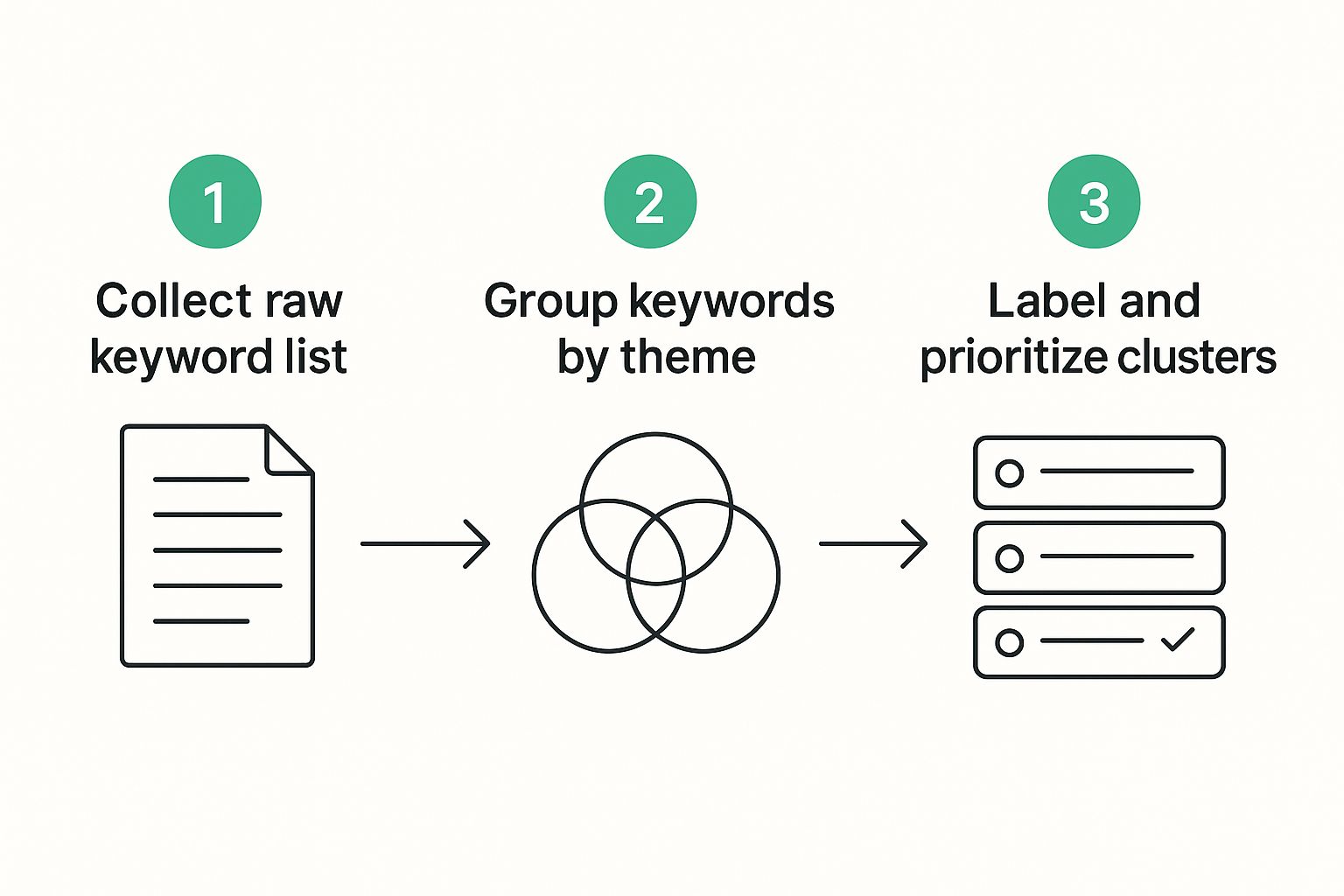
First things first, let's group these keywords by topic. This is what SEOs call topic clustering. Instead of chasing every keyword one by one, you bundle them together based on their shared theme. This approach lines up perfectly with how search engines work these days—they want to see that you're an expert on a whole subject, not just a single phrase.
Let’s say you run an online plant shop. A messy list isn't going to help you. Instead, you'd create clusters like these:
- Low-Light Houseplants: This bucket would hold terms like "best indoor plants for no sun," "snake plant care," and "zz plant benefits."
- Pet-Friendly Plants: Here, you'd toss in keywords like "non-toxic plants for cats," "safe houseplants for dogs," and "are spider plants poisonous."
You're taking a chaotic spreadsheet and turning it into a neat, thematic content plan. Suddenly, it’s much clearer where you should focus your energy.
Prioritizing Based on Intent and Opportunity
With your keywords all sorted into neat little groups, it's time to decide which clusters get your attention first. And no, it's not just about chasing the biggest search volume numbers. A truly smart strategy finds the sweet spot by balancing three critical factors.
- Relevance: How directly does this keyword cluster connect to your products or services? Always start with topics that are a bullseye for what you actually sell.
- Search Volume: Volume is still important, of course. It tells you there's real demand. Look for clusters where the combined search volume of all the related terms adds up to something meaningful.
- Competition (Keyword Difficulty): Let’s be realistic—how hard will it be to rank? Go after clusters with lower keyword difficulty scores to snag some quicker wins, especially if your website is still building authority.
My Two Cents: I’m always on the hunt for "Goldilocks" keywords. These are the terms with decent search volume (think 50-500 searches/month), sky-high relevance to my business, and low difficulty. They're your low-hanging fruit and can start bringing in the right kind of traffic way faster than going after super competitive head terms.
This balanced view helps you build a keyword strategy that delivers both short-term wins and long-term growth. Don't sleep on long-tail keywords. It's a wild statistic, but a massive 94.74% of all keywords get 10 or fewer searches per month. This means the biggest opportunities are hiding in those super-specific phrases.
Mapping Keywords to the Customer Journey
The final layer of your strategy is to map these keyword clusters to the different stages of the customer journey. This is how you make sure you're creating content that meets people exactly where they are, whether they’re just starting to poke around or have their credit card in hand.
- Awareness Stage (Informational Intent): These are broad, question-based searches. Think "why are my plant leaves turning yellow?"
- Consideration Stage (Commercial Intent): At this point, people are comparing their options. Keywords might look like "snake plant vs. spider plant" or "best low-maintenance indoor trees."
- Decision Stage (Transactional Intent): They're ready to pull the trigger. These are your "buy monstera plant online" or "plant delivery service near me" type of queries.
When you organize your list this way, you're not just creating content—you're building a complete funnel that guides people from their first question to their final purchase. This approach is absolutely fundamental, and our guide on how to choose SEO keywords dives even deeper into this.
Once your keyword list is properly grouped and prioritized, it becomes an incredible asset you can use to scale content creation without the guesswork.
Got Questions About Keyword Lists? I've Got Answers.
As you start pulling together your keyword list, a few questions always seem to come up. It's totally normal. Let's walk through some of the most common ones I hear so you can keep moving forward.
How Often Should I Update My Keyword List?
One of the biggest questions is about timing. Is this a one-and-done task? Definitely not. Your keyword list shouldn't just sit in a folder collecting digital dust. Think of it as a living document that grows with your business.
I tell my clients to do a big, comprehensive review at least once a quarter. But you should always be on the lookout for new ideas to add. Search trends change, new players enter the market, and your own priorities will shift. A regular check-in keeps your strategy sharp and focused on what people are actually searching for today.
Should I Bother Targeting My Own Brand Name?
Yes, a thousand times yes. I know it can feel a little strange—after all, you should already rank #1 for your own name, right? But targeting your branded keywords is a powerful defensive move.
It lets you completely control the conversation on that search results page. You can push competitors down, own the messaging, and direct people to the exact page you want them to see, like a special offer or a new product announcement. It's about owning your turf.
What About Those Super Low-Volume Keywords?
It's tempting to toss out any keyword with only 10 or 20 searches a month. Don't do it. These hyper-specific, long-tail keywords can be absolute gold.
Why? Because the person searching for something that niche knows exactly what they want. The buying intent is often through the roof.
My Take: I’d rather have a keyword that gets 10 searches a month from people ready to buy than a keyword with 1,000 searches from a crowd that's just browsing. These are often the easiest wins to capture.
Do I Really Need to Think About "Mobile Keywords"?
The old idea of separate "desktop" and "mobile" keywords is pretty much dead. Instead, it’s all about understanding how mobile behavior has changed all keyword research.
Today, more than 60% of all search traffic worldwide comes from mobile devices, and Google now primarily uses the mobile version of a website for indexing and ranking. This has made our search queries a lot more conversational. Think about how you use voice search on your phone.
In fact, the average Google search is around 3.4 words long, often phrased as a natural question. You can dig into more of the numbers in these Google search statistics from semrush.com. So, building a modern keyword list means thinking mobile-first, which really just means thinking in natural, human language.
Ready to build a high-impact keyword list without all the manual grunt work? RankHub uses AI to analyze your website and your competitors, spitting out a prioritized list of opportunities in less than a minute. Stop guessing and start ranking. Start your first AI-powered keyword research on RankHub today.
More from Our Blog
Zoho Marketing Automation Explained: Is It Right for You?
Compare Zoho Marketing Automation vs HubSpot on pricing, features, ease of use, and automation depth. See which wins for small teams and solo founders.
Read more →
Looking for an SEO Company? Here Are Your Best Options
Compare top SEO companies, AI platforms, and agencies. Find the best fit for your budget, from $49/month tools to full-service retainers.
Read more →
Marketing AI Tools Compared: Which Delivers Real Results?
Compare top marketing AI tools for SEO content creation. See pricing, features, and which tool fits solo founders, SMBs, and marketing teams.
Read more →