
So, what does "selecting keywords" really mean? It's about figuring out your business goals, getting into your customers' heads, and then finding the search terms that connect the two. You’re not just chasing traffic; you’re looking for the exact phrases that lead to sales, sign-ups, or whatever action matters most to you.
Build Your SEO Strategy Before You Brainstorm
I see people make this mistake all the time: they dive headfirst into a keyword tool without any real plan. Before you even glance at search volume or keyword difficulty, you absolutely need a strategy. This just means you need to be crystal clear about what "success" actually looks like for your business.

This first step has nothing to do with data and everything to do with empathy. You're trying to understand your customer's biggest headaches and the specific questions they're asking Google. Nail this foundation, and every keyword you choose later on will be tied to a real, measurable business goal.
Define Your Primary Business Goals
First things first: what are you actually trying to accomplish? Your answer here will completely shape the kinds of keywords you go after. "More traffic" is not a goal—it's a wish. Get specific.
Maybe your goals look something like this:
- Increase online sales for your new line of waterproof jackets.
- Generate qualified leads for your B2B software company.
- Boost brand awareness in the Midwest.
- Drive sign-ups for your weekly email newsletter.
You can't draw a map until you know your destination. An e-commerce store chasing sales will want transactional keywords like "buy insulated hiking boots," while a blog trying to build awareness will target informational searches like "how to choose hiking boots."
A keyword with 100,000 monthly searches is worthless if it doesn't attract people who will help you hit your business goals. Strategy always, always comes before volume.
Understand Your Audience and Their Journey
Once your goals are locked in, it’s time to think about your audience. Who are these people? What keeps them up at night? To effectively build your SEO strategy before brainstorming, understanding how to improve organic search ranking is key, because that’s the endgame of all this work.
This is where your keyword research connects to your overall marketing. When you truly know your audience, you can pick keywords that meet them at every step of their journey—from when they first realize they have a problem to the moment they're ready to buy.
To dive deeper into this, check out our complete guide on https://rankhub.ai/blog/how-to-create-content-strategy.
Kicking Off Your Keyword Brainstorm
Alright, this is where the fun starts. Forget about search volume, metrics, and spreadsheets for a minute. The first real step is to just get a bunch of raw ideas down on paper. We're building what’s called a "seed list"—the foundation for everything that comes next.
Think big picture. What are the core things you're all about? What do you actually sell or do? What problems are you solving for people? Just dump it all out without overthinking it. If you run a company that sells high-end coffee beans, your brain dump might look like this: "single-origin coffee," "espresso beans," "how to make cold brew," and "best coffee for french press."
Get Inside Your Customer's Head
Here's a hard truth: the words you use to describe your business probably aren't the words your customers are using. You need to get out of your own echo chamber and figure out what they're actually typing into Google.
The absolute best way to do this? Go talk to your sales or customer support teams. Seriously. These folks are on the front lines every single day, hearing exactly how real people talk about their needs and problems.
A quick 15-minute chat can uncover a goldmine. Ask them things like:
- What exact phrases do customers use when they call in with a problem?
- What are the top three questions people ask right before they decide to buy?
- Are there any common things people get wrong or seem confused about?
Their answers are pure gold. You might be focused on "ergonomic office solutions," but your customer service team will tell you that people are just asking for a "chair that doesn't hurt my back." That's the language you need.
My Two Cents: Don't just ask for a list of words. Ask for the stories behind them. The context of a customer's question often points to a whole cluster of related long-tail keywords you’d never come up with on your own.
Finally, do a little light snooping on your competitors. I'm not talking about stealing their entire strategy, but just seeing what they're focusing on. Look at their main navigation menu and their blog categories. It’s a super quick way to spot topics or angles you might have overlooked.
At this point, you should have a big, messy, beautiful list of ideas. Don't worry about organizing it yet. This raw list is exactly what we need for the next step, where we’ll start using data to find the real winners.
Find Untapped Keywords with Modern Tools
Alright, you've got your brainstormed list of seed keywords. Now for the fun part: letting technology do the heavy lifting. This is where we take that handful of ideas and blow it up into hundreds, even thousands, of potential keywords—each one loaded with data. The goal here isn't just to get a bigger list; it's to find the smarter terms that reflect how real people actually search.
Artificial intelligence has completely flipped the script on this. The market for these tools is exploding and projected to hit a whopping $1.2 billion by 2025. Why? Because we need smarter ways to analyze all those long-tail and local keywords. AI tools don't just spit out basic suggestions; they can get a read on search intent, understand the relationships between words, and even give you a peek into future trends.
Turning Your Seed List into Gold
Think of your seed list as the starting point. You'll plug those core terms into a tool like RankHub or even Google's Keyword Planner, and they’ll instantly generate a massive list of related searches, questions, and variations you'd probably never come up with on your own.
Let’s say one of your seed keywords is "home coffee brewing." You drop that into a tool, and it just blossoms. Suddenly you’ve got hundreds of real-world queries people are typing into Google.
Here's a look at what that might look like inside RankHub:

You can see how it moves way beyond your initial idea, uncovering gems like "pour over vs drip coffee" or "best coffee grinder for french press." And the best part? It comes with all the data you'll need to decide which ones are worth going after.
A great tool doesn't just expand your list; it reveals the entire universe of searches related to your topic. It’s your window into the conversational, question-based queries that show someone is ready to learn, buy, or act.
The right software gives you a serious strategic advantage by showing you exactly how your audience thinks and speaks. This data-driven expansion is how you'll find those hidden keywords your competitors are sleeping on. If you're looking for the right tool for the job, check out this guide on the best keyword research software to see what fits your workflow.
Alright, you've got a giant list of keywords. Feels good, right? But here's the thing—a huge list is mostly just noise. The real magic happens when we start trimming the fat and finding the keywords you can actually win. This isn't about hoarding data; it's about making smart, strategic decisions.
The goal is to find that sweet spot between three key things: search volume, keyword difficulty, and relevance. A keyword with 50,000 monthly searches is completely useless if the competition is untouchable or it brings the wrong kind of people to your site.
This visual gives you a great idea of what I mean.
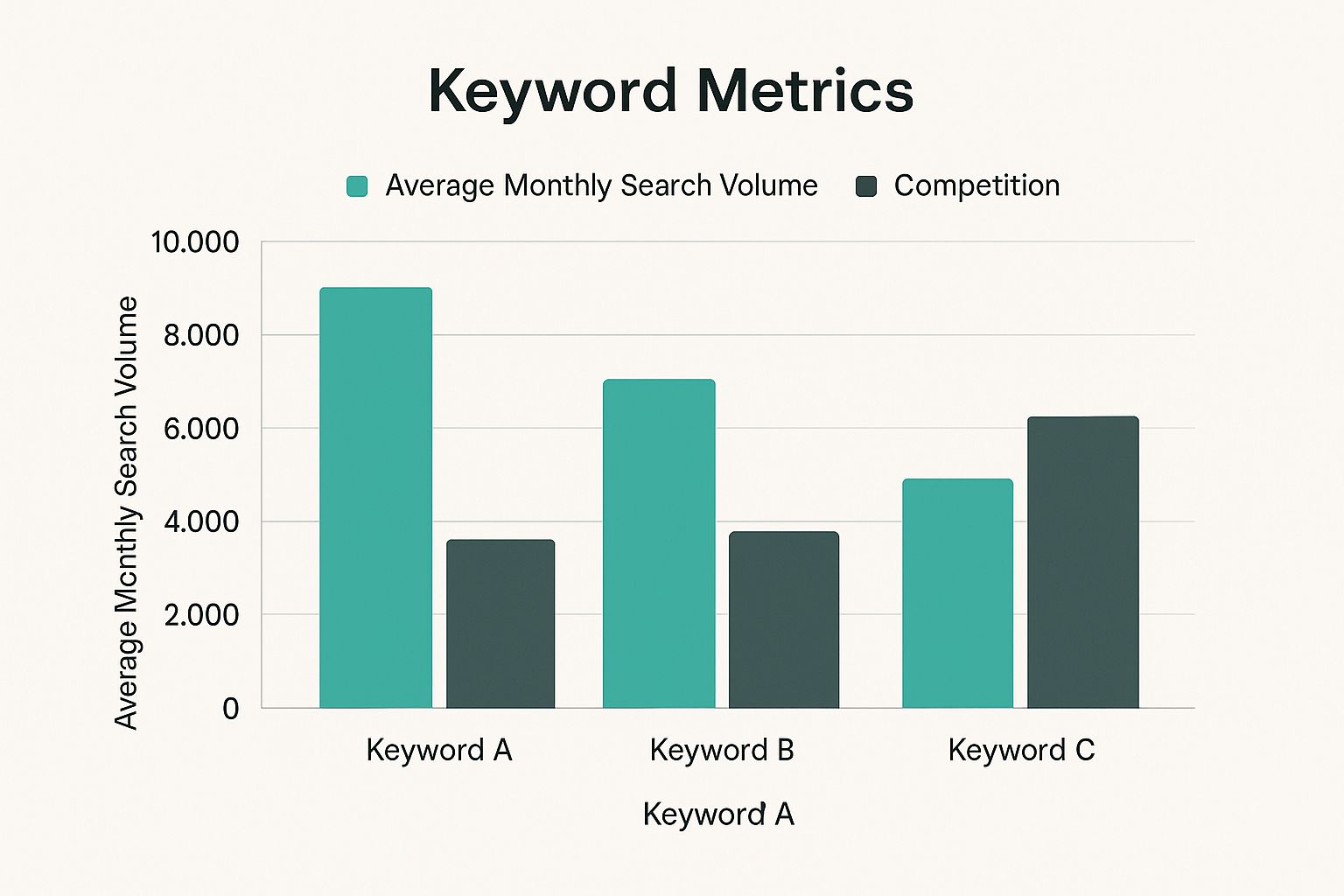
See how Keyword C is the clear winner? It’s not about chasing the biggest numbers. It’s about finding the right opportunity. That's where you'll get the best return on your effort.
To help you get a handle on these metrics, here's a quick reference table.
Keyword Metrics at a Glance
| Metric | What It Means | Why It Matters |
|---|---|---|
| Search Volume | The estimated number of times a keyword is searched for in a month. | High volume can mean more traffic, but it's not the only thing that counts. |
| Keyword Difficulty | A score (usually 0-100) that estimates how hard it is to rank on page one for the term. | This helps you find realistic targets. A low score is a great starting point for newer sites. |
| Relevance/Intent | The why behind the search. Is the user looking to learn, compare, or buy? | This is everything. Matching your content to the user's intent is how you convert visitors into customers. |
Understanding these three pillars is the foundation of building a keyword list that actually works.
Focus on What People Actually Want (Intent)
It’s so easy to get mesmerized by big search volume numbers, but I'm telling you, search intent is where the real value is. You have to get inside the searcher's head and figure out why they typed that phrase into Google.
Once you understand their goal, you can create content that perfectly matches it. I like to group my keywords into a few simple buckets:
- Informational Intent: People are looking for answers. Think "how to change a tire" or "what is a 401k." These are perfect for creating helpful blog posts and in-depth guides.
- Transactional Intent: These folks are ready to pull out their wallets. They're searching for terms with words like "buy," "deal," or "pricing." You'll want to aim these keywords at your product or service pages.
- Navigational Intent: This is when someone is just trying to get to a specific site, like searching for "Facebook login" or your brand name.
Don't just chase volume. Look at the search results for your target keywords. Are they all dominated by huge, household-name brands? If so, that's a sign the competition might be too fierce, and you should probably look for a different angle.
Build a Balanced Keyword Portfolio
I like to think of my final keyword list as a stock portfolio. You wouldn't put all your money into one risky stock, right? The same goes for keywords. A healthy, resilient SEO strategy needs a mix of different keyword types.
Your final, refined list should have a little bit of everything:
- Head Terms: These are the big, ambitious, one- or two-word phrases like "CRM software." They're tough to rank for, but the long-term traffic potential is massive.
- Medium-Tail Keywords: A little more specific, like "CRM for small business." These often hit that perfect balance between decent search volume and manageable competition.
- Long-Tail Keywords: These are super-specific, low-volume queries like "best CRM for real estate agents in Texas." They're way easier to rank for and often have incredibly high conversion rates because the intent is crystal clear.
One of my favorite tricks for finding gold is to see what my competitors are ranking for that I'm not. A keyword gap analysis is perfect for this—it shows you proven keywords you can start targeting to siphon off some of their traffic.
After you've gone through this whole process, you'll be left with a lean, powerful, and truly actionable keyword list.
Mapping Keywords to Your Content Plan
Alright, you've done the heavy lifting and now you have a solid list of keywords. So, what's next? This is where the magic happens. We're going to turn that list from a simple spreadsheet into a powerful content roadmap that actually gets results.

It's all about giving every keyword a home and connecting your research to real pages on your website. This is how you make sure every piece of content you create has a clear purpose and a fighting chance to rank.
Go for the Quick Wins: Prioritize Long-Tail Keywords
I know it’s tempting to go after those big, flashy keywords with tons of search volume. But trust me, that's usually a tough, uphill battle, especially if you're not a huge brand. The real gold is in the long-tail keywords.
These are the longer, super-specific phrases people type into Google. They might not have massive volume, but they signal exactly what the user wants. Think about it: only a minuscule 0.0008% of keywords get over 100,000 monthly searches. On the flip side, nearly 95% get 10 or fewer.
Long-tail keywords (phrases with three or more words) actually make up over 29% of all keywords with more than 10,000 monthly searches. Because the competition is lower and the user's need is so specific, they almost always convert better than broad terms.
Create a Simple Keyword Map
Let's not overcomplicate things. A keyword map is just a simple spreadsheet that assigns a primary keyword and a few related secondary terms to each important page on your site. It's your single source of truth for your content strategy.
Here’s what I usually include in mine:
- URL: The page you're targeting.
- Primary Keyword: The main term this page should rank for.
- Secondary Keywords: 2-3 closely related terms to support the main topic.
- Search Intent: Is the user just looking for info, or are they ready to buy something?
Think of it like giving every page a job. Your homepage's job is to rank for your brand name. A blog post's job is to rank for a specific question your customers are asking. This simple step prevents you from accidentally making two pages compete against each other for the same keyword—a common mistake I see all the time.
To really put this plan into action, you'll want to organize it into a content calendar. If you need a starting point, check out this guide on building a content calendar template in Excel. This is what turns your keyword list into a concrete plan and gets you the results you've been working for.
Common Questions I Hear About Picking Keywords
When you first dive into keyword research, a few questions always seem to come up. I've heard them countless times from clients and in workshops. Let's clear the air on a couple of the big ones so you can keep your strategy on track.
How Many Keywords Should a Single Page Go After?
This is probably the most common question I get. The simple answer? You should focus on one primary keyword per page. That’s your main target, the phrase you want to be known for.
Then, you can back that up with maybe two to four secondary keywords. These are usually long-tail variations or closely related terms that add depth. Think of them as supporting actors that help tell the whole story of your page.
A huge mistake I see people make is trying to cram a dozen different keywords onto one page. It just doesn't work. You end up diluting your message, confusing Google, and ranking for nothing at all. Keep it focused.
What’s the Real Difference Between a Keyword and a Topic?
It's easy to get these two mixed up, but the distinction is pretty important for modern SEO.
A keyword is the exact phrase someone types into Google. Something specific like, “best running shoes for flat feet.” A topic, on the other hand, is the much broader subject that keyword belongs to. In this case, the topic might be "running shoes" or even "marathon training essentials."
These days, SEO is all about building topical authority. You don't just target one-off keywords anymore. The goal is to create a whole "cluster" of content around a main topic, covering all the related keywords. This signals to search engines that you're the go-to expert on that subject.
Ready to stop guessing and start ranking? RankHub uses AI to analyze your entire site and generates a prioritized keyword strategy in under a minute. Find your winning keywords today.
More from Our Blog
Zoho Marketing Automation Explained: Is It Right for You?
Compare Zoho Marketing Automation vs HubSpot on pricing, features, ease of use, and automation depth. See which wins for small teams and solo founders.
Read more →
Looking for an SEO Company? Here Are Your Best Options
Compare top SEO companies, AI platforms, and agencies. Find the best fit for your budget, from $49/month tools to full-service retainers.
Read more →
Marketing AI Tools Compared: Which Delivers Real Results?
Compare top marketing AI tools for SEO content creation. See pricing, features, and which tool fits solo founders, SMBs, and marketing teams.
Read more →