Marketing Automation Software Explained: Features, Benefits & Selection
Introduction: why marketing automation software matters now
Marketing automation software has moved from competitive advantage to baseline expectation in a remarkably short time. At RankHub, our analysis shows that businesses adopting automation consistently outpace those relying on manual processes, particularly when it comes to content output, lead nurturing, and revenue growth.
A market growing at remarkable speed
The numbers tell a compelling story. According to Statista (2024), the global marketing automation market was valued at USD 6.65 billion in 2024 and is projected to reach USD 15.58 billion by 2030. That trajectory reflects genuine business demand, not hype.
Adoption has reached a tipping point
According to Digital Silk (2025), 76% of companies now use marketing automation in some capacity. At that level of adoption, automation is no longer optional. Businesses that delay risk falling behind on lead generation, personalization, and scalable revenue growth.
The shift toward AI-powered workflows
The latest generation of tools goes well beyond scheduled emails. AI-powered platforms now handle keyword research, content creation, audience segmentation, and campaign optimization autonomously. This shift means smaller teams can execute strategies that once required entire departments, making automation especially critical for solo founders, growing startups, and lean marketing teams.
What is marketing automation software: definition and core purpose
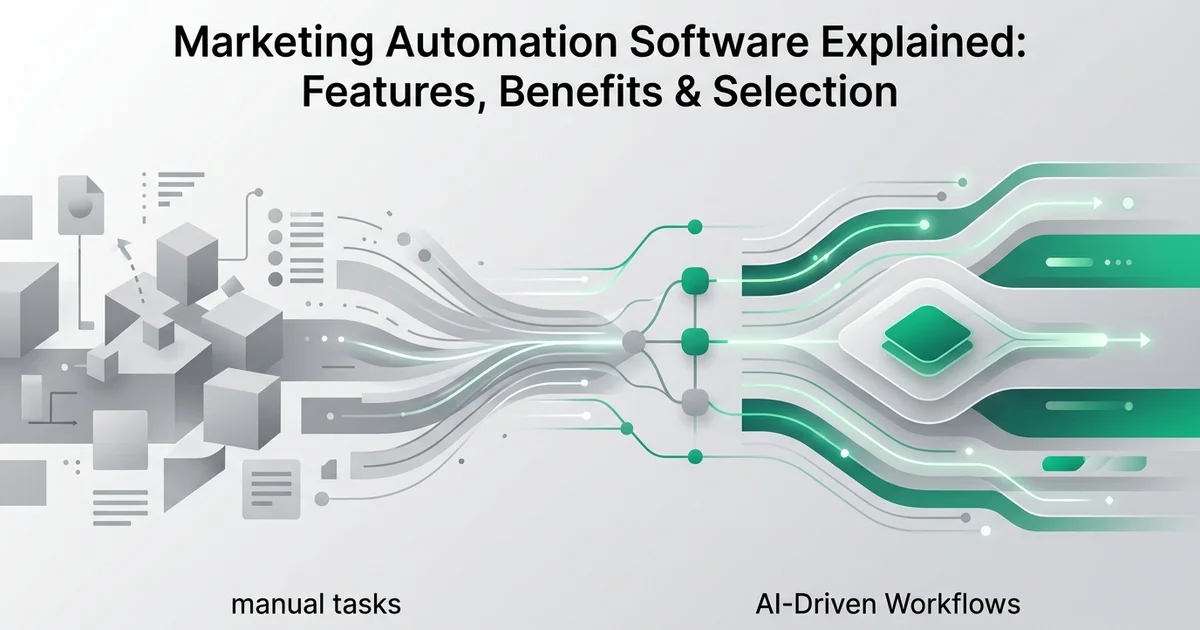
Marketing automation software is a technology platform that replaces repetitive, manual marketing tasks with rule-based or AI-driven workflows. Instead of sending emails one by one or manually posting to social channels, the software executes those actions automatically, based on triggers, schedules, or audience behavior.
Core definition and how it works
At its most fundamental level, marketing automation software connects your audience data to your communication channels and acts on that data without requiring human intervention at every step. A prospect downloads a whitepaper, and the system immediately enrolls them in a nurture sequence. A customer goes quiet for 30 days, and a re-engagement campaign launches automatically. According to MoEngage (2025), businesses that adopt marketing automation see measurable improvements in lead quality and campaign consistency, precisely because human error and delays are removed from the equation.
Channels it orchestrates
Modern platforms coordinate touchpoints across multiple channels simultaneously, including:
- Email and SMS for direct, personalized outreach
- Social media for scheduled posts and paid audience targeting
- Web personalization for dynamic on-site content
- Conversational tools such as chatbots and in-app messaging
This multi-channel coordination is what separates a true content marketing automation platform from a simple scheduling tool.
Marketing automation vs. CRM: a critical distinction
Many teams conflate marketing automation with CRM software, but the two serve different purposes. A CRM stores and manages customer relationship data. Marketing automation acts on that data, using it to trigger campaigns, score leads, and personalize journeys at scale. The two systems are complementary, not interchangeable, and most mature marketing stacks integrate both.
The role of lead nurturing and personalization
Beyond broadcasting messages, marketing automation excels at guiding individual prospects through a buying journey. By tracking behavior, segmenting audiences, and delivering relevant content at the right moment, the software creates personalized experiences that manual processes simply cannot replicate at scale. This capability is the foundation of effective demand generation for solo founders and lean teams alike.
Types of marketing automation software: choosing the right fit
Not all marketing automation platforms are built the same way. The right fit depends on your team size, technical resources, and the channels you need to manage. Understanding the major categories helps you avoid overpaying for features you will never use or underinvesting in a platform that cannot scale with you.
Email marketing automation platforms
These tools focus almost exclusively on email workflows, list segmentation, and triggered campaigns. They are typically the most affordable entry point and work well for businesses whose primary channel is email. Think welcome sequences, abandoned cart reminders, and re-engagement flows built around subscriber behavior.
Full-stack marketing automation suites
Full-stack platforms combine email, SMS, social media scheduling, landing page builders, and analytics under one roof. They suit growing marketing teams that need a single source of truth across multiple channels. The trade-off is complexity: these suites often require dedicated onboarding time and a steeper learning curve.
AI-powered and agentic automation systems
The newest category involves platforms that do not just execute predefined workflows but actively optimize them. Agentic systems can adjust send times, rewrite subject lines, and reallocate budget based on real-time performance data. For seo content automation software, this same logic applies: tools like RankHub Autopilot research keywords, write SEO-optimized articles, and publish them on schedule without requiring manual input at each stage.
No-code and low-code platforms
Solo founders and lean teams benefit most from drag-and-drop automation builders that require no engineering support. These platforms prioritize speed to launch over deep customization, making them ideal for validating campaigns quickly.
Industry-specific solutions
E-commerce brands, SaaS companies, B2B organizations, and nonprofits each have unique funnel structures. Industry-specific platforms embed logic that matches those structures natively, reducing the configuration work required to get meaningful results.
How marketing automation software works: the mechanics behind the platform
Marketing automation software operates by connecting data inputs to predefined actions through a rules-based engine. When a contact meets a specific condition, the platform executes a response automatically, without human intervention. Understanding the core mechanics helps teams configure workflows that actually reflect how buyers behave.
The workflow builder: triggers, conditions, and actions
Every automation starts with a trigger, an event that initiates a sequence. A contact downloading a whitepaper, visiting a pricing page, or abandoning a cart can each fire a workflow. From there, conditions filter which contacts proceed, and actions define what happens next: sending an email, updating a record, assigning a task to sales.
Most modern platforms present this logic visually, using drag-and-drop canvas builders where teams can map multi-step sequences without writing a single line of code.
Lead scoring and segmentation logic
As contacts move through workflows, the platform assigns scores based on behavioral signals: email opens, page visits, form submissions, and content downloads. Contacts crossing a score threshold can be automatically routed to sales or placed into a higher-priority nurture track.
Segmentation layers on top of scoring, grouping contacts by firmographic data, lifecycle stage, or engagement history. This ensures every message reaches the right audience at the right moment.
CRM and CDP integration
Automation platforms rarely operate in isolation. They sync bidirectionally with CRM systems to keep contact records current, and increasingly connect with customer data platforms (CDPs) to unify behavioral data from every touchpoint. This integration eliminates manual data entry and gives sales teams full visibility into marketing activity.
AI and machine learning in real time
According to Digital Applied (2026), AI adoption within marketing automation is accelerating rapidly, with platforms now using machine learning to optimize send times, predict churn risk, and surface next-best-action recommendations dynamically.
This same principle applies beyond email. Platforms like RankHub Autopilot apply automated scheduling and AI-driven content sequencing to SEO workflows, ensuring content is researched, written, and published on a consistent cadence without manual intervention. For teams exploring seo automation for content teams, this represents the same trigger-condition-action logic applied directly to organic search.
Key benefits of marketing automation software: quantified outcomes
The business case for marketing automation software is well-documented and measurable. Across lead generation, conversion rates, and return on investment, organisations that adopt these platforms consistently outperform those relying on manual processes. The numbers are compelling enough to make a strong argument for any growth-focused team.

Lead generation: more qualified prospects, faster
One of the most cited statistics in this space is striking. According to Amra & Elma (2025), businesses using marketing automation generate 451% more qualified leads than those that do not. This is not simply a volume increase. Automation enables smarter segmentation and lead scoring, so the prospects reaching your sales team are genuinely ready to buy.
Conversion and pipeline improvements
The downstream impact on conversions is equally significant:
- 80% of marketing automation users report improved lead generation outcomes
- 77% see a direct increase in conversion rates after implementation
- Automated nurture sequences keep prospects engaged across longer buying cycles without requiring manual follow-up
Return on investment: the financial case
According to Digital Applied (2026), marketing automation delivers an average return of $5.44 for every $1 spent over a three-year period, representing a 544% ROI. For SMBs and solo founders operating with lean budgets, that figure reframes automation from a cost to a core growth investment.
Time savings and personalisation at scale
Beyond revenue metrics, automation eliminates repetitive manual tasks, freeing teams to focus on strategy and creative work. Platforms can simultaneously deliver personalised content and offers to thousands of prospects, something no human team could replicate manually. For content-heavy workflows, tools like RankHub Autopilot extend this same logic to SEO, automating keyword research, article writing, and scheduled publishing to save 40 or more hours per month. Pairing that with a structured seo content calendar automation approach compounds these efficiency gains further.
Challenges and limitations: what to watch out for
Marketing automation software delivers real gains, but it is not without friction. Teams that go in without a clear plan often encounter steep learning curves, data problems, and integration headaches that slow adoption and erode ROI before the platform ever reaches its potential.
Implementation complexity and the learning curve
Most platforms require significant configuration before they produce results. New teams frequently underestimate the time needed to map workflows, build segments, and test sequences properly. Budget for onboarding time, not just subscription costs.
Data quality and list hygiene
Automation amplifies whatever data you feed it. Outdated contacts, duplicate records, and missing fields produce misfired campaigns and deliverability penalties. Regular list audits are non-negotiable.
Over-automation and impersonal messaging
Poorly configured workflows generate generic, high-frequency messages that feel spammy. Audiences disengage quickly. Every automated touchpoint should still feel intentional and relevant to the recipient.
Integration with legacy systems
Connecting automation tools to older CRMs or disparate platforms often requires custom development. For small businesses exploring their first online marketing platform for small businesses, prioritising tools with native integrations reduces this risk considerably.
Cost considerations for smaller teams
Entry-level plans can appear affordable, but costs scale with contact volume and feature tiers. Startups should map expected list growth against pricing models before committing.
How to get started with marketing automation: a practical roadmap
Getting started with marketing automation does not need to be overwhelming. A structured, phased approach helps teams of any size move from zero to operational without wasting budget or burning out. According to Digital Applied (2026), businesses that follow a deliberate implementation process see significantly faster time-to-value from their platforms.
Explore what RankHub Autopilot offers for marketing automation software RankHub Autopilot.
Step 1: Audit your current marketing stack and identify pain points
Before purchasing any software, document what tools you already use, where manual tasks slow your team down, and which customer touchpoints have no automation at all. This audit prevents redundant spending and clarifies exactly what you need to solve.
Step 2: Define your ideal customer profile and buyer journey stages
Map out who your customers are and how they move from awareness to purchase. Automation workflows are only as effective as the segmentation logic behind them. Without clear journey stages, even sophisticated platforms produce generic, low-converting sequences.
Step 3: Choose a platform that matches your budget, team size, and use cases
Solo founders and small teams should prioritise platforms with low entry costs, intuitive interfaces, and strong native integrations. Avoid over-investing in enterprise features you will not use for 12 to 18 months. Pairing your marketing automation platform with best seo automation tools compounds your organic reach without adding headcount.
In our experience at RankHub, the teams that scale fastest combine email and CRM automation with automated SEO content publishing. RankHub Autopilot handles keyword research, article writing, and scheduled publishing automatically, saving 40-plus hours per month that would otherwise go toward manual content production.
Step 4: Migrate and clean your contact data
Dirty data is one of the most common reasons automation campaigns underperform. Before migrating contacts, remove duplicates, correct formatting errors, and segment lists by engagement history and lifecycle stage.
Step 5: Build your first automation workflows
Start with three high-impact sequences:
- Welcome series: Introduce new subscribers to your brand and set expectations.
- Lead nurture: Deliver educational content that moves prospects toward a decision.
- Re-engagement: Win back dormant contacts before removing them from your list.
Step 6: Monitor performance and iterate
Track open rates, click-through rates, conversion rates, and unsubscribe rates from day one. According to inBeat Agency (2025), companies that regularly review and optimise their automation workflows consistently outperform those that set campaigns live and leave them unchanged. Schedule monthly performance reviews and treat every workflow as a living asset.
Best practices for marketing automation: expert-level strategies
Once your automation is live and performing, the difference between average results and exceptional ones comes down to discipline and craft. These expert-level practices separate marketers who get incremental gains from those who build compounding, long-term growth engines.
Segment ruthlessly
Generic workflows produce generic results. Build micro-targeted sequences for each buyer persona, using firmographic data (company size, industry, revenue) alongside behavioral signals like pages visited and content downloaded. The more precisely you define your audience segments, the more relevant your messaging becomes.
Personalize beyond the first name
First-name personalization is table stakes. True personalization draws on purchase history, browsing behavior, intent signals, and lifecycle stage. A prospect who has visited your pricing page three times deserves a fundamentally different message than someone who just downloaded a top-of-funnel guide.
Test and optimize continuously
A/B test subject lines, send times, calls to action, and message length. Never assume a winning variant will hold forever. Audience preferences shift, and regular testing keeps your automation sharp.
Maintain strict list hygiene
Inactive contacts drag down deliverability and skew your performance data. Regularly suppress or remove contacts who have not engaged in 90 to 180 days, and honor unsubscribe requests immediately. According to MoEngage (2025), marketers who prioritize list hygiene report significantly higher open and conversion rates.
Align sales and marketing with clear handoff criteria
Define exactly what a marketing-qualified lead looks like before it passes to sales. Document lead scoring thresholds, handoff triggers, and follow-up SLAs so no qualified prospect falls through the cracks.
Orchestrate across every channel
Email alone is no longer enough. Coordinate touchpoints across SMS, social retargeting, push notifications, and on-site personalization to create a seamless buyer experience. According to Digital Applied (2026), omnichannel automation strategies deliver substantially higher customer retention rates than single-channel approaches. If content is part of your orchestration mix, platforms like RankHub Autopilot can automate your SEO content pipeline entirely, publishing keyword-researched, optimized articles on schedule so organic search becomes a consistent, hands-off touchpoint within your broader automation strategy.
AI and machine learning in marketing automation: the next frontier
AI is no longer a future consideration for marketing teams. It is actively reshaping how automation software thinks, decides, and executes. From scoring leads to writing copy, machine learning capabilities are compressing what once took entire teams into processes that run continuously in the background.

Predictive lead scoring
Traditional lead scoring relies on rules you define manually. AI-driven scoring models analyze behavioral signals, firmographic data, and historical conversion patterns to rank prospects dynamically. The result is a prioritized pipeline where sales teams focus effort on contacts most statistically likely to close.
Real-time content personalization
Machine learning enables platforms to adjust messaging, product recommendations, and offers at the individual level, in real time, based on browsing behavior, purchase history, and engagement signals. Personalization at this scale was previously impossible without significant engineering resources.
Autonomous and agentic workflows
Agentic AI systems go beyond rule-based automation. They monitor campaign performance, identify underperforming segments, and self-optimize sequences without manual intervention. According to Digital Applied (2026), AI-powered automation is increasingly handling decisions that marketers previously made manually.
Conversational AI and natural language generation
Chatbots now qualify leads, answer objections, and book meetings autonomously. Simultaneously, natural language generation tools produce subject lines, email copy, and ad creative at scale. For teams exploring a cost-effective seo agency alternative, platforms like RankHub Autopilot apply this same AI writing capability to SEO content, researching keywords and publishing optimized articles automatically.
Marketing automation for different business sizes: tailored approaches
The right automation stack depends heavily on where your business sits today. A solo founder has fundamentally different needs than an enterprise marketing team, and choosing tools built for the wrong scale wastes both budget and time.
Solo founders and startups: start simple
Early-stage businesses benefit most from no-code platforms that require zero technical setup. The priority is capturing leads and nurturing them through basic email sequences. Tools with drag-and-drop builders, pre-built templates, and free tiers let founders automate before they have a dedicated marketing hire.
For content-driven growth, platforms like RankHub Autopilot fit naturally into a lean startup stack. Its automated keyword research and scheduled article publishing function as a full seo automation platform without requiring a content team.
Small to mid-market businesses: adding sophistication
SMBs can layer in SMS workflows, social media scheduling, and light CRM integration once email nurture is running smoothly. Personalization becomes the differentiator at this stage. According to Marketing LTB (2025), 78% of mid-market B2B organizations run at least one automation platform.
Enterprise: full-stack investment
Large organizations require advanced segmentation, multi-channel orchestration, and AI-powered optimization across global campaigns. According to Digital Applied (2026), 95% of enterprise B2B organizations operate at least one marketing automation platform, making adoption effectively universal at this scale.
Future trends in marketing automation: what's coming next
The marketing automation landscape is shifting fast. AI is moving from assistant to autonomous actor, privacy regulations are reshaping data strategy, and the boundaries between marketing, sales, and service technology are dissolving. Understanding what is coming next helps you invest in platforms that will still be relevant in three years, not just three months.
Agentic AI and autonomous workflows
The next wave of automation goes beyond rule-based triggers. Agentic AI systems can set goals, make decisions, and execute multi-step campaigns with minimal human input. According to Digital Applied (2026), 45% of marketing teams are expected to use agent-style automation systems by 2026, a significant leap from today's largely supervised workflows.
Privacy-first automation and first-party data
Third-party cookies are effectively finished. Forward-thinking teams are rebuilding their data foundations around first-party collection, consent management, and customer data platform (CDP) integration. Automation platforms that connect cleanly to CDPs will have a structural advantage, enabling personalization that is both effective and compliant.
Unified customer data layers
Marketing, sales, and service data increasingly need to live in one shared layer. Siloed systems create friction and gaps in the customer journey. Platforms that unify these touchpoints enable seamless omnichannel orchestration, so a support interaction can trigger a relevant marketing sequence automatically.
Automation for content production
Content creation is becoming a core automation use case. SEO content platforms like RankHub Autopilot now handle the full pipeline: keyword research, article writing, featured image generation, and scheduled publishing via webhook integration. For teams without dedicated content resources, this kind of autopublishing capability slots directly into the broader marketing automation stack. If you want to understand the return on this approach, the data on SEO automation ROI in 2026 makes a compelling case.
Conclusion: taking action with marketing automation software
Marketing automation software has moved well beyond a competitive differentiator. For solo founders, lean marketing teams, and growing SMBs alike, it is now the operational foundation that separates scalable businesses from those stuck in manual workflows.
The business case is clear
The numbers speak for themselves. According to Marketing LTB (2025), businesses using marketing automation generate 451% more qualified leads, while ROI figures reaching 544% demonstrate that the investment pays back many times over. The global market continues to expand rapidly, reflecting how broadly organisations have recognised this value.
Your next step: audit, define, and choose
Start by mapping your current stack against your actual use cases. Identify where leads are falling through, where content creation is bottlenecked, and where personalisation is missing. From there, shortlist platforms that address those specific gaps rather than chasing feature volume.
Future-proofing your strategy
AI-driven workflows and autonomous content pipelines are already reshaping what automation can do. Platforms that embed these capabilities natively, including tools like RankHub Autopilot for fully automated SEO content production, position your business to scale without proportionally scaling headcount. Act now, and your future self will thank you.
Related Articles
Frequently asked questions
What is marketing automation software and how does it work?
Marketing automation software uses rules, triggers, and AI to execute repetitive marketing tasks automatically. When a contact takes a specific action, such as filling out a form, the platform responds instantly with targeted messages, lead scoring updates, or CRM entries, without manual intervention.
What are the benefits of marketing automation for small businesses?
Small businesses gain the most from automation because it multiplies limited resources. According to inBeat (2026), businesses see an average $5.44 return for every $1 spent, equivalent to a 544% ROI over three years.
What is the difference between CRM and marketing automation software?
A CRM manages existing customer relationships and sales pipelines. Marketing automation software focuses on attracting, nurturing, and converting prospects before they become customers. Most modern platforms integrate both functions, but they serve distinct purposes.
How does marketing automation improve lead generation?
Automated nurture sequences keep prospects engaged between touchpoints, delivering relevant content based on behavior. According to MarketingLTB (2025), around 76% of companies now use some form of marketing automation, reflecting how central it has become to lead generation strategies.
Is marketing automation worth the cost for a small business?
Yes, particularly when you choose a platform scaled to your needs. Start with core email and lead nurturing features, then expand. For SEO content specifically, RankHub Autopilot automates the entire content pipeline, saving 40-plus hours per month without requiring a dedicated content team.
How do AI and machine learning improve marketing automation software?
AI enables predictive lead scoring, dynamic content personalization, and autonomous content creation. These capabilities allow platforms to optimize campaigns in real time rather than relying on static rules, dramatically improving conversion rates and reducing manual oversight.
Based on our work at RankHub, the businesses that see the fastest results combine behavioral email automation with an always-on SEO content engine, creating a compounding growth loop that works continuously in the background.
More from Our Blog
10 Online Business Ideas That Work for Beginners & Entrepreneurs
Discover 9 proven online business ideas for 2025, including startup costs, revenue timelines, and step-by-step validation strategies for solo founders.
Read more →
Building an SEO Career: What You Need to Know to Succeed
Learn how to launch an SEO career with our step-by-step guide covering skills, tools, portfolio projects, and realistic salary expectations for 2025.
Read more →
Comparing Top Online Market Research Tools for Your Business
Compare top online market research tools: RankHub, Statista, and SurveyMonkey. Pricing, features, and recommendations for your business.
Read more →