
Ever noticed how Google doesn't just give you a list of blue links anymore? Those extra bits of information—maps, quick answers, image carousels—are what we call SERP features. They're Google's way of answering your question right on the results page, saving you the extra click.
What Are SERP Features, Really?
Think of the old Google results page as a simple directory with ten phone numbers. It worked, but you still had to do the calling. Today's SERP is more like a full-blown interactive guide. It’s got everything from storefronts (Shopping ads) and information kiosks (Knowledge Panels) to photo galleries (Image Packs).
These special results are all part of Google's mission to give you the most relevant information as quickly as possible. Instead of just showing you a path to an answer, Google now tries to pull the answer out for you and put it front and center.
Why They're a Game-Changer for SEO
If you're trying to get found online, understanding these features is no longer optional—it’s central to any modern https://rankhub.ai/blog/what-is-search-engine-optimization strategy. In many cases, landing a spot in a SERP feature can drive more traffic and eyeballs than a traditional number one ranking.
Here’s a quick rundown of why they’re so powerful:
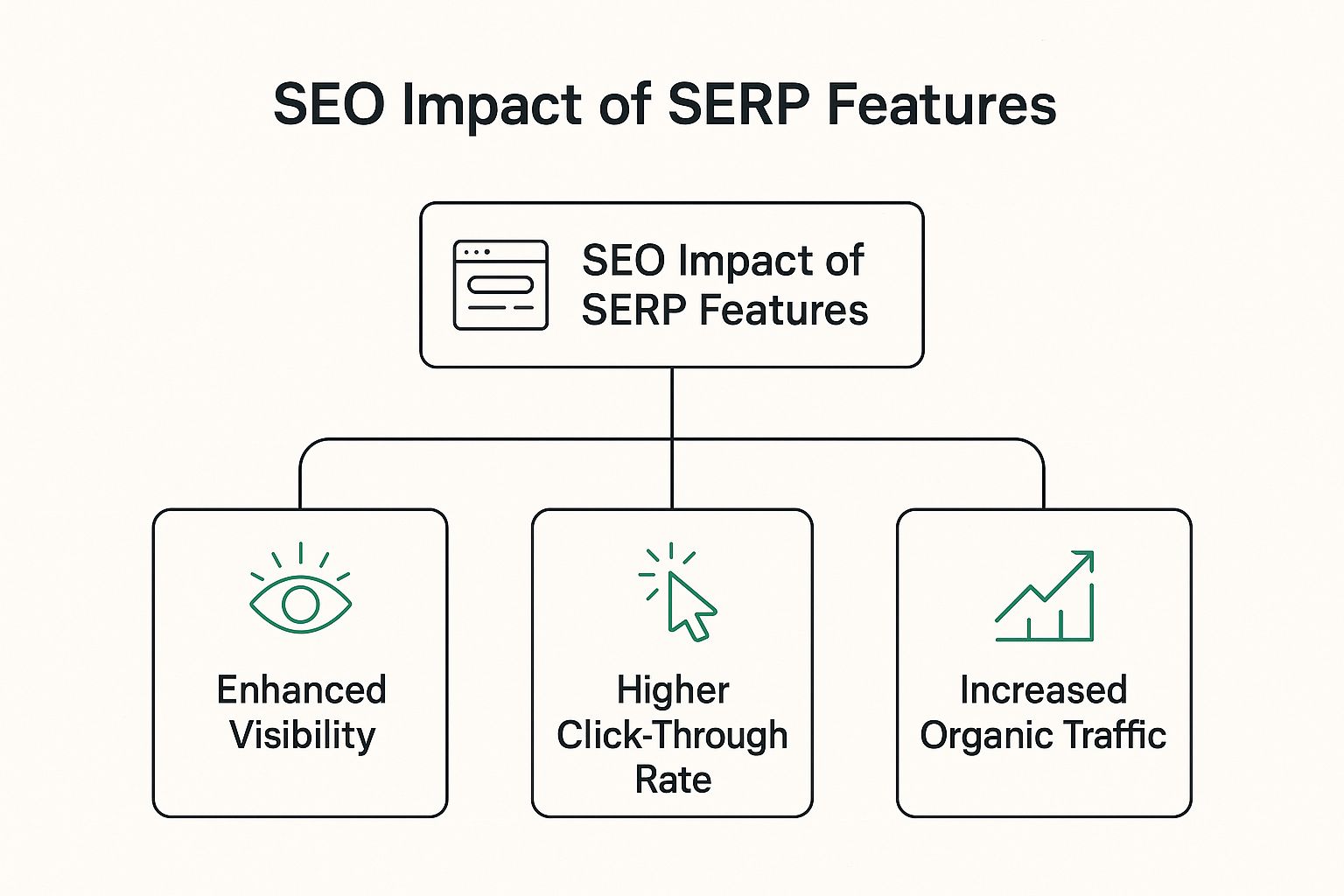
- They're impossible to miss. SERP features dominate the top of the page, grabbing a user's attention before they ever scroll down to the regular results.
- They build instant trust. When Google features your content as the answer, it gives your brand a huge credibility boost.
- They get more clicks. Let's be honest, a rich result with a picture, stars, or a bolded answer is just more appealing than a plain blue link.
Here's a mind-blowing stat: Over 97% of all Google searches now trigger at least one SERP feature. If you’re not aiming for them, you're essentially invisible to the vast majority of your potential audience.
A Quick Look at Common SERP Features
Here’s a simple breakdown of the most frequent SERP features you'll encounter and what they're designed to do.
| SERP Feature | Its Main Job | Best for Answering |
|---|---|---|
| Featured Snippets | Provides a direct, concise answer at the top of the page. | "How to," "what is," and definition-based questions. |
| Knowledge Panels | Offers a snapshot of info about a person, place, or thing. | Fact-based queries about specific entities. |
| Local Pack | Shows a map with 3-4 local business listings. | "Near me" or location-specific searches (e.g., "pizza boston"). |
| Image Packs | Displays a horizontal row or block of related images. | Searches where visuals are key (e.g., "modern kitchen ideas"). |
| People Also Ask | A dropdown of related questions and their answers. | Broader topics that spark follow-up questions. |
| Top Stories | Features recent news articles from reputable sources. | Searches for trending topics or breaking news. |
Mastering these features is what separates good SEO from great SEO today.
How We Moved Beyond Ten Blue Links
Remember when a Google search spit out a clean, simple list of ten blue links? Feels like a lifetime ago, doesn't it? The search results page has morphed from a basic digital phone book into a full-blown answer engine. This whole revolution happened because of one simple human trait: our need for instant gratification.
We got tired of clicking through links to find what we were looking for. We just wanted the answer, and we wanted it now. That pressure for speed and convenience is what pushed Google to change its entire game. Instead of just showing you a map to the information, Google started pulling the best bits of information directly onto the results page.
And just like that, the first SERP features were born.
The Rise of the Answer Engine
The real turning point came in 2012 with the launch of the Knowledge Graph. Think of it as Google's giant digital brain—a massive database connecting people, places, things, and ideas. This was the tech that allowed Google to understand the context behind our searches, paving the way for the feature-packed results we now see every day.
This evolution is exactly why just ranking #1 isn't the be-all and end-all anymore. As the SERPs got more crowded, paid ads also carved out prime real estate, making it crucial to understand how to optimize Google Ads for a truly complete search strategy.
Today, SERP features show up in a staggering 97% of all Google search queries. Just the "People Also Ask" boxes appear in about 75% of searches. The classic "ten blue links" is officially the exception, not the rule.
Knowing this backstory is key. It's not just trivia; it explains why these features exist and why they’re now the absolute core of modern SEO. They aren't just fancy add-ons—they are the search experience.
Your Field Guide to the Most Common SERP Features
Alright, let's get our hands dirty and look at the SERP features you’ll actually run into out in the wild. Think of this as your spotter's guide for identifying the biggest opportunities right on Google’s results page.
Each one of these features is Google's attempt to answer a searcher's question as fast as possible. They’re basically shortcuts, and if you know how they work, you can get your content in front of a lot more people.
The Most Coveted Spot: Featured Snippets
Ever heard of "Position Zero"? That's the Featured Snippet. It’s that prized box sitting right at the top of the search results, giving a quick, direct answer to a question. It's the holy grail for SEOs and content folks.
This screenshot gives you a perfect real-world look at how SERP features dominate the page.
See how the traditional blue links are pushed down? That's the power of these features in action.
Google snags this info from a webpage it trusts most for that specific query. The amazing part is, you don't even need to be the #1 organic result to win it. If you want to learn the tricks to grabbing this spot for yourself, check out our guide on how to optimize for featured snippets.
The Visual Powerhouses: Image and Video Packs
Some searches just scream for visuals. Think about queries like "small bathroom remodel ideas" or "how to change a tire." This is where Google brings out the big guns:
- Image Packs: You'll see these as a horizontal row of pictures, usually right near the top of the page. They're impossible to miss.
- Video Carousels: A scrollable list of video thumbnails, almost always pulled from YouTube, that directly relate to the search.
These visual features are absolute attention magnets. If your content is visually rich, optimizing your images with good alt text and your videos with clear titles can land you a spot and drive a ton of traffic.
Local and Knowledge-Based Features
Not every search is a broad question. A huge chunk of searches are for specific people, places, or things. That's where these next two features come into play.
Knowledge Panels: These are the info boxes that show up on the right-hand side of the results page. They're like a digital baseball card, giving you a quick summary of a person, place, or company by pulling info from sources like Wikipedia and official websites.
And for any business with a physical address, the Local Pack is everything. Search for "coffee shops near me," and that map you see with three businesses listed below it? That's the Local Pack. It gives people everything they need—address, phone number, hours, and reviews—to walk right through your door.
Understanding the Impact of AI Overviews

The newest kid on the block is also the one shaking things up the most: the AI Overview. This feature is single-handedly rewriting the rules for how people find information and how our websites get traffic.
Think of it this way: if traditional SERP features are like helpful road signs pointing you to different destinations, an AI Overview is like a personal guide who’s already visited all those places for you and just gives you a summary of the best route. It pulls from multiple sources and spits out a custom answer right at the top, often meaning users don't have to click a single link to get what they need.
And this isn't some far-off change; it's happening right now. AI Overviews already show up in 13.14% of Google searches, which is a massive leap from just 6.49% two months ago. These summaries typically pull from about five different sources, and more than half of them are already ranking in the top 10.
How Do AI Overviews Work?
So, what's the secret sauce here? Under the hood, these overviews are run by some seriously complex artificial intelligence that can read, understand, and piece together human language from all over the web.
The core technology is a field known as Natural Language Processing (NLP). This is what lets Google sift through countless articles, blog posts, and forums to generate a single, coherent summary that directly answers a searcher's question.
Being cited in an AI Overview is the new "Position Zero." It positions your content as a foundational source of truth on a topic, which is a powerful signal of authority.
For those of us in SEO, this changes everything. The goal isn't just to rank #1 anymore. The real prize is creating content so clear, trustworthy, and well-organized that Google’s AI hand-picks it to build its own answers.
How SERP Features Change Your SEO Strategy
Alright, so knowing what SERP features are is one thing. But figuring out how they plug into your actual, day-to-day SEO work? That's where the real magic happens.
These features completely change the game. The goal isn't just to snag that #1 blue link anymore; it's about earning the most visible and valuable real estate on the page. Think of it this way: the modern search results page isn't a simple list—it's a dynamic, visual dashboard, and you want to own the biggest billboard on it.
This new reality brings up something called zero-click searches. This is when someone finds their answer right there in a Featured Snippet or Knowledge Panel and never actually clicks through to a website. At first, that sounds like a total loss, right? But it's also a massive branding opportunity. Even without that click, your brand is the one providing the authoritative answer, which builds trust and gets your name in front of people.
Moving From Ranking to Owning
Instead of just gunning for the top spot, the new goal is to own the most valuable SERP real estate for your target keywords. This means you need to start creating content that's specifically designed to win these features.
For example, a super-organized listicle isn't just a blog post; it's a potential Featured Snippet. A deep-dive Q&A page could get you featured all over the "People Also Ask" boxes.
This shift in strategy can have a direct impact on your bottom line. Earning a spot in the Local Pack can drive real foot traffic to your door, while getting into a video carousel can send views on your YouTube channel through the roof. You have to stop seeing these features as obstacles and start seeing them as powerful new ways to grab highly qualified traffic.
To really nail this, you need a clear picture of where you stand right now. Running regular site audits is crucial. Using something like a complete WordPress website audit checklist can help you spot all the little technical and content-based opportunities to better target these rich results.
The most successful SEO strategies today aren't about ranking higher, but about appearing better. A position in a SERP feature is often more visible and trusted than a traditional #1 link.
At the end of the day, this all comes down to being more thoughtful about how you create content. You have to get inside the user's head, anticipate their exact question, and then serve up the answer in the clearest, most direct format you can. When you do that, you're not just helping the user—you're making it incredibly easy for Google to pick up your content and feature it.
Of course, tracking whether all this hard work is paying off is essential. You can dig deeper into that by learning how to measure SEO ROI the right way.
Got Questions About SERP Features? Let's Clear Things Up.
Even after you get the hang of SERP features, a few questions always seem to pop up. That's totally normal. Let's walk through some of the most common ones I hear so you can feel more confident about your SEO plan.
The big one is always: Can I choose which SERP feature my content shows up in?
Sorry, but the short answer is no. You can’t just tell Google, "Hey, put me in that Featured Snippet!" and you definitely can't pay for a spot in an organic feature.
Getting your content into a SERP feature is all on Google's algorithms. They're built to find the single best answer for whatever someone is searching for. Your job is to create content that’s so helpful and clear that Google has no choice but to see it as the top dog.
So, Are SERP Features Good or Bad for SEO?
This is a classic "it depends" situation, and I know how frustrating that answer can be. On one hand, features that spit out an immediate answer can create "zero-click searches." This is when a user gets what they need right on the results page and never clicks through to your site, which can feel like you're losing out on traffic.
But there’s a huge upside. Snagging a prime spot like a Featured Snippet or showing up in a Local Pack can do wonders for your visibility. It puts your brand front and center, building authority and often boosting your click-through rate from people who want to dig deeper.
The traffic you do get from a SERP feature is often more qualified and ready to engage than from a standard organic link. The key is to see them not as traffic thieves, but as powerful tools for brand exposure.
How Do AI Overviews Change the Game?
With AI Overviews becoming more common, the need for truly deep, well-researched, and super-organized content is more critical than ever. Since these AI-powered summaries pull info from multiple places, your goal is to be one of those go-to sources.
So, how do you do that? Focus on these things:
- Answer questions completely: Don’t just give a surface-level response. Go deep with detailed explanations, real data, and your own unique take on the topic.
- Structure your content clearly: Use logical headings (H2s, H3s), bullet points, and short, punchy paragraphs. This makes it way easier for AI to understand and reference your information.
- Show you know your stuff: Back up what you're saying and prove you're an expert.
At the end of the day, the best approach is to write content that's genuinely helpful for a real person. If you do that, the AI will almost always catch on.
SERP Features vs. Rich Snippets: What's the Difference?
Okay, let's clear up one last bit of common confusion. People often mix up SERP features and rich snippets, but they're two different things.
Think of it this way:
A SERP feature is any result on the page that isn't one of the standard blue links. Things like Image Packs, Knowledge Panels, or a People Also Ask box fall into this category.
A rich snippet, on the other hand, is an upgrade to a standard blue link. It adds extra visual info, like star ratings for a recipe, the price of a product, or the number of reviews.
So, rich snippets make the normal results look fancier, while SERP features are entirely different types of results altogether.
Ready to stop guessing and start targeting the right keywords for SERP features? RankHub analyzes your entire website in under a minute to uncover high-value opportunities you're missing. Give RankHub a try.
More from Our Blog
40 Sweet S Names That Stand Out for Your Baby
Discover 11 adorable S names for babies, from classic Sophia to unique Stellan. Compare styles, meanings, and popularity with data-backed recommendations.
Read more →
7 Content Writing Tools That Boost Your SEO Rankings
Discover the top 9 SEO content writing tools to automate drafting, optimization, and publishing. Boost rankings with AI-assisted workflows.
Read more →
5 Pro Tips for Creating Outstanding Audiobooks with ElevenLabs
Master ElevenLabs audiobooks with expert tips on production, distribution, quality control, and monetization. Learn from industry professionals.
Read more →