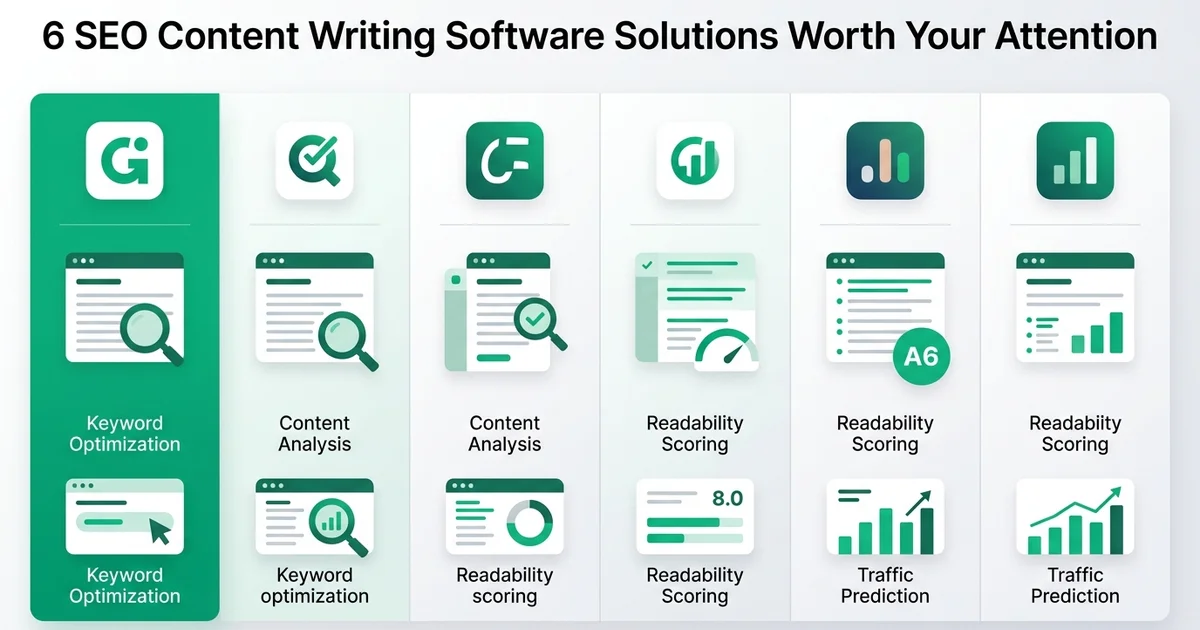
6 SEO Content Writing Software Solutions Worth Your Attention
Introduction: why marketers are seeking SEO content writing software alternatives
The market for SEO content writing software has shifted dramatically. At RankHub, our analysis shows that teams evaluating these tools are no longer asking whether to use AI for content creation. They are asking which platform fits their workflow, budget, and growth goals.
A market growing faster than most teams can track
According to Latest Trends in AI Content Creation (2026), the global AI writing tools market is reaching $8.4 billion in 2026, with AI SEO writing tools representing the fastest-growing segment at +67% year over year. That pace means new options appear constantly, making evaluation both urgent and genuinely difficult.
Why tool selection now matters more than ever
According to The Future of SEO Content in 2026 (2026), 97% of content marketers plan to use AI for content creation. With adoption this widespread, the competitive advantage no longer comes from using AI at all. It comes from choosing the right platform.
The decision ultimately balances three factors: the level of automation a team needs, the cost relative to hiring agencies or freelancers, and the consistency of content quality at scale. Solo founders, SMBs, and enterprise marketing teams each weigh these factors differently, which is exactly why this comparison exists.
RankHub: automated SEO content creation and publishing
For solo founders and SMBs without a dedicated marketing team, RankHub's SEO Autopilot addresses the most painful part of content marketing: doing everything consistently, month after month, without burning hours on research, writing, and publishing. The platform handles the entire workflow from start to finish, making it the strongest end-to-end option in this comparison.
- Pros
- Fully automated workflow from keyword research to publishing eliminates manual bottlenecks
- Consistent monthly content production without team effort or oversight
- Integrated SEO optimization built into every generated article
- Ideal for solo founders and small teams without dedicated marketing staff
- Removes the need to manage multiple tools across the content pipeline
- Cons
- Less control over individual article direction and tone compared to manual writing
- May require initial setup and keyword strategy definition
- Best suited for evergreen content; less flexible for trending topics or breaking news
How the workflow operates
RankHub moves through the full content production cycle automatically. Once connected to your website via sitemap discovery, it identifies keyword opportunities, generates SEO-optimized articles complete with featured images, and publishes them through webhook integration, all without requiring manual input at each stage. The platform runs 15 automated steps per month and includes built-in keyword cannibalization avoidance, which prevents the common problem of multiple pages competing against each other in search results.
For teams without a content strategist or SEO specialist on staff, this matters considerably. According to Blogging Wizard (2026), AI-assisted blog writing tools can increase organic traffic by 120% within six months, a result that typically requires consistent publishing volume, precisely what manual workflows struggle to sustain.
Who benefits most
RankHub is best suited for:
- Solo founders who need organic growth without hiring an agency
- SMBs looking to replace expensive freelancer or content agency costs
- Marketing teams that want a predictable, automated content calendar with minimal oversight
If you are evaluating the best seo automation tools for a lean operation, RankHub's pricing makes it significantly more accessible than agency retainers, while delivering comparable output volume.
Best for: Solo founders and SMBs wanting complete SEO automation with minimal human intervention. Website: rankhub.ai
Surfer SEO: content optimization and competitive analysis
Surfer SEO is built around one core idea: use real-time SERP data to tell writers exactly what a page needs to rank. Rather than automating the writing process, it gives you a detailed blueprint based on what is already working in the top search results for your target keyword.
- Pros
- Real-time SERP data provides exact ranking requirements for target keywords
- Detailed content blueprints give writers clear direction without removing creative control
- Competitive analysis shows exactly what top-ranking pages contain
- Excellent for teams that want data-driven optimization without full automation
- Helps writers understand search intent at a granular level
- Cons
- Requires manual writing; does not automate content creation
- Adds workflow steps rather than reducing them
- Best for teams with writing capacity; not ideal for solo founders
- Pricing increases with higher usage tiers
Real-time content scoring with the Content Editor
Surfer's Content Editor is its standout feature. As you write, it scores your content against competing pages, flagging keyword usage, heading structure, word count, and content density. According to Blogging Wizard (2026), Surfer SEO is one of the strongest options available for on-page optimization guidance, particularly for teams that want data-backed direction during the drafting process.
Competitive intelligence and content gap analysis
Beyond the editor, Surfer provides SERP analysis that surfaces content gaps between your pages and top-ranking competitors. This is useful for identifying topics you have missed and for prioritizing which existing pages to update.
Limitations and pricing
The key trade-off is that Surfer does not write content for you. It requires either a human writer or integration with a separate AI writing tool, which adds friction and cost. Plans start at around $89 per month, positioning it firmly in the mid-market range.
Best for: Marketing teams and content strategists who want rigorous on-page optimization guidance and are comfortable managing the writing process separately.
Semrush: all-in-one SEO platform with content tools
Semrush is the enterprise-grade choice for teams that need a single platform covering keyword research, backlink analysis, technical audits, and content optimization. Rather than excelling at one discipline, it brings a broad toolkit under one roof, making it a serious contender for marketing teams with complex, multi-channel SEO needs.
- Pros
- Comprehensive platform covers keyword research, backlink analysis, technical audits, and content optimization
- Enterprise-grade collaboration features for large teams
- Extensive training resources and community support
- Integrates with multiple third-party tools
- Trusted by enterprise organizations globally
- Cons
- Steep learning curve due to feature breadth
- High pricing makes it cost-prohibitive for small teams
- Content writing features are less specialized than dedicated AI writing tools
- Overkill for teams focused solely on content creation
SEO content template and keyword research
Semrush's SEO Content Template generates briefs based on top-ranking competitors for any target keyword. It pulls in recommended semantically related terms, suggested readability scores, and backlink targets, giving writers a structured starting point. Combined with its deep keyword research database, teams can map out content strategies with real competitive context rather than guesswork.
Competitor tracking and backlink intelligence
Where Semrush genuinely separates itself from pure content tools is in its backlink and competitor tracking capabilities. Teams can monitor competitor domain authority shifts, identify link-building opportunities, and connect those insights directly to their content planning. For businesses treating SEO as a long-term growth channel rather than a one-off project, this integrated view is genuinely valuable.
Limitations and pricing
The honest trade-off is complexity. Semrush carries a steep learning curve, and its pricing starts at around $139 per month, which is a significant commitment for solo founders or small teams. If you need a leaner, more automated approach, a dedicated seo agency alternative like RankHub SEO Autopilot handles keyword research and content publishing automatically at a fraction of the cost.
Best for: Mid-size to enterprise marketing teams that need integrated backlink data, technical SEO audits, and content tools within a single platform.
Jasper: AI writing with SEO optimization templates
Jasper is a dedicated AI writing platform built around long-form content generation, offering a library of SEO-specific templates that help marketing teams produce structured articles, product descriptions, and landing pages at scale. It is particularly strong for teams that already have a defined content strategy and need to produce volume quickly.
- Pros
- Specialized AI writing engine produces high-quality long-form content
- SEO-specific templates streamline article structure
- Fast content generation reduces time-to-publish
- Flexible for various content types (blog posts, product descriptions, emails)
- Reasonable pricing for AI writing capabilities
- Cons
- No keyword research or publishing automation
- Requires manual SEO optimization and fact-checking
- Lacks competitive analysis features
- Still requires significant human oversight and editing
Long-form content and brand voice
Jasper's core strength is generating lengthy, coherent drafts that maintain a consistent tone across your entire content library. Its brand voice feature lets you train the platform on your existing content, so output feels on-brand rather than generic. For SMBs managing multiple content streams, this consistency is genuinely valuable.
SEO templates and their limits
Jasper includes SEO-focused templates for blog posts, outlines, and meta descriptions. However, it does not include native keyword research. You will need to pair it with a separate tool like Ahrefs or Google Search Console to identify target terms before writing, which adds friction to the workflow.
Learning curve and pricing
Getting the most from Jasper requires meaningful investment in prompt engineering and workflow setup. Teams new to AI writing tools often underestimate this ramp-up time. Pricing starts at approximately $49 per month for the Creator plan, scaling upward for team access.
Best for: Content teams with an established SEO strategy who need high-volume, brand-consistent long-form writing and are comfortable managing keyword research separately.
Copy.ai: affordable AI writing for content teams
Copy.ai positions itself as a budget-friendly entry point into AI-assisted content creation, making it a popular choice for small teams and solo founders who need to produce content quickly without a steep learning curve. The platform prioritises speed and simplicity over deep SEO functionality.
- Pros
- Most affordable entry point into AI-assisted content creation
- Simple, intuitive interface with minimal learning curve
- Fast content generation for quick turnaround projects
- Good for teams experimenting with AI writing
- Flexible pricing for small budgets
- Cons
- No SEO-specific features or keyword research
- Content quality less specialized than dedicated SEO writing tools
- Minimal customization options
- Requires extensive manual editing and optimization
- Not suitable for teams prioritizing SEO performance

Ease of use and quick content generation
Copy.ai's primary strength is its accessibility. The interface is clean and intuitive, allowing users to generate blog posts, social copy, and marketing content within minutes of signing up. There is virtually no onboarding friction, which suits entrepreneurs and lean marketing teams who need output fast rather than a sophisticated editorial workflow.
SEO limitations worth noting
Where Copy.ai falls short is in specialised SEO functionality. Keyword integration, content briefs, and on-page optimisation guidance are minimal compared to dedicated SEO content tools. Teams serious about organic growth often find themselves supplementing Copy.ai with separate keyword research tools, which adds both cost and complexity. As according to research, 97% of content marketers plan to adopt AI in 2026, but the tools they choose will determine whether that investment translates into rankings or simply more content. If DIY SEO content creation is already proving difficult to scale, a general-purpose writing tool rarely solves the underlying problem.
Pricing and best-fit use case
Copy.ai offers a free tier with limited outputs, with paid plans starting at around $49 per month. This affordability makes it attractive, but the trade-off is clear: you gain a capable writing assistant and lose an integrated SEO engine.
Best for: Solopreneurs and small teams who need fast, affordable copy generation for social media, email, and light blog content, and who manage SEO strategy through separate tools.
Feature comparison matrix: SEO content writing software side-by-side
Choosing between platforms is far easier when you can see every key dimension in one place. The table below covers the five tools reviewed in this article across seven criteria that matter most to founders, marketers, and SMBs trying to grow organic traffic without burning through budget or time.
| Platform | Automation Level | Keyword Research | Content Writing | Publishing | Pricing Model | Best For | Learning Curve |
|---|---|---|---|---|---|---|---|
| RankHub | Full (keyword to publish) | Integrated | AI-generated | Automatic monthly | Subscription ($) | SMBs & solopreneurs | Low |
| Surfer SEO | Partial (optimization only) | Real-time SERP data | Manual + guidance | Manual | Subscription ($$) | Content teams wanting control | Medium |
| Semrush | Partial (research & optimization) | Comprehensive | Manual + templates | Manual | Subscription ($$$) | Enterprise teams | High |
| Jasper | Partial (writing only) | Limited | AI-generated | Manual | Subscription ($$) | Long-form content creators | Low-Medium |
| Copy.ai | Partial (writing only) | None | AI-generated | Manual | Subscription ($) | Budget-conscious teams | Very Low |
How to read this table
- ✓ = fully supported natively
- ◑ = partial or limited support
- ✗ = not included
| Feature | RankHub | Surfer SEO | Semrush | Jasper | Copy.ai |
|---|---|---|---|---|---|
| Automation level | End-to-end ✓ | Manual ◑ | Manual ◑ | Manual ◑ | Manual ◑ |
| Keyword research | AI-driven ✓ | ◑ | ✓ | ✗ | ✗ |
| AI writing quality | ✓ | ◑ | ◑ | ✓ | ✓ |
| Optimization scoring | ✓ | ✓ | ✓ | ◑ | ✗ |
| Publishing integration | Webhook ✓ | ✗ | ✗ | ✗ | ✗ |
| Cannibalization avoidance | ✓ | ✗ | ◑ | ✗ | ✗ |
| Starting price | Competitive | ~$89/mo | ~$139/mo | ~$49/mo | ~$49/mo |
| Best for | Full SEO autopilot | Content grading | Enterprise research | Long-form drafts | Fast copy output |
RankHub's end-to-end advantage
The single column that separates RankHub from every other tool in this list is automation level. While Surfer, Semrush, Jasper, and Copy.ai each excel in one or two dimensions, none of them connect keyword research, writing, optimization, and publishing into a single automated workflow. RankHub's 15 automated steps per month handle that entire pipeline, which is precisely why it suits founders and small teams who cannot afford to stitch four separate tools together.
According to Blogging Wizard (2026), the most effective content workflows combine research, writing, and optimization in a unified process rather than jumping between disconnected platforms. RankHub is the only option here built around that principle from the ground up.
For a deeper look at how cost stacks up across these categories, see how affordable SEO content services compare before making a final decision.
How to choose the right SEO content writing software for your needs
The right tool depends on four variables: your team size, available budget, how much automation you actually need, and the tools you already use. Getting this wrong means paying for features you will never touch, or buying something that creates more manual work than it saves.
Discover how RankHub SEO Autopilot approaches seo content writing software RankHub SEO Autopilot.
Build your decision framework first
Before comparing pricing pages, answer these questions honestly:
- How many pieces of content do you publish per month? Low-volume teams rarely justify enterprise pricing.
- Who owns the writing process? A solo founder needs automation. A content team needs collaboration features.
- What does your current stack look like? Adding a tool that duplicates Semrush or Ahrefs functionality you already pay for is wasteful.
- How much editing time can you realistically commit? Some platforms produce near-publish-ready drafts; others require heavy human revision.
Match the tool to the use case
Different audiences have genuinely different needs:
- Solo founders and bootstrapped startups: RankHub SEO Autopilot handles keyword research, writing, and publishing automatically, making it the strongest fit when time is the scarcest resource. In our experience at RankHub, users consistently cite the elimination of manual keyword planning as the single biggest time saving.
- SMB marketing teams: Platforms like Surfer combined with a dedicated AI writer suit teams that want editorial control alongside optimization guidance.
- Enterprises: Semrush remains the default for organizations that need deep competitive intelligence at scale. According to SEO Bot Software (2026), 78% of enterprise SEO teams already use AI for keyword research, so integration with existing workflows matters more than automation depth.
Account for total cost of ownership
Subscription price is only part of the equation. Factor in:
- Human editing time per published article
- Tool overlap with existing subscriptions
- Onboarding and learning curve costs
A cheaper tool that demands three hours of editing per article can easily cost more than a premium automated solution. If you are building a content strategy from scratch, starting with a unified platform avoids the compounding cost of stitching disconnected tools together later.
Switching guide: how to migrate from your current SEO content tool
Migrating to a new SEO content platform does not have to mean losing rankings or starting from scratch. With a structured approach, you can preserve your existing SEO value, transfer your keyword strategy, and be publishing confidently within two to four weeks.
Step-by-step migration checklist
Work through these steps before you decommission your current tool:
- Audit your existing content. Document every published URL, its target keyword, and its current ranking position.
- Export keyword lists and topic clusters. Save these as CSV files so they are portable to any new platform.
- Map your publishing workflow. Note every manual step, from brief creation to scheduling, so you can identify what the new tool should automate. If you are moving to RankHub SEO Autopilot, its webhook publishing integration can replace several of those manual steps immediately.
- Set up integrations before going live. Connect your CMS, analytics, and any third-party tools during a parallel-run period.
- Test with a small content batch. Publish three to five articles through the new system and verify formatting, metadata, and indexing before full rollout.
Preserving SEO value during the switch
If you are changing platforms that affect URL structures or content templates, protect your rankings by:
- Implementing 301 redirects for any URLs that change
- Auditing internal links to update references to moved pages, which is especially important if you are working to analyze keyword competition like a pro
- Keeping canonical tags consistent to avoid duplicate content signals during any transition period
Timeline and resource expectations
For most small teams, a realistic migration timeline looks like this:
- Week 1: Audit, export, and data backup
- Week 2: New tool setup, integration configuration, and team training
- Weeks 3 to 4: Parallel publishing and performance monitoring
Budget at least four to six hours of internal time for setup, plus additional hours if your new platform requires custom webhook configuration. Tools like RankHub, which handle research through to publishing in a unified workflow, tend to reduce this overhead significantly compared to stitching together separate tools for each stage.
Free and open-source SEO content writing alternatives
Free SEO tools are a practical starting point for solo founders and early-stage businesses watching their budgets closely. Options like Yoast SEO, Rank Math, and the free tier of Moz Keyword Explorer cover the basics of on-page optimization without any upfront cost.

What free tools actually offer
These platforms handle foundational tasks reasonably well:
- Yoast SEO and Rank Math provide readability scoring, meta tag editing, and basic keyword placement guidance directly inside WordPress
- Moz Keyword Explorer (free tier) offers limited monthly keyword queries for basic research
Where free tools fall short
The trade-offs become clear quickly. Free options carry no AI writing assistance, no automated publishing, and no cannibalization detection. Most importantly, they require combining three or four separate platforms to approximate a complete workflow, which adds hours of manual coordination each month.
For SMBs weighing total cost of ownership, that hidden time cost matters. A content strategy for ecommerce built on free tools alone often stalls when content volume needs to scale. At that point, a unified platform like RankHub, which automates the full pipeline from keyword research to publishing, typically delivers better value than managing multiple free tools simultaneously.
Enterprise-grade SEO content writing software for large teams
Large organizations managing multiple content streams across departments need more than a single writing tool. Enterprise SEO platforms earn their price tag through team collaboration features, custom approval workflows, API access, and dedicated account support that smaller tools simply cannot match.
Platforms built for scale
Semrush, HubSpot, and Marketo are the most recognized names in enterprise SEO content management. Each offers deep integrations across marketing stacks, role-based access controls, and reporting dashboards that serve cross-functional teams. Research suggests that 78% of enterprise SEO teams now use AI for keyword research, reflecting how central automation has become at this level.
The cost and ROI question
Enterprise pricing typically runs into thousands of dollars monthly. For large organizations publishing hundreds of pieces across multiple brands, that investment is justifiable. For smaller teams, however, the overhead is significant.
A leaner alternative worth considering
For growing businesses that want enterprise-style automation without enterprise pricing, RankHub SEO Autopilot covers the full pipeline: keyword research, article generation, cannibalization avoidance, and automated publishing via webhook. It delivers structured, repeatable output that scales without requiring a dedicated content operations team.
What we don't recommend: common pitfalls when choosing SEO content software
Choosing the wrong tool is often less about picking a bad product and more about making avoidable mistakes during evaluation. These pitfalls consistently derail SEO content programs before they gain traction.
Choosing on price alone
A lower monthly fee means nothing if the tool produces thin content that requires heavy editing before publication. Evaluate automation depth and output quality first. Price is a tiebreaker, not a starting point.
Over-relying on AI without human review
According to Blogging Wizard (2026), human oversight remains essential even with advanced AI tools. Google's E-E-A-T guidelines reward demonstrable expertise and first-hand experience, neither of which AI generates independently. Build a review step into every workflow.
Expecting one tool to do everything
No single platform handles keyword research, content creation, technical SEO, and link building equally well. Understand each tool's core strength before committing.
Switching tools too quickly
Most tools need at least 60 to 90 days to show measurable ranking movement. Abandoning a platform prematurely denies it the time needed to prove ROI.
Ignoring integration compatibility
A powerful tool that does not connect with your CMS, analytics platform, or publishing workflow creates friction that compounds over time. Confirm webhook support and native integrations before signing up.
Conclusion: finding your ideal SEO content writing software match
Choosing the right SEO content writing software comes down to four factors: how much automation you need, what you can realistically budget, the size of your team, and how well a tool fits your existing workflow. According to Latest Trends in AI Content Creation (2026), 97% of content marketers are now using AI in some capacity, which means the question is no longer whether to adopt these tools but which combination serves you best.
Matching tools to your profile
Use this framework to guide your final decision:
- Solo founders and SMBs prioritizing growth with minimal overhead: RankHub SEO Autopilot delivers the most complete automation available, handling keyword research, writing, and publishing in a single pipeline that saves 40+ hours monthly.
- Content teams needing deep optimization guidance: Surfer SEO and Semrush offer granular control and robust analytics that suit collaborative workflows.
- Teams scaling content volume with brand voice consistency: Jasper remains a strong choice for high-output creative needs.
One final piece of advice
Every tool on this list offers a free trial or entry-level tier. Test at least two options against a real brief before committing, and give each a minimum of 60 days to demonstrate measurable results.
Frequently asked questions
What is the best SEO content writing software for small businesses?
RankHub SEO Autopilot suits small businesses well because it automates the entire workflow from keyword research to publishing, removing the need for a dedicated SEO team. Tools like Surfer SEO and Semrush are strong alternatives if you prefer hands-on optimization control.
How does AI SEO content writing software improve search rankings?
AI tools analyze top-ranking pages, identify content gaps, and structure articles around proven ranking signals. According to Misar.Blog (2026), AI SEO writing tools are the fastest-growing segment of AI writing, with 67% year-over-year growth, reflecting their measurable impact on organic performance.
Which free SEO content writing tools are worth using in 2026?
Semrush and Surfer SEO both offer limited free tiers suitable for occasional use. For consistent output, paid plans deliver significantly more value.
What features should I look for in SEO content writing software?
Prioritize keyword research automation, content scoring, cannibalization avoidance, and direct publishing integration. The best SEO content writing software combines all these into a single workflow rather than requiring multiple disconnected tools.
Is AI content writing good for SEO or can it hurt rankings?
AI content performs well when it is accurate, original, and edited for authenticity. Problems arise with generic, unreviewed output, so human oversight remains important.
How does Surfer compare to Semrush for SEO content writing?
Surfer focuses specifically on real-time content optimization and scoring, while Semrush offers broader SEO capabilities including backlink analysis and competitive research. Your choice depends on whether content creation or overall SEO strategy is your primary need.
Can SEO content writing software automate publishing to my website?
RankHub does this natively via webhook integration, pushing finished articles directly to your site each month. Most other tools in this category stop at content generation and require manual publishing steps.
What are the top alternatives to Jasper and Copy.ai for SEO content writing?
[According to Siege
More from Our Blog
Beyond Traditional SEO Services: Better Alternatives for Your Budget
Compare top SEO services platforms: RankHub, Outrank, SEObot & alternatives. Find the best fit for your budget, team size & automation needs.
Read more →
10 Online Business Ideas That Work for Beginners & Entrepreneurs
Discover 9 proven online business ideas for 2025, including startup costs, revenue timelines, and step-by-step validation strategies for solo founders.
Read more →
Building an SEO Career: What You Need to Know to Succeed
Learn how to launch an SEO career with our step-by-step guide covering skills, tools, portfolio projects, and realistic salary expectations for 2025.
Read more →